- A study has documented hermit crabs trapped in bottles and containers on the Nicobar Islands.
- Smaller crabs are disproportionately impacted because bottle openings selectively trap only those crabs with shells that are small enough to fit through them.
- Researchers suggest bottle redesigns that enable crabs to exit them and also recommend implementing broader policies that hold manufacturers accountable for plastic waste.
If you stand on the soft silver sand on the aquamarine beaches of the Andaman and Nicobar Islands, you can often see plastic waste washed ashore. When you bend down and look closely, you might find a tiny crab trapped inside a bottle. You might try to rescue the crab by shaking it loose, but chances are that it has already died. This is not an isolated incident.
Researchers recorded 4,783 instances from January to July 2024 where hermit crabs were entrapped in marine litter across 28 beaches in the Nicobar Islands, according to a new study published in January 2026. The study was conducted by Mayur Fulmali and Nehru Prabakaran from the Wildlife Institute of India. The researchers surveyed beaches across two island subgroups – Nancowry and Great Nicobar.
“These small crabs are very important for the coastal ecosystem and in most marine litter studies, they are neglected,” said Fulmali.
Approximately 4-12 million metric tonnes of plastic waste enters oceans annually, causing widespread harm. The study notes that Nicobar Islands are particularly vulnerable to marine debris because they are located near the Malacca Strait, one of the world’s busiest shipping routes. Various ocean currents transport enormous quantities of plastic waste from neighbouring countries and deposit it on these shores.
Hermit crabs are small, scavenger invertebrates that maintain beach health and are food for many species in water and on land. They clean the beach, cycle nutrients, and disperse seeds. Coastal communities also rely on these animals for nutrition and livelihood. They are a delicacy in some parts of Nicobar Islands and used as fishing bait, explained Prabakaran.
Investigating the litter
While working in Nicobar Islands, Fulmali noticed hermit crabs trapped in plastic bottles. “I saw a pattern that there are some crabs which are exclusively found in specific bottle sizes,” he said. He decided to investigate this through a study.
In the coming months, Fulmali conducted field work on hermit crab entrapment alongside his daily job of assessing sea turtle nesting sites. He collaborated with Prabakaran, who specialises in coastal and marine ecosystems and has been working in the Nicobar Islands since 2009. “All these beaches have an invariably heavy amount of plastic deposition. And this has little to do with India, as the majority of this plastic comes from international waters,” Prabakaran told Mongabay-India.
When the researchers looked at the data they collected from these beaches, the scale of the problem became clear. The study found that over eight out of 10 crabs were entrapped in plastic and glass bottles and the rest were trapped in other containers such as styrofoam boxes, helmets, and fishing floats. Among all the trapped animals, less than a percent were found alive, indicating a very low chance of survival.

When a bottle’s mouth becomes a deadly filter
The primary finding of the study is how the opening of the bottle acts as a size-selective filter. Hermit crabs whose shells are smaller than the opening can enter, since they travel with their shells. Crabs with larger shells are protected from getting trapped in smaller bottles. “Small-sized crabs are most vulnerable to bottles that are between one and two litres,” said Fulmali. The team found the highest number of crabs trapped in one and half, two, and five-litre bottles, a finding that surprised Fulmali, who initially expected larger bottles to be the biggest traps.
However, the vulnerability varies by species. Four hermit crab species of the genus Coenobita were found in the containers: C. perlatus, C. rugosus, C. cavipes, and C. violascens. Among these, C. rugosus was particularly abundant and more vulnerable because it resides close to beach vegetation where plastic accumulates.
The study also found that plastic bottles are not the only culprit. Different types of containers pose a threat to hermit crabs including containers modified by people for storage and fishing as well as plastic-coated paper plates which have a slippery surface that prevents escape.
More research needed on interaction between plastic and animals
During field work, every morning Fulmali and his local assistants would get up at 5 a.m., walk a couple of hours along the coast and sometimes even climb a hill to get to a beach. Upon arrival, they would set up camp and begin the work. First, they laid small rectangular plots using sticks and ropes within plants on the beach, where a high amount of marine debris get stuck, washed ashore by the waves. Next, they thoroughly searched the debris for containers. “You first look for bottles with missing caps and then take the bottle and just shake it. And if you hear some noise, look inside and you might come across some small hermit crabs,” Fulmali told Mongabay-India.
Although, the visits to the remote beaches were not easy. Fulmali collected bottles in gunny bags to measure them later at camp. There were hundreds of very small hermit crab shells inside these, making measurement and identification difficult.
During the night, sometimes other crabs scuttled into the camp, attracted to bags containing samples and attempted to drag them away. In their search for new housing, they would tear up plastic bags to find the shells stored in them.

Hermit crabs are known as scavengers for good reason – they even wiped clean the pots with stubborn food residue that were left outside the tents at night.
Once the team collected all the samples and measured the shells and bottles, they returned to the lab where they categorised the containers by volume, ranging from small to extra large. Then they analysed the data to figure out which container volume traps the most amount of crabs and investigate the link between shell size and bottle opening diameter.
Vasantkumar Rabari, a zoologist teaching at the Maharaja Sayajirao University of Baroda, who specialises in plastic pollution impacts on coastal fauna, appreciated the study’s systematic methodology. The researchers focused on bottle opening diametre but acknowledge that other factors such as material, colour, and shoulder steepness require further investigation. “This is an observation-based study. There needs to be controlled experimental research to understand whether hermit crabs actively enter different-sized bottles and why they are unable to escape”, noted Rabari.
Most research in India focuses on microplastics inside animals’ bodies and there is a lack of studies examining interactions between macro/mega plastics and animals and its ecological consequences, he explained.
The study’s findings are a cause of concern. If pollution remains unchecked, smaller hermit crabs will decline, impacting the shore ecosystem and the coastal food web.
Design solutions and policy changes
To prevent hermit crab deaths, researchers propose modifying bottle design – making the mouth bigger, changing the shoulder angle and neck to reduce steepness – to make escape easier. “If you just modify a little bit of the slope, giving more grooves for them to get some grip to climb up, then that could solve a lot of issues,” said Prabakaran. But the larger fix is preventing plastic debris from getting into the sea, he emphasised.
Beyond design solutions, the researchers propose broader policy changes: holding manufacturers accountable for plastic waste, implementing deposit-return systems, restricting single-use plastics in coastal areas, and establishing community-led waste collection points.

Keeping these small crabs safe requires more work. The team recommends future research on whether bottle shapes play a role in trapping animals, a population assessment of affected crab species, and establishing a global citizen science network to map entrapment hotspots. Rabari emphasised the need for expanding research to other coastal regions: “Studies on the interaction of macro, micro and mega plastic with fauna should be conducted throughout the coastline of India.”
This study documents the toll of plastic pollution on hermit crabs in the Nicobar islands, at a time when the National Green Tribunal has approved the ₹810 billion-Great Nicobar Island project, amid ecological concerns of large developmental projects in ecologically-sensitive islands.
Read more: India needs a marine litter policy as plastic waste chokes corals
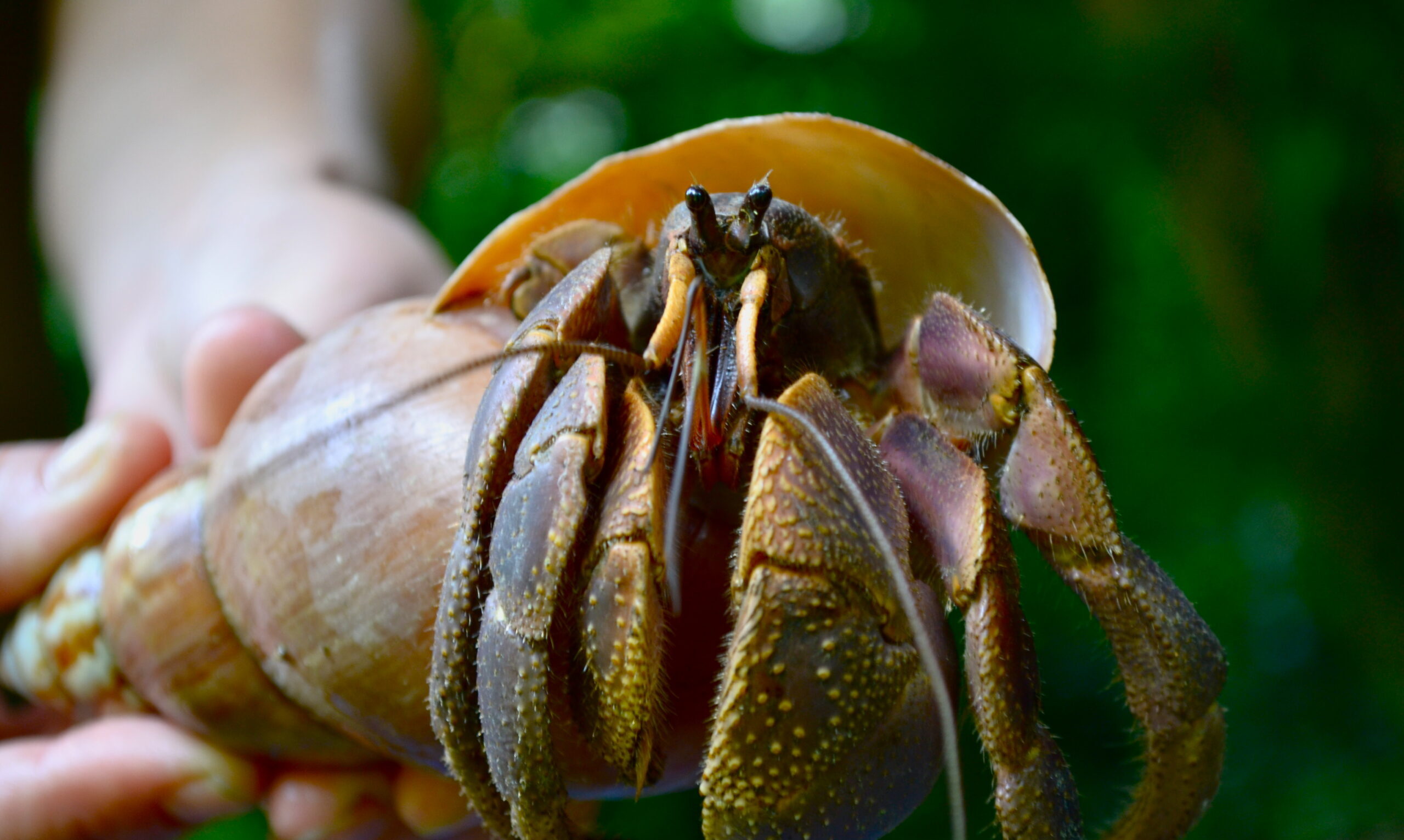
Banner image: Coenobita brevimanus or Indo hermit crab, residing in a shell of the Giant African snail at a waterfall on Little Andaman. Representative image by Vandana K.