- Poor connectivity, weak price discovery, and dependence on intermediaries undermine farm viability in the Darjeeling and Sikkim Himalayas despite demonstrating strong local production capacity and adaptability.
- While self-help groups, markets, and value-added products are emerging as solutions, limited infrastructure, training, and aggregation prevent scaling.
- Strengthening farmer producer organisations, post-harvest facilities, digital market linkages, and youth-focused agri-entrepreneurship can stabilise incomes and sustain hill agriculture.
- The views in this commentary are that of the author.
Market access plays a decisive role in shaping agrarian livelihoods in the fragile mountain economies of the Darjeeling and Sikkim Himalayas. In regions marked by difficult terrain, limited infrastructure, and climate uncertainty, the ability to reach markets often determines whether farming remains viable. Declining engagement with agriculture affects not only household incomes, but also food security, agrobiodiversity, and traditional farming knowledge across the Eastern Himalaya.
During my research on how seasonal produce, local markets, and informal trade networks influence income stability among small and marginal farmers, it became evident that market accessibility is not merely about physical proximity to mandis. Rather, it hinges on the quality, fairness, and reliability of market linkages. While local communities show remarkable adaptability through seasonal trade and informal markets, shrinking economic returns are steadily pushing many farmers away from agriculture.
Collective action and value addition
Travelling from Sikkim to North Bengal offers clear evidence of this adaptability. Across hilly landscapes, farmer communities are experimenting with collective action and value addition to strengthen livelihoods. Over the past two years of field visits focused on agricultural systems, human–wildlife conflict mitigation, government schemes, and market linkages, I observed villages producing a range of value-added goods — bamboo shoots, red cherry (Dalle khursani) chilli paste, pickles, honey, clarified butter, and locally-crafted woven products, particularly in areas such as Yuksom in West Sikkim. Some communities have developed homestays to tap into tourism, selling fresh produce directly to visitors and turning agriculture into an experiential economy. A few tech-savvy farmers have also begun using social media to market their produce.
These efforts mark a positive shift. Farmers are actively seeking better prices, diversified products, and more stable income streams. Local haats and weekly markets such as Rinchenpong and Geyzing in West Sikkim play a crucial role in this process, providing government-supported platforms where farmers can sell directly to consumers. Regular participation in these markets ensures steady movement of produce, improves local food availability, and generates small but reliable cash incomes.
In several villages, self-help groups are deepening value addition efforts. In Dzongu in North Sikkim, self-help groups (SHGs) are processing buckwheat into flour, bread, and beer, supported by better packaging. In the Sittong Valley of Darjeeling district, women’s groups are turning invasive plants into handmade soaps and bio-briquettes — compressed fuel blocks made from organic waste — demonstrating both innovation and pride in local enterprise.
Seasonal forest and farm produce such as Indian bay leaf and red cherry chilli remain central to the hill economy. During peak harvest periods, farmers and small collectors transport these products to Agricultural Produce Market Committee (APMC) mandis, gaining access to wider trading networks and better price discovery. For households with small landholdings, such seasonal sales provide essential cash income that supplements subsistence farming.
Hurdles to cross for better economy
However, these market interactions have weakened since the COVID-19 pandemic. Fewer sellers and reduced participation at haats have disrupted local trade, adversely affecting farm incomes. As returns decline, an increasing number of young people are migrating out of villages in search of alternative livelihoods.
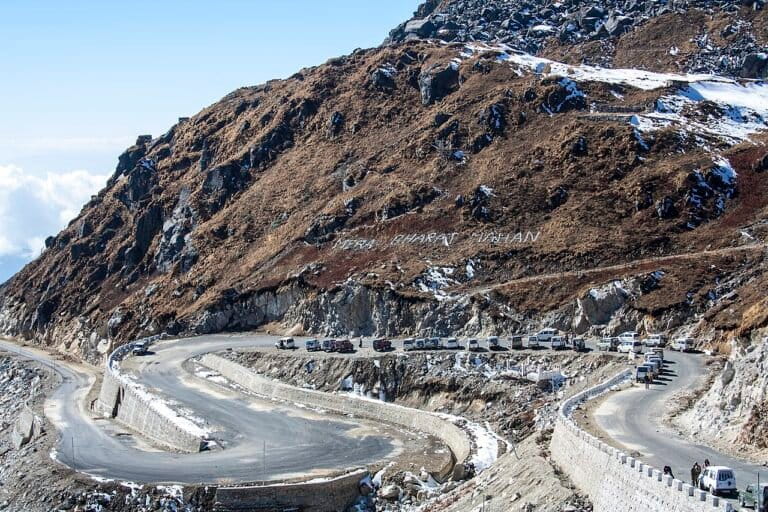
Structural barriers continue to limit agricultural growth. Poor road connectivity across locations such as Panbu and Rimbick in West Bengal and Mangan in North Sikkim drives up transportation costs. Landslides, narrow mountain roads, and long distances affect the freshness of produce and often force distress sales, eroding already thin profit margins.
Post-harvest challenges further compound these problems. Limited access to real-time market information, storage facilities, and aggregation centres leaves farmers dependent on middlemen. The absence of cooperative farming practices restrict the ability to meet bulk demand, while price volatility in crops such as ginger, turmeric, and oranges undermines income certainty and bargaining power. Many farmers remain unaware of wholesalers, online bulk platforms, and government procurement systems, confining sales to local markets and limiting income potential. Despite growing interest in value addition, the absence of sorting and grading units, cold storage, packhouses, and processing facilities leads to high spoilage, particularly of fruits, vegetables, bamboo shoots, dairy, and honey.
Opportunities for scalable market solutions
Yet, the foundation for change is strong. What farmers need now is organised support. Establishing local aggregation and collection centres — even basic facilities for sorting, weighing, and temporary storage — could reduce dependence on middlemen and improve access to larger markets. Strengthening farmer producer organisations (FPO) would enable negotiating for better prices, improve access to government schemes, and create direct links with traders, retailers, and exporters.
There is also significant scope to promote high-value, climate-resilient crops suited to the region. Organic honey, medicinal plants, spices such as ginger, turmeric, and large cardamom, red cherry chilli products, horticulture, floriculture, and handmade crafts offer scalable income opportunities when effectively linked to markets. Targeted value-addition training can help farmers develop market-ready products. Capacity-building initiatives for agri-entrepreneurs and SHGs should focus on market-oriented product development strategies, consumer-friendly packaging, shelf-life enhancement, presentation standards, and compliance with FSSAI regulations.
Yet another scalable action is developing digital market linkage platforms by creating farmer-friendly chatbots that provide weather forecasts, real-time prices, verified buyers, and transport updates, which can strengthen market linkages, especially when combined with online ordering systems. Equally important is re-engaging rural youth. Introducing entrepreneurship, digital marketing, and farm-business training in schools and colleges can help counter agricultural disengagement and create viable local livelihoods.
The study reveals a vibrant agricultural landscape constrained by solvable challenges. Low post-production value, unstable prices, and limited institutional support have fostered a perception of agriculture as economically unviable. Addressed thoughtfully, market systems can become a powerful lever — not only for income stability, but for sustaining agriculture as a dignified and resilient livelihood in the Himalayan farming belt.
The author is a research associate at ATREE. Her work explores sustainable livelihood generation opportunities in the Himalayas, with a focus on community-based initiatives, conservation-linked livelihoods, and strategies that balance ecological sustainability with local economic development.
Read more: Sunny days, zero returns, climate change leaves women farmers tired and broke
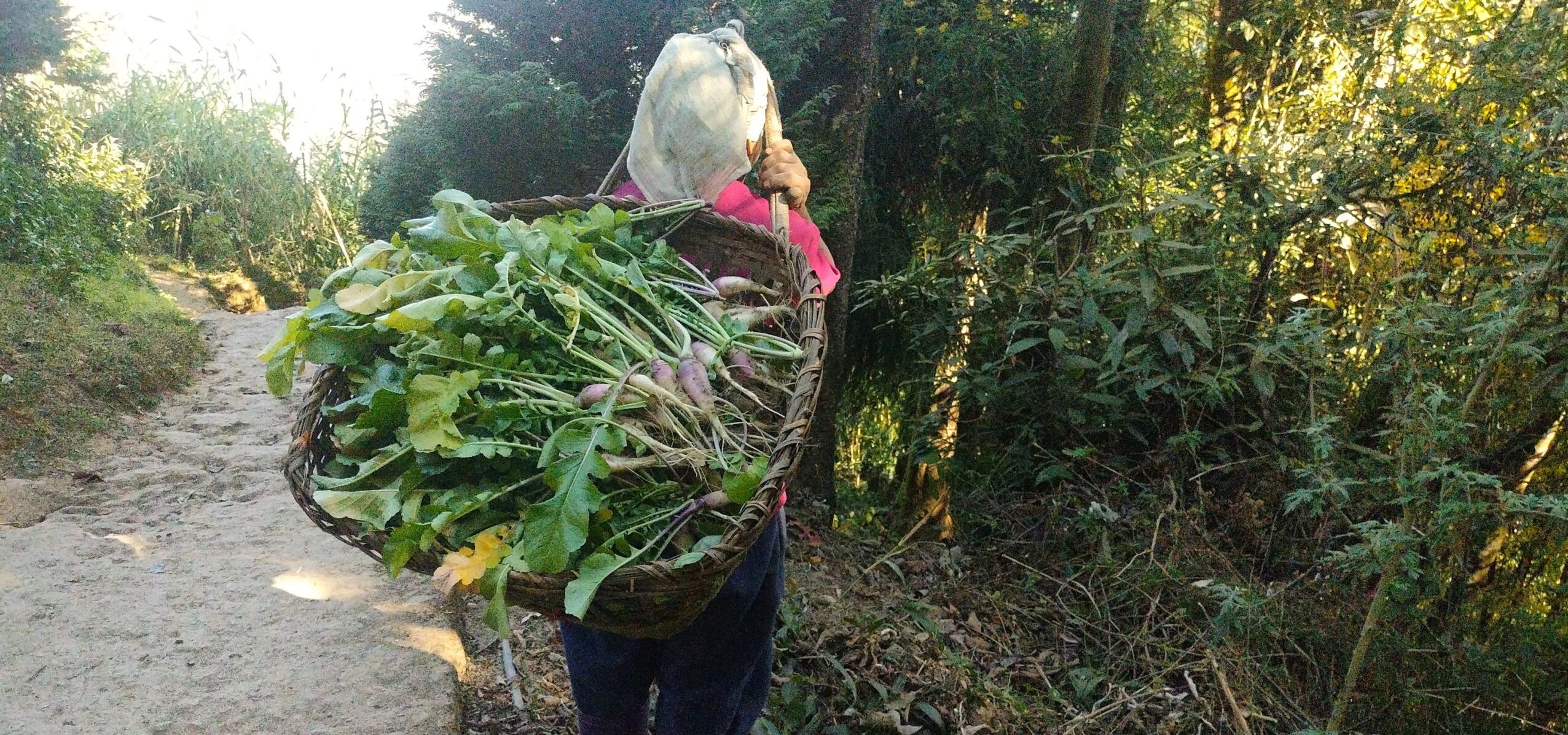
Banner image: A farmer carries her radish harvest in Sikkim. Image by Srijana Sharma.