
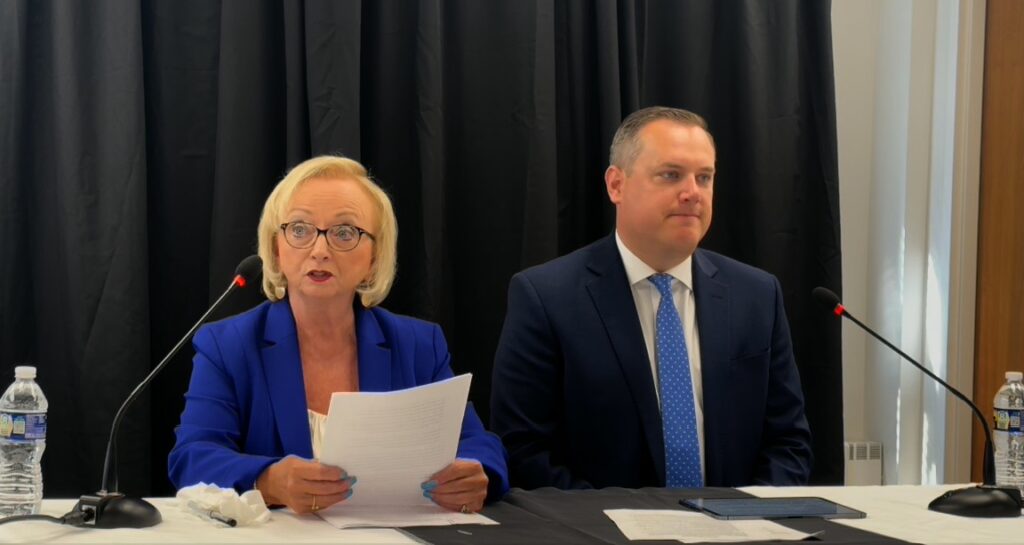
I have long worked on literacy policy while having math phobia. To catch up, I can’t think of a better teacher than Josh Michael, president of the Maryland State Board of Education.
Michael was a classroom teacher in math who earned a Ph. D. focused on math, unique credentials for board presidents. Also, a historical first: He was the student representative on the state board as a high school senior. Now, he and state superintendent Carey Wright, whom he recruited, have catapulted Maryland to the top of all states in groundbreaking literacy and math reforms.
Here is my conversation with him, edited to fit space limits.
The flagship initiative in Maryland is reading. What do you see as the similarities between math and reading plans to dramatically improve student performance?
JM: The primary similarities are alignment with research, teacher training, interventions and accountability. Coherence is essential. Improvement comes from aligning systems in school, not isolated programs. Math requires the same discipline.
Steven Pinker writes, mathematics is “ruthlessly cumulative.” For example, a missed concept in multiplication resurfaces in fractions and then again in algebra.
The science of math, like the science of reading, has grown, though it is still evolving. Translating that evidence into consistent practices is the heart of the challenge. Each of our 1,400 schools must respond quickly to keep students progressing.
Your opinion matters
Maryland Matters welcomes guest commentary submissions at editor@marylandmatters.org.
We suggest a 750-word limit and reserve the right to edit or reject submissions. We do not accept columns that are endorsements of candidates, and no longer accept submissions from public officials or political candidates.
Opinion pieces must be signed by at least one individual using their real name. We do not accept columns signed by an organization. Commentary writers must include a short bio and a photo for their bylines.
Views of writers are their own.
One lesson we have learned from state Superintendent Carey Wright’s literacy reform efforts is that this work is not a miracle. It’s a marathon. Sustained alignment and disciplined implementation matter more than headlines. The same mindset guides our approach to math.
What makes the Maryland math plan a national model?
Maryland is the first to collapse Algebra I, geometry and Algebra II into two integrated courses. We are focused on ensuring students reach Maryland’s College and Career Readiness standards by the end of 10th grade. This allows students to move more quickly into advanced coursework, dual enrollment in high school and college, apprenticeships and career-connected pathways.
We are one of the first states to require all students to receive 60 minutes of math instruction every day, or 300 minutes per week, at every grade-level.
Unlike some other states, acceleration is not being scaled back. Our plan is to build it into the design. Structured acceleration opportunities are required for every middle school in every school statewide. Students who need support are to receive timely interventions. Community colleges were at the table in defining the math students must know to succeed in their credit-bearing coursework.
Have you set measurable goals for improved outcomes?
Yes. We are measuring results and whether implementation is effective. We are focused on improved proficiency, stronger performance on national tests, expanded access to rigorous opportunities and narrowing gaps.
Because math is cumulative, we can’t rely solely on end-of-year assessments. The rate of progress matters. We are tracking student growth and high-quality instructional materials, tiered interventions and acceleration practices.
What are the biggest challenges to effective implementation of the plan?
Capacity, consistency and resources. Because math builds sequentially, gaps compound quickly. Math does not reset each year. The process must start with core instruction. Even then, too many students may need tiered support just to access grade-level work. Key are adequate staffing, time in the school schedule, high-quality materials and trained interventionists.
At the same time, we must build coherence across our 24 local school systems. Implementation has to be consistent and sustained, and it must be backed by the resources necessary to make it real.
At the same time, math reform is unfolding alongside the broader demands of the Blueprint for Maryland’s Future. We have real work ahead. But we also have clarity about what works and partners committed to doing it well. School systems, the General Assembly, the governor, higher education and families are aligned around improving math outcomes. That alignment gives me confidence in what Maryland can achieve.