Researchers at Maynooth University have been exploring one of nature’s and astronomy’s major conundrums and they are much closer to the answer.
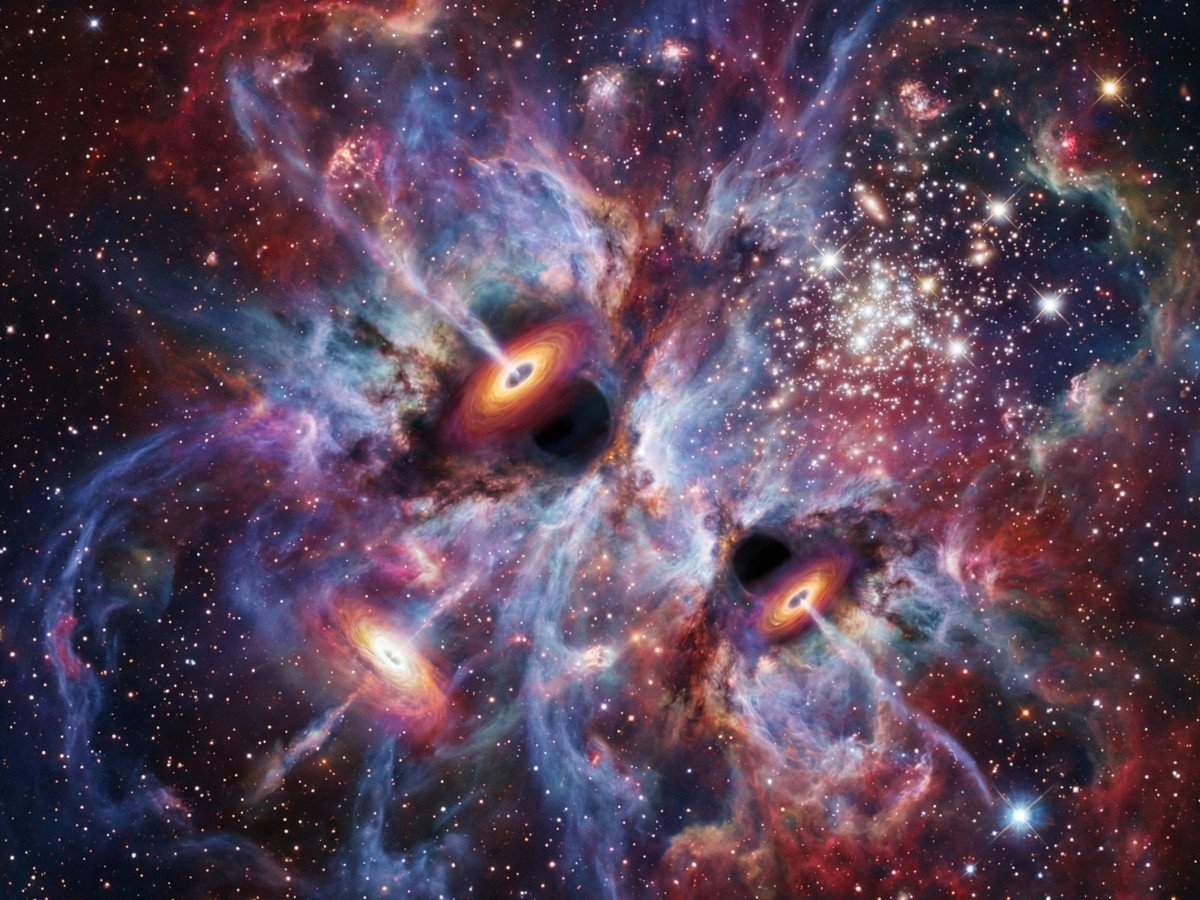
A team of researchers at Maynooth University (MU) have been looking to answer one of the most pressing questions in the field of astronomy: How did black holes get so large and so quickly? The discovery was made by the university’s research group and featured in scientific journal Nature Astronomy.
“We found that the chaotic conditions that existed in the early universe triggered early, smaller black holes to grow into the super-massive black holes we see later following a feeding frenzy which devoured material all around them,” explained Daxal Mehta, a PhD candidate in MU’s Department of Physics, who led the research.
Using high-tech computer simulations, the team at MU were able to deduce that the first generation of black holes, which would have formed a few hundred million years after the Big Bang, grew extraordinarily quickly, eventually coming to be tens of thousands of times the size of Earth’s sun.
“This breakthrough unlocks one of astronomy’s big puzzles,” said Dr Lewis Prole, a postdoctoral fellow at MU and also a research team member. “That being how black holes born in the early universe, as observed by the James Webb Space Telescope, managed to reach such super-massive sizes so quickly.”
MU’s Research shows that dense, gas-rich environments in early galaxies enabled short bursts of ‘super Eddington accretion’. This is a term used to describe what occurs when a black hole consumes matter far more quickly than what is considered normal or safe. It occurs so quickly that the black hole should throw ‘its food’ away with light, however, in this instance it doesn’t.
MU have said that “The results provided a ‘missing link’ between the first stars and the super massive black holes that came much later.”
Mehta explained, “These tiny black holes were previously thought to be too small to grow into the behemoth black holes observed at the centre of early galaxies. What we have shown here is that these early black holes, while small, are capable of growing spectacularly fast, given the right conditions.”
Black holes come in the form of ‘heavy seed’ and ‘light seed’ types, with light seed types relatively small to begin with and the heavy types on the other hand starting life much larger, perhaps up to one hundred thousand times the mass of the Sun at birth.
Up until this moment in time, astronomers believed heavy seed types were necessary to explain the presence of the super-massive black holes found at the centre of most large galaxies, however, Dr John Regan of MUs Physics Department and a research group leader, said, “now we’re not so sure”.
He added, “The early universe is much more chaotic and turbulent than we expected, with a much larger population of massive black holes than we anticipated too.”
The results of MU’s research may also have implications for an important joint European Space Agency and NASA Laser Interferometer Space Antenna mission, which is scheduled to launch in 2035.
Regan explained, “Future gravitational wave observations from that mission may be able to detect the mergers of these tiny, early, rapidly growing baby black holes.”
Earlier this week, as part of the Sofia Massive Star Formation Survey, which is investigating how larger stars are formed, NASA’s Hubble Space Telescope captured striking images of ‘infant stars’.
Don’t miss out on the knowledge you need to succeed. Sign up for the Daily Brief, Silicon Republic’s digest of need-to-know sci-tech news.