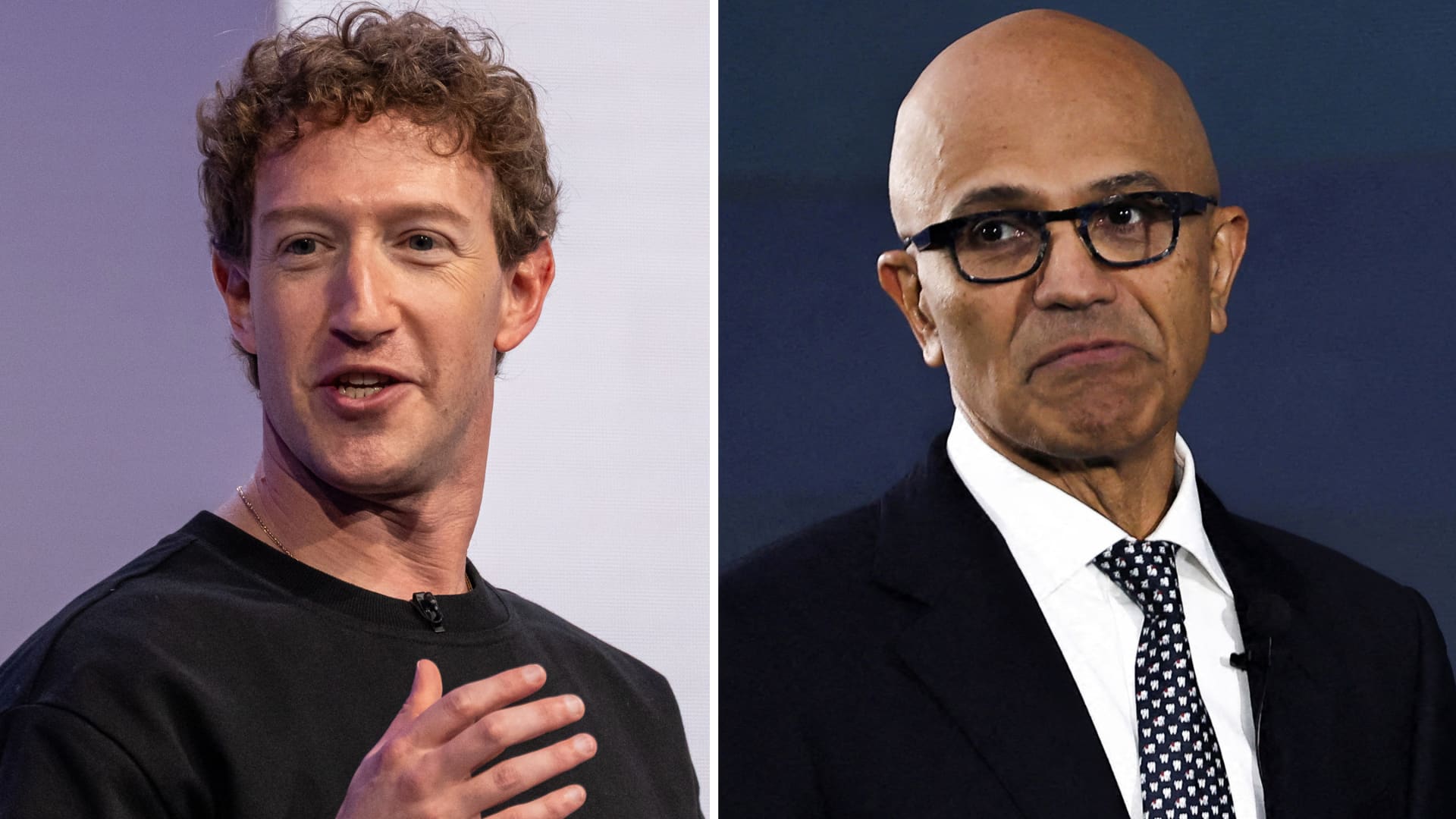
It’s a tale of two different megacaps so far this earnings season when it comes to artificial intelligence.
Meta Platforms surged more than 8% after showing signs that AI investments are boosting the bottom line, while Microsoft shares dropped as the company struggled to justify recent spending plans to investors and showed a slowdown in its cloud segment.
The money flowing into AI and new technology has been a major source of debate on Wall Street as investors increasingly want to see that companies are reaping rewards from the massive spending over the last year.
Meta appeared to gain approval from investors to keep putting money into AI. The social media giant issued strong guidance and said it plans to funnel between $115 billion and $135 billion AI spending this year.
That’s nearly double what it spent in 2025.
In past quarters, investors have raised concerns over the company’s ambitious spending. However, the company’s 24% year-over-year revenue growth, fueled primarily by online advertising, seemed to ease previous worries about its AI strategy.
CEO Mark Zuckerberg suggested the company is working on a range of new products this year and said investments would support his mission for “building personal super intelligence.”

Meta and Microsoft one-day stock chart.
But while investors seemed to reward Meta’s spending plans, Microsoft’s stock plummeted over 11% and headed for its worst day since March 2020.
The software maker showed slowing growth in its Azure cloud segment, which declined to 39% growth from 40% growth in the company’s first fiscal quarter. Investors closely watch the segment as a stand-in for measuring enterprise AI demand.
At the same time, capital expenditures and finance leases in the quarter jumped 66% to $37.5 billion, surpassing the $34.31 billion expected by analysts polled by Visible Alpha, as the company supports demand for its cloud and AI segments.
The company also said its struggling with compute capacity constraints as demand continues to outweigh supply.
Microsoft finance chief Amy Hood said Azure would have grown 40% if the company had funneled all of its new GPU chips in the first and second quarter into its Azure business.
She also said the company is balancing having “incoming supply better meet growing Azure demand” with product innovation and growing first-party AI usage in services like GitHub Copilot and M365 Copilot.
The company’s demand backlog rose to $625 billion, up 110%, which included a $250 billion cloud agreement with OpenAI during the period. The ChatGPT maker accounted for 45% of its commercial remaining performance obligations.
Analysts at Evercore ISI said “concerns about OpenAI’s ability to meet funding commitments” likely contributed to the post-earnings stock spiral but called the sentiment “overblown.”
Beyond Big Tech
The contrasting AI-fueled moves bled into the broader technology sector.
IBM gained a wave of confidence from investors in its AI strategy, with shares popping 8%. The technology and consulting company topped expectations and showed strong software and infrastructure growth as it builds out new automation tools and AI infrastructure.
Analysts at Goldman Sachs said the software and infrastructure growth, coupled with market share gains in consulting, put the company on “track to complete its pivot to long-term growth.”
Meanwhile, IBM’s AI book of business more than doubled to $12.5 billion from $5 billion a year ago. That growth seemed to justify the company’s investments.
Analysts at JPMorgan called IBM a “relatively defensive name with increasingly favorable exposure to Software and AI tailwinds.”
Yet ServiceNow shares dropped 11% as concerns that AI is eating away at the broader software sector’s business model overshadowed the company’s better-than-expected earnings. Shares have dropped 25% already since the start of 2026 and 50% over the last year.
The sector has sold off in recent months on worries that new AI tools will deteriorate demand for their workflows and licenses and put a dent in longstanding revenue models.
During an earnings call with analysts, ServiceNow CEO Bill McDermott defended the company’s business model and recent multibillion acquisition spree, which some investors had flagged as a sign that the company is trying to restart growth.
“Let’s clear it up with the facts,” he said. “Enterprise AI will be the largest driver of return on the multi-trillion-dollar supercycle of investment in AI infrastructure.”
WATCH: Meta jumps on earnings beat, strong Q1 guidance