
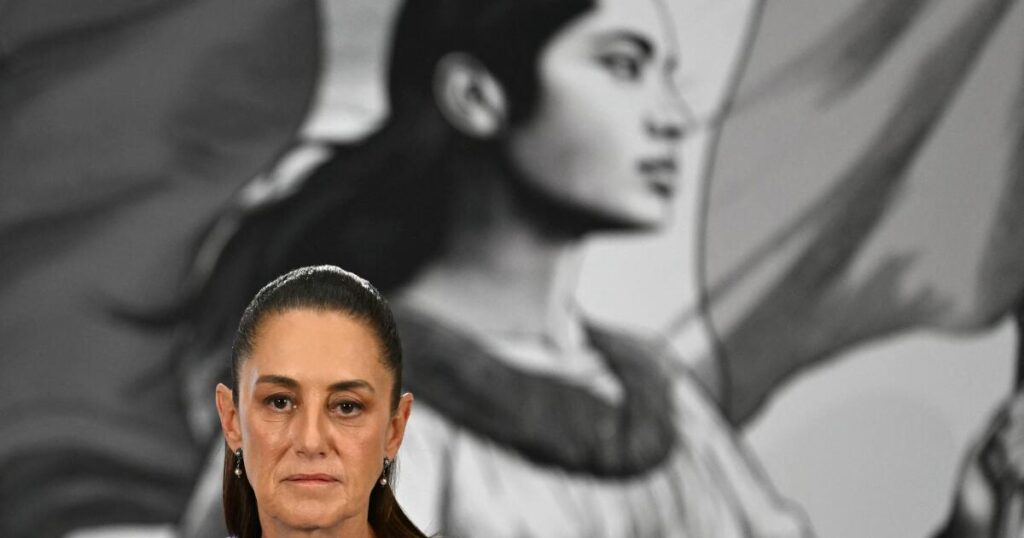
MEXICO CITY — Mexican President Claudia Sheinbaum denounced the U.S. prosecution of a sitting Mexican governor and other officials on drug trafficking charges as “political,” and said Thursday that Mexico would not comply with Washington’s demands that the accused be arrested and extradited to the United States.
“We are not permitting a foreign government to say what is the future of Mexico,” said a defiant Sheinbaum, who repeatedly assailed U.S. “meddling” in the incendiary case.
U.S. authorities have not submitted “compelling proof” to justify the arrests and detentions of anyone in Mexico, Sheinbaum said.
The Mexican leader’s stance puts her administration on a likely collision course with President Trump, who says Sheinbaum’s government hasn’t done enough to crack down on cartels.
Sheinbaum’s comments came a day after the unsealing of a bombshell indictment in federal court in New York accusing 10 current and former Mexican officials of drug trafficking, arms offenses and links to the notorious Sinaloa cartel co-founded by Joaquín “El Chapo” Guzmán.
Rubén Rocha Moya, governor of the Mexican state of Sinaloa, at the inauguration of President Claudia Sheinbaum in Mexico City in 2024.
(Luis Barron / Eyepix Group/Sipa USA via Associated Press)
Topping the list of accused is Rubén Rocha Moya, governor of the northwestern state of Sinaloa.
Rocha Moya and others named have denied the charges, calling them an attempt to subvert Mexico’s sovereignty.
The indictment presents Sheinbaum with one of her biggest challenges yet. In standing firm against the U.S. action, she risks being seen as shielding drug traffickers and their political allies.
Sheinbaum faces “a terrifying Hamlet-like dilemma: to yield or not, with disastrous consequences in either case,” Jorge Castañeda, a Mexican former foreign minister, wrote in El Proceso magazine.
Her response risks “sounding like a defense of corrupt governments,” said Carlos Pérez Ricart, a professor of international relations at the Center for Research and Teaching in Economics.
Pérez said he agreed with Sheinbaum’s plan to have Mexican authorities evaluate the evidence against the Sinaloa officials, which he said appeared “strong.” Still, he said, she was correct to view the U.S. indictment in political terms. “There’s no doubt the United States is weaponizing its prosecutorial powers to serve a political agenda,” he said.
The indictment provides a disturbing portrayal of an entire Mexican state and its institutions at the service of the “Chapitos” faction of the Sinaloa cartel, led by the sons of Guzmán.
The Chapitos, U.S. prosecutors charge, manipulated ballots and kidnapped and intimidated Rocha Moya’s opponents to help him win the 2021 gubernatorial election. In exchange, the indictment alleges, the governor and his allies helped the Chapitos traffic massive quantities of fentanyl, cocaine, heroin and crystal methamphetamine to the United States.
During her morning news conference, Sheinbaum seemed to mock some of the U.S. evidence, including photographs of handwritten ledgers allegedly denoting payoffs to Mexican politicians.
Sheinbaum emphasized that it was unprecedented for the United States to initiate charges directly against a sitting governor. “This has never happened before, ever,” she said.
She repeatedly said that her government “protects no one,” but demanded “real” and “irrefutable” evidence before taking action against Rocha Moya and others, most whom are members of Sheinbaum’s ruling Morena party.
Although Sheinbaum said she was standing up for Mexican sovereignty, her opponents accused her of politically motivated deception.
“Sheinbaum decided to cover it up so as not to sink Morena,” Sen. Lilly Téllez of the conservative National Action Party said on X.
Opposition politicians lined up in Congress to thank Washington for what they viewed as confirmation of their long-time conviction that Mexico under Morena is, in effect, a narco-estado, or “narco state” — the phrase that Sheinbaum has deployed to describe previous, non-Morena governments.
Polls show significant numbers of Mexicans in fact welcome more U.S. intervention in the fight against gangs because they believe Mexican institutions lack the capacity to combat the problem.
Many Mexicans interviewed had mixed feelings about the U.S. charges.
“On the one hand, I don’t like that the United States interferes in Mexico,” said Roberto Santillán, a dentist in the capital. “On the other hand, we know that Mexico is never going to punish these corrupt politicians because they are from the same party as the president.”
Complicating matters is the the fact that Sheinbaum is extremely popular — boasting a 70%-plus approval rating — and has never been linked to personal enrichment or corruption.
“The president should turn these people over to the United States and demonstrate that she fears no one,” said Lourdes Romero, 22, a student. “Otherwise, the message is that she is afraid of the discovery of the web of corruption between los narcos and the politicians of Morena.”
U.S.-Mexico relations have been deeply strained under Trump, who has threatened military strikes against drug targets in Mexico, a proposal Sheinbaum has repeatedly rejected. This month she vowed an investigation into CIA activity in Mexico after it was revealed that two U.S. agents had died in a car crash in Chihuahua state in the aftermath of a raid on a drug lab.
Trump officials have been clear that their ongoing crackdown on organized crime in Latin America, including deadly drone strikes on alleged drug boats, is part of a broader campaign to exert political dominance in the region.
In January, U.S. forces ousted leftist Venezuelan President Nicolás Maduro and flew him to New York to face drug charges, replacing him with a Trump-friendly alternative. The U.S. has sanctioned leftist Colombian President Gustavo Petro, a frequent Trump critic, for alleged ties to drug trafficking, despite little evidence.
During Thursday’s briefing, Sheinbaum recalled Mexico’s outraged response to the 2021 arrest of a former Mexican defense minister at Los Angeles International Airport on trafficking charges.
Retired Gen. Salvador Cienfuegos was released after an intense lobbying campaign by then-President Andrés Manuel López Obrador, Sheinbaum’s predecessor and mentor, directed at Trump, who was serving his first term.
Cienfuegos never faced charges in Mexico, and López Obrador accused the U.S. Drug Enforcement Administration of fabricating a case against him.
“Why did they do the investigation like this?” López Obrador said at the time. “Without support, without proof?”
Special correspondent Cecilia Sánchez Vidal in Mexico City contributed to this report.