
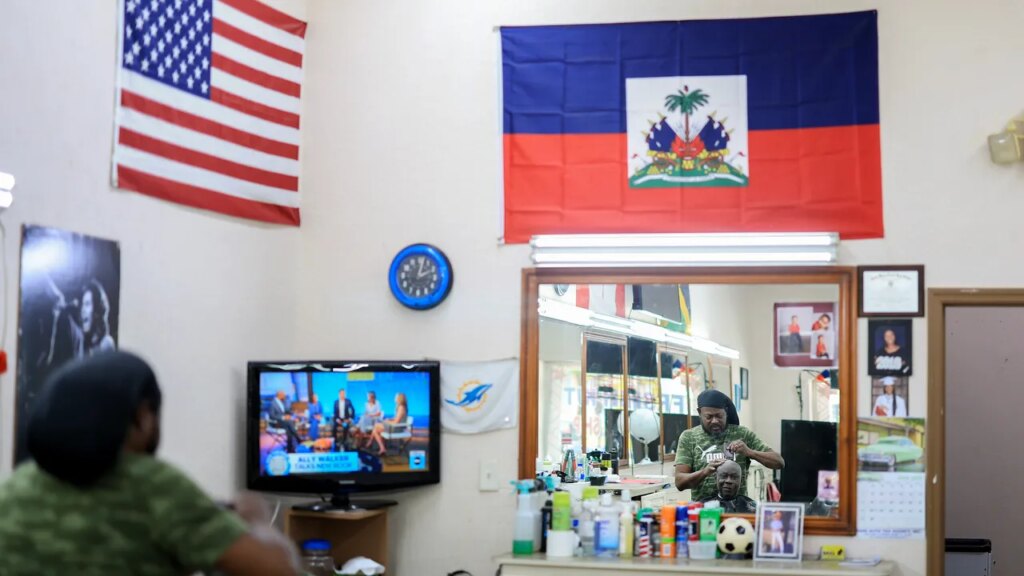
The first documented arrival of Haitian refugees in South Florida dates to 1972, when a wooden sailboat, the Saint Sauveur, ran aground off of Pompano Beach, carrying sixty‑five asylum seekers fleeing the ruthless dictatorship of Jean-Claude Duvalier. Many Haitian families gravitated to Lemon City, one of the oldest settlements in Miami, developed in the late eighteen-hundreds and, at the time, largely populated by lemon-grove workers from the Bahamas. As more Haitians arrived in the area in the nineteen-seventies and eighties, they opened businesses, churches, markets, and cultural centers. Viter Juste, a businessman and activist who’s often called the father of Miami’s Haitian community, coined the name of the neighborhood in the early nineteen-eighties, and it stuck.
Today in Little Haiti, a seven‑foot bronze statue of Toussaint Louverture, one of the leaders of the Haitian Revolution, stands in a small plaza known as the City of Miami Freedom Garden. The plaza sits across from a gas station and bakery, surrounded by rows of modest homes, some purchased decades ago by newly arrived Haitian immigrants, before gentrification began to reshape the neighborhood. Since the statue’s installation, in 2005, three years after I moved to Miami, and a little more than a year after the bicentennial of Haitian independence, the spot has become a neighborhood gathering place. On January 1st, Haitian Independence Day, people stop by to take photos while area churches and neighbors share bowls of soup joumou, “freedom soup,” eaten to commemorate that day. Some afternoons, elders sit on the green benches surrounding the statue to talk or look out at the neighborhood, as they might once have done from their front porches back in Haiti. Occasionally, a group of tourists passes by, led by a tour guide dressed in a traditional blue denim karabela shirt and a straw hat, pausing to look up at the Haitian and American flags perched on tall flagstaffs, before reading the English translation of Louverture’s most famous declaration, at the statue’s base: “By overthrowing me, you have cut down the trunk of the liberty tree of the Blacks in Saint Domingue. It will grow again from its roots for they are numerous and they run deep into the ground.”
On January 12th, at the foot of the statue, a group of elected officials and community members gathered to commemorate the 7.0-magnitude earthquake that struck Haiti in 2010, killing more than two hundred thousand people and displaced 1.5 million. The event has been held annually for the past fifteen years, but this year there was an extra layer of sombreness to the proceedings, which the overcast skies seemed to reflect. On February 3rd, the Trump Administration is set to terminate Temporary Protected Status (T.P.S.) for Haitians in the United States, placing some three hundred and thirty thousand men, women, and children at risk of deportation. T.P.S., granted to certain immigrant populations when the conditions in their home country make safe return impossible, does not provide a path to citizenship, but gives recipients the crucial ability to work legally in the U.S. and, in many states, to obtain a driver’s license. After the 2010 earthquake, Haitian community leaders successfully appealed to the Obama Administration for T.P.S., and it has been extended ever since. Under Donald Trump, though, several countries with T.P.S. status, including Venezuela and Somalia, have recently had their designations terminated, and Haiti’s status is in limbo, as a pivotal lawsuit before the U.S. District Court in Washington, D.C., challenges the Trump Administration’s decision to revoke it. During hearings in early January, the presiding judge, Ana C. Reyes, questioned the government’s assertion that it would be safe to return to Haiti, pointing to the fact that the F.A.A. has restricted civilian flights over the capital of Port-au-Prince, and the State Department has warned against travel to Haiti. Reyes’s ruling is expected on February 2nd, one day before the T.P.S. designation for Haitians is set to expire.
According to the U.N., Haiti is facing one of the worst humanitarian crises in the world. Since the assassination of President Jovenel Moïse, in 2021, armed groups have assumed control of large portions of the capital and surrounding areas, terrorizing civilians and causing 1.4 million people, including seven hundred and forty-one thousand children, to be displaced. Friends and family members of mine have moved from neighborhood to neighborhood to escape the violence. Some have had to abandon their homes, with all of their belongings still inside, only to find out later that those houses were burned to the ground. Displaced families often spend weeks, sometimes months, in makeshift dwellings, including public squares and deserted government buildings, while children lose months or even years of education as schools close or become inaccessible owing to gang activity. Sexual violence against women and girls has been on the rise as a tool of control by gangs. Five million and seven hundred thousand Haitians, close to half the population, are now facing high levels of food insecurity. Since Moïse’s assassination, Haiti has had no elected officials. The country’s interim governing body, the Transitional Presidential Council, has been mired in infighting and corruption allegations, and though its mandate ends on February 7th it has yet to reach consensus on who will lead the country or what form the next government will take.