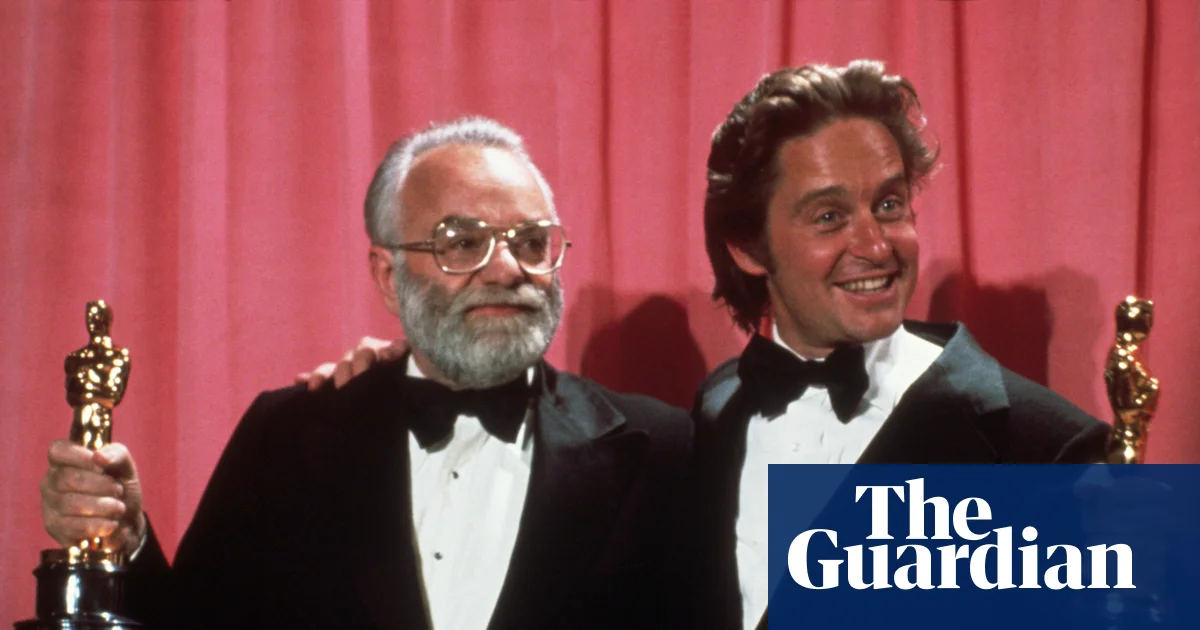
His early career was defined by the Vietnam war with early roles in political films such as Hail, Hero! and Summertree. So it felt natural for Michael Douglas, just 31, to make his first foray into producing with One Flew Over the Cuckoo’s Nest, a tale of one man raging against the system.
Fifty years since its release, Douglas is struck how Cuckoo’s Nest resonates anew in today’s landscape. “It’s about as classic a story as we’ll ever have and it seems timeless now, with what’s going on in our country politically, about man versus the machine and individuality versus the corporate world,” the 81-year-old says via Zoom from Santa Barbara, California.
Is he talking about Donald Trump? “Not just in America but we see autocratism continue around the world,” Douglas adds. “When we have insecurity, people tend to go to having an omnipotent figure that will solve everything.”
The autocrat in Cuckoo’s Nest is Nurse Ratched (Louise Fletcher), who enforces strict routines and suppresses any spark of individuality in an Oregon psychiatric hospital. She wages a battle of wills with Randle McMurphy (Jack Nicholson), a rebellious small-time criminal who fakes insanity to avoid prison labour and ends up committed to a mental institution. As McMurphy’s anarchic spirit spreads, the ward briefly feels freer and more alive.
The film, released on 4K Blu-ray last month for its 50th anniversary, is based on Ken Kesey’s 1962 novel. Fresh from his success in Spartacus, Douglas’s father Kirk had acquired the rights and played McMurphy in a 1963 Broadway stage production. Douglas, meanwhile, read Cuckoo’s Nest in college. “Reading it, and being a hippie at the time, and the psychedelics that were involved and all that, it was kind of a Bible for us,” he recalls.
Kirk spent years trying get a film version made but decided to give up and sell the rights. Douglas recalls: “I never thought about producing but I said let me run with it and he was generous enough and kind enough to let that happen. As a result, we finally got it made. My half of the producing fee I gave to Dad and he made more money off of that than any movie he had done in his career.
“But he was disappointed at not being able to play the part, which always had been an issue, and I certainly know after all these years how you can count good parts on one hand in your whole career. It doesn’t come along that often. The only saving grace was when he finally saw the picture he loved it and he loved Jack’s work.”
Kirk’s letdown at not playing the role was offset by “how proud and impressed” he was, Douglas adds. “He looked at me with a new eye, something you couldn’t believe, because to your father you were always a kid and so it was nice. But yeah, he liked to remind me about it.”
Douglas’s producing partner Saul Zaentz asked Kesey to write a screenplay but it was not the right fit and they fell out with the author. The project began to take shape, however, with screenwriter Lawrence Hauben, who steered Douglas towards the wild, mordant humour of Czech director Miloš Forman.
Forman, then holed up in New York’s Chelsea hotel and reputed to be in the grip of a breakdown, nonetheless flew to California. Unlike most directors, who kept their plans to themselves, Forman dissected the script page by page. Douglas was sold.
They had to wait six months for Nicholson to finish another project but this proved a blessing as they could extend casting options far and wide. Danny DeVito, who was Douglas’s oldest friend and had appeared in a 1971 off-Broadway production of Cuckoo’s Nest, was the first to sign up. Finding the right actor to play Chief Bromden, a towering Native American who pretends to be deaf and mute, would be more serendipitous.
On a flight to New York, Douglas sat next to a used-car dealer and rodeo announcer called Mel Lyman from Eugene, Oregon, and told him about the film. “I gave him my number and forgot about it and about six months later, I get a call in my office. ‘Listen, Michael, the biggest sonofabitch Indian I ever seen walked in the door the other day. This sonofabitch is big, Michael, I’m telling you.’ That was Will Sampson.”
When Douglas and Nicholson first met Sampson at Portland airport, they knew they had their man. “Will comes off [a plane] with his cowboy boots on and his hat and he’s over seven feet, with long hair, and Jack shouts: ‘Oh, my God, it’s the chief! It’s the chief! Oh, I can’t believe it’s the chief.’ He looked at him and it was central casting. That was probably the most euphoric moment: how are we gonna find this guy, this character, and there he was.
“Then Jack said, ‘Can he talk? Can he talk?’ And then he went, ‘Wait a minute, he doesn’t have to talk! He doesn’t talk in the movie.’ We were so excited that we wanted him to stay with us so he came with us. We were on a little tiny twin prop plane and we were overcrowded. Will was sitting in the front seat next to the pilot, and we didn’t have enough room, and Jack was sitting on his lap: ‘God damn, it’s the chief, it’s the chief!’
They struck gold again with Fletcher for the role of Ratched. Douglas says: “It was at a time politically – Gloria Steinem – when the idea of a woman playing a villain was a no-no. Guys loved to be the villain; villains were great. Four major actresses turned the part down and then Miloš found Louise in a Bob Altman movie, playing a smaller part and we tested her and she was wonderful, and that was a great new discovery too.”
The production decamped to an active psychiatric hospital in Oregon – in January, when daylight vanished by mid-afternoon. The hospital’s director, Dr Dean Brooks (who would later appear in the film), encouraged his patients to join the crew. They did, across multiple departments.
Douglas recalls: “Why are we in Oregon in January? It gets dark at 3.30 in the afternoon, whatever light I had out the windows. We felt there was this need for the very verisimilitude and the cooperation. Dr Brooks, who now has been cast as in the picture, helped integrate our actors into actual group therapy sessions with the patients in the hospital.
“Since it was a state mental hospital, it was also a hospital for the criminally insane. Part of our deal with them was hiring many patients to work on our crew. In the art department we had an arsonist working there, and I remember thinking, is this the best place for this gentleman to be?”
But ultimately, Douglas argues, the decision to film on location paid off. “The difference of going home every night back to your home in Los Angeles and then coming to work versus being there. At a point many of our actors were actually sleeping on their cots on the set at night because it built that bond.”
Nicholson and Fletcher watched electroconvulsive shock therapy at six o’clock one morning. Actor Brad Dourif, who played a young, voluntary patient on the psychiatric ward, found the immersive experience valuable. Speaking from his home in Woodstock, New York, the 75-year-old recalls: “We would go up and spend four hours in maximum security with dangerous people.
“Drugs changed everything. Everybody was extraordinarily normal. I talked to a bunch of people and they were very normal. That was the lesson that Miloš wanted us to have: that he didn’t want everybody to look crazy with some kind of shtick. He kept saying, ‘Do it natural, natural’.
He adds: “There was a big fight over windows. The cinematographer frosted the windows and Miloš was upset about that because he said that he wanted to see outside and to see cars going outside, to get a feeling that they’re not isolated from a world that they could take part in. It was sitting right out there and whatever it was that was going on in everybody’s head, all they had to do was, go outside. They didn’t have to be there – almost.”
Dourif believes that Bibbit is bipolar, a term that had not yet been introduced. The character also has a pronounced stutter, which worsens under stress or when confronting authority, symbolising the way the world – and especially his mother – has silenced him. Dourif recalls how he worked on the stutter.
“I did some exercises where I would go to a place where there was a line and everyone was in a hurry and you had to know what you wanted before you got there, otherwise people would kill you – like Grand Central station – and I would go and stutter.
“Miloš also said to me, which was an incredible note, that in his experience, anybody who talks to somebody and stutters is being incredibly courageous because at the moment they are trying to talk, they are totally alone.”
Cuckoo’s Nest was turned down by every major studio yet went on to win the “big five” Oscars: best film, director, actor, actress and screenplay. Steven Spielberg, who had directed Jaws that year, told the recent Jaws @ 50 documentary: “Oh yeah, I would’ve [voted for] One Flew Over the Cuckoo’s Nest for best picture over Jaws. I would’ve done that.”
It was a first Academy award for Nicholson. Dourif reflects: “He was owed an Oscar and he was like, ‘I’m not letting this slip out of my hands, man, I’m going to do the very best I can.’
“He brought everybody up. He was the only person who had done a lot of movies. The rest of us had done stage so he knew what we were supposed to do. He was there to advise us. Basically, he understood about needing to play and so when it was difficult off camera he would try to make us laugh. That was a cool thing.”
Mercurial and mischievous, Nicholson delivered set pieces such as pretending to watch a baseball game – announcing imaginary pitches, hits, and plays with exuberance – even as he stares at a blank TV screen after Ratched refused his request to switch the ward’s schedule.
Dourif continues: “Somebody said about Nicholson that his performances were, ‘I can do what I want’ – there was something innately rebellious in his spirit – but by Cuckoo’s Nest it had translated to, ‘I can do what I want, and you can too.’ It was an allegory against the dangers of what institutions do to people.”
In the pantheon of great movie endings – Citizen Kane, Dead Poets Society, The Graduate, Planet of the Apes – there is surely a place for Cuckoo’s Nest. The chief discovers that McMurphy has been lobotomised, smothers him with a pillow as an act of mercy and finds uncanny strength to uproot a huge hydrotherapy machine and hurl it through a window so he can run away to freedom.
Dourif was moved by the ecstatic response of Christopher Lloyd as one of the patients whose spirit was liberated by McMurphy: “I thought Will was incredible – he did a beautiful job – but Christopher Lloyd sold that. His reaction to it was astounding and absolutely dead on.”
Douglas also credits composer Jack Nitzsche’s inspired use of a bowed saw, saying: “Jack created this incredible score – wah, wah, wah, wah, wah, wah – which built up at the end. Then Christopher Lloyd, that last image – we knew the ending worked.
“It was one of those pictures where we’re firing on all cylinders. We had a solid script, it was cast beautifully, very well directed, the score was great. My first movie as a producer, it lends me so much information for the rest of my career. I learned so much from that and I’m so proud to be sitting here talking to you about it 50 years later.”