
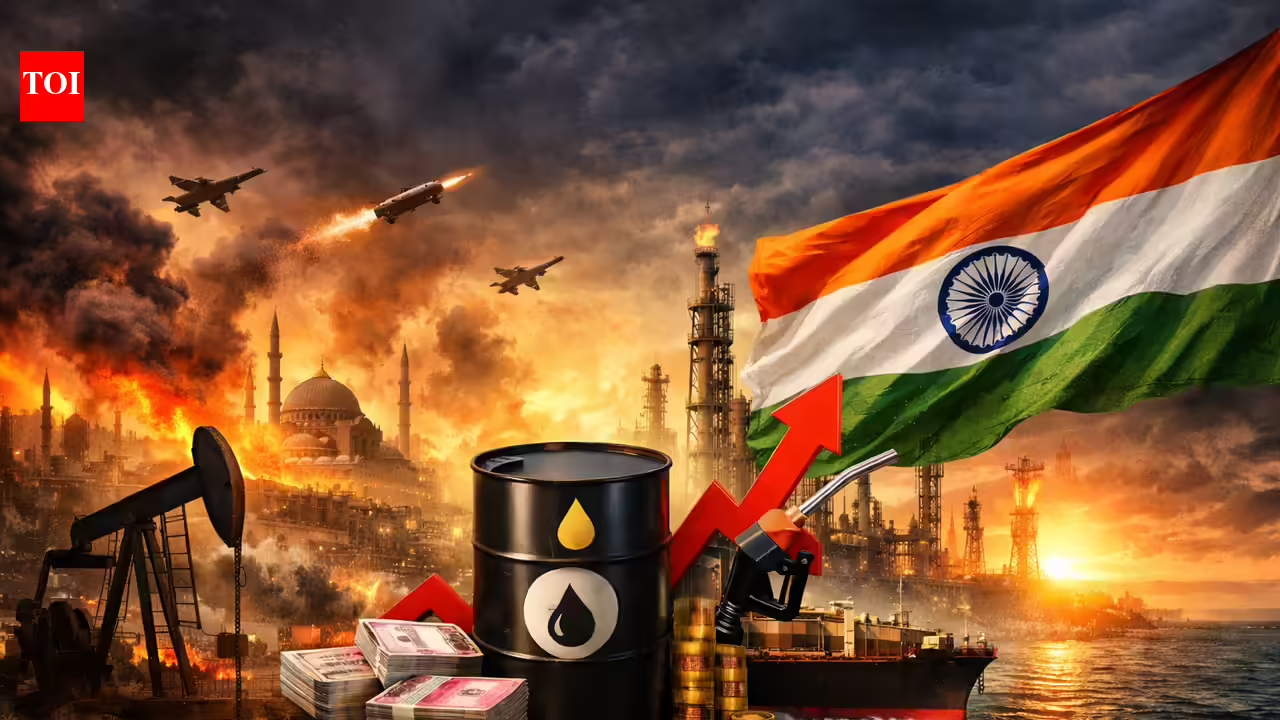
The Middle East is on a boil and concerns are raising on what it might mean for India. New Delhi imports nearly 88% of its crude oil needs, so any disruption in global supplies can quickly push up its oil bill and fuel inflation. Fresh security concerns around the Strait of Hormuz have already driven global crude prices sharply higher.Brent crude jumped more than 10% to $80 per barrel, while US-traded oil rose about 9% to $73. The spike indicates increasing market nervousness over possible supply disruptions through one of the world’s busiest oil routes.
What does Middle East conflict mean for India’s oil markets?
The development carries particular significance for India, which majorly relies on imports to fulfil its crude oil requirement. Furthermore, any sustained rise in global prices is likely to inflate the country’s import bill and add to fuel-driven inflationary pressures.As the conflict continues to escalate, the Strait of Hormuz and the Bab el-Mandeb Strait could see major disruptions, two vital sea lanes connecting India with the Gulf as well as major markets in North America and Europe.Price hikesCrude oil plays a vital role in everyday consumer products such as detergents, biscuits, toothpaste, paints and packaging. Petroleum derivatives are widely used in items like soaps, shampoos, creams, hair oils, bottles and tubes. These inputs make up more than 25% of production costs for FMCG companies and about 40% for paint manufacturers. Hence, in case crude prices continue to soar, these daily use products may get further costlier. “Also, demand will be impacted in states like Kerala, Uttar Pradesh, West Bengal and Telangana which have high Gulf remittances,” Abhijit Roy, Berger Paints chief executive officer told ET.Arup Chauhan, promoter of Parle Products, India’s largest biscuit maker told ET that “the escalation (in Brent crude prices) would have a cascading effect overall.”“Let’s hope for things to settle down within the next 72 hours or so.”Widen deficitAjay Bagga, Banking and Market Expert, told ANI that around 20-22 million barrels per day, which is roughly one-fifth of global oil consumption, passes through the Strait of Hormuz. Even short-lived disruptions at this chokepoint tend to push up insurance premiums, freight charges and crude benchmarks. Markets are already seeing steep increases in war-risk insurance, tanker rerouting and naval escort activity, along with higher embedded logistics costs, he noted.Bagga outlined a range of possible price outcomes. Under limited escalation, Brent could move to $100-115 per barrel. If maritime disruptions occur, prices may rise to $120-140, while a sustained closure risk could drive crude to $150 or beyond.Every $10 increase in crude widens India’s current account deficit by roughly 0.4-0.5% of GDP and lifts CPI inflation by 30-40 basis points. “This is not simply a geopolitical story. It is a macroeconomic story,” he said.He added that sectors such as aviation, chemicals, automobiles, paints and oil marketing companies could face pressure if higher crude costs are not fully passed on. Potential relative gainers include upstream oil firms, defence, IT because of the US dollar hedge, and gold-linked plays. “Geopolitical risk is no longer episodic. It is structural. 2026 marks the return of hard geopolitics,” Bagga said, urging investors to stress-test portfolios for $120 oil, diversify geographically, own real assets and hedge currencies.Diversifying oil basketGTRI indicated that in the event of a Hormuz closure, refiners could reroute supplies via pipelines to Red Sea ports. India may also step up sourcing from Russia, the United States, West Africa and Latin America, and draw on its strategic petroleum reserves to manage near-term shocks.However, risks remain uneven across fuels. Sumit Ritolia, lead research analyst, Refining and Modelling at Kpler, said that while India may be able to cope with higher crude prices and temporary supply disruptions, LPG supplies appear more vulnerable. “Escalating Middle East tensions once again highlight a structural reality: India remains materially exposed to the Strait of Hormuz – not just for crude, but even more so for LPG and LNG,” says Sumit Ritolia.Meanwhile, energy policy expert Narendra Taneja said that oil markets may see only a brief phase of volatility following the recent escalation in the Iran-Israel conflict. He expected the situation to stabilise within 7 to 10 days, that the United States and Israel may move towards diplomatic engagement after achieving their immediate objectives.Speaking to ANI, Taneja said, “I’m worried about the way things are going, but my own sense is that probably within the next 7-10 days, things will begin to stabilise. Probably the United States and Israel are going to say, all right, we have achieved what we have set out to achieve, and they will call for peace or negotiations and so on.”