
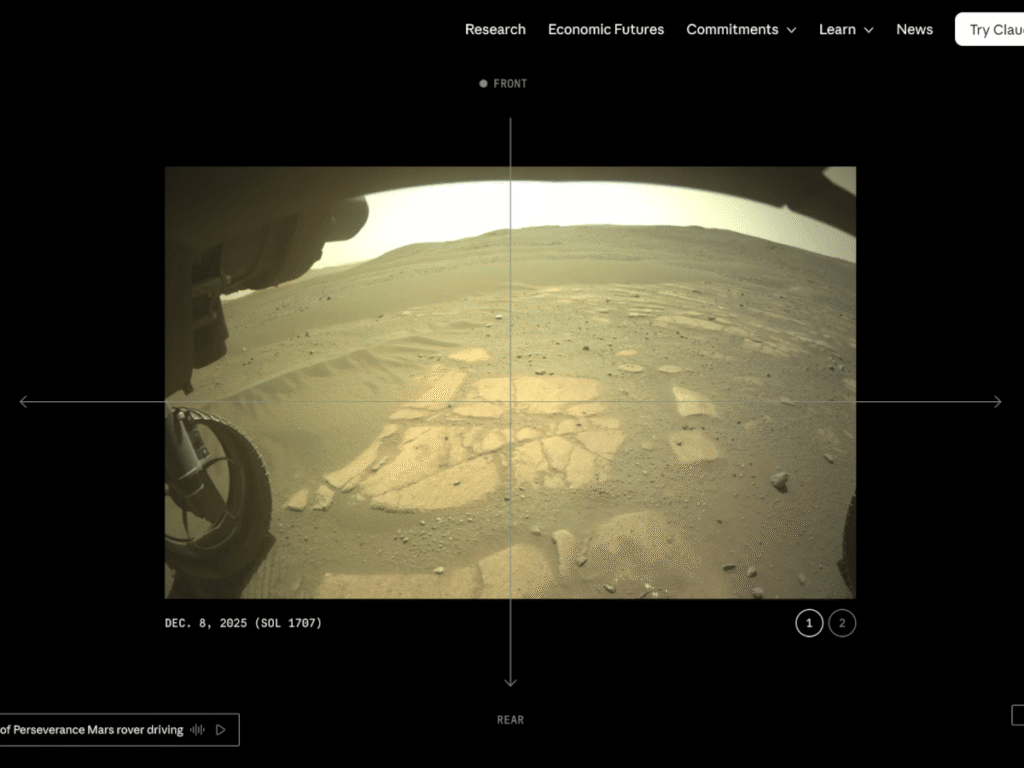
The organisation used GenAI to create waypoints for NASA’s rover, a task that is typically undertaken by a mission’s human planners.
The National Aeronautics and Space Administration (NASA) and artificial intelligence (AI) platform Anthropic have “made history” by using GenAI technology Claude to perform the first AI-assisted drive on Mars.
In December of last year NASA’s Jet Propulsion Laboratory (JPL) led by the Rover Operations Centre (ROC) team used Claude to plan the Perseverance Mars rover’s journey, a task that is typically delegated to human rover planners.
“This demonstration shows how far our capabilities have advanced and broadens how we will explore other worlds,” said NASA administrator Jared Isaacman.
He added, “Autonomous technologies like this can help missions to operate more efficiently, respond to challenging terrain and increase science return as distance from Earth grows. It’s a strong example of teams applying new technology carefully and responsibly in real operations.”
To create a safe and efficient route to explore, NASA explained Claude analysed territory and identified obstacles using decades of rover data and mission constraints.
Additionally, the rover could traverse specific Mars locations previously buried in 30 years of mission imagery logs. The organisation said this is work that previously took hours or days, but with advanced technologies was completed in minutes.
After identifying critical terrain features, for example bedrock, outcrops, hazardous boulder fields and sand ripples, Claude generated a continuous path complete with waypoints.
To ensure the AI’s instructions were fully compatible with the rover’s flight software, the engineering team also processed the drive commands through JPL’s digital twin, before sending the commands to the Mars-based rover.
Vandi Verma, a space roboticist at JPL and a member of the Perseverance engineering team said, “The fundamental elements of GenAI are showing a lot of promise in streamlining the pillars of autonomous navigation for off-planet driving: perception (seeing the rocks and ripples), localisation (knowing where we are), and planning and control (deciding and executing the safest path).
“We are moving towards a day where generative AI and other smart tools will help our surface rovers handle kilometer-scale drives while minimising operator workload, and flag interesting surface features for our science team by scouring huge volumes of rover images.”
Also in December of last year, NASA JPL was reconsigned alongside Ubotica Technologies and Open Cosmos at the SpaceNews Icon Award for Space AI Partnership event, for their joint work on Dynamic Targeting.
This is a technology that uses artificial intelligence to allow spacecraft to decide autonomously and within seconds where to make science observations from orbit.
Don’t miss out on the knowledge you need to succeed. Sign up for the Daily Brief, Silicon Republic’s digest of need-to-know sci-tech news.