
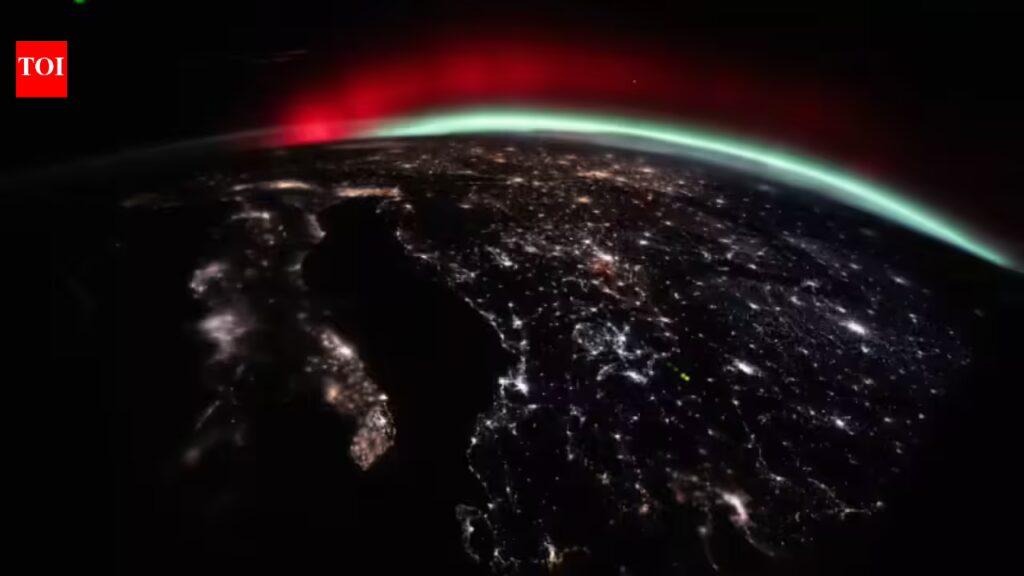
On 19 January 2026, Europe was treated to a stunning aurora spectacle like a true rarity, with large parts of Europe illuminated with varying shades of red and green in a natural setting on that chilly winter night. Generally, auroras appear in locations around the poles, but on this day, it was so vivid that sites far away from the North Pole could witness its sheer spectacle. The entire scene was recorded by NASA on its International Space Station 262 miles above Earth.The photograph shows us luminous curtains of light tracing the horizon of the planet, the dark mass of the continent of Europe beneath it, and the groups of lights of its cities visible through the atmosphere above. But it encourages us to think about the fact that the skies of the Earth are influenced by forces well beyond the planet itself.
International Space Station captures rare aurora over Europe
The photo was taken at about 10:02 pm local time during a flyover of the ISS over the Mediterranean Sea at night. From this vantage point, the astronauts could see north across Italy into central and northern Europe. The altitude of the ISS furnished a perspective where the aurora can be viewed spread out around the curvature of the Earth to highlight its enormousness.The photograph was taken by NASA’s Chris Williams, who was aboard the shuttle at the time and was responsible for capturing the image. The photograph has been included in NASA’s photo gallery as well. Such photos are not often taken due to the specific timing required for orbital positioning around Earth in darkness and increased aurora activity in space.
What causes auroras in Earth’s atmosphere
Auroras come about when charged particles, which are emitted from the Sun, come in contact with Earth’s atmosphere. These move at space in the solar wind, guided towards the planet by Earth’s magnetic field. Upon encountering the uppermost atmosphere near the poles, they collide with a variety of gases like oxygen and nitrogen.These impacts result in energy releases that emit their own light. Oxygen at lower altitudes gives off the more familiar green glow, while oxygen at higher altitudes emits red light. Nitrogen can also produce purple or blue colours, although these are less discernible to the human eye. The colours evident in this January display suggest very strong solar activity reaching deep into Earth’s magnetic environment.
Why the colours appear red and green
The large contrast between the colors of red and green observed in the picture by NASA can be described by referring to the positions or altitudes at which each phenomenon takes place. Green seems to appear at a lower position where oxygen levels are higher. The position of red is higher, where oxygen levels are lower.The fact that both colors could be observed at once means that solar energy particles were passing through multiple layers of our atmosphere at one time. In most cases, this can signal geomagnetic storms of extreme proportions. In fact, auroras can end up getting expanded well below their normal latitudinal limits.
Role of space weather in shaping the display
One of the most noticeable phenomena resulting from space weather is auroras. Space weather is basically an occasion when solar activity is combined with Earth’s magnetic field. Most auroras appear when energy is released from the Sun. Sometimes, energy is released from the Sun, and charged particles move from the Sun.The disturbance of the magnetosphere by such micro-particles is what leads to auroras, thus linking auroras with space weather phenomena, where a few micro-particles can significantly influence the weather of certain places on Earth, including its auroras. Space weather is concerned mainly with how solar activity can influence the satellite, satellite-based, let alone terrestrial, weather of Earth, auroras inclusive.
Why this aurora matters to scientists
Beyond its beauty, the aurora captured over Europe provides valuable data for scientists studying Earth’s upper atmosphere and magnetic field. Observations from space allow researchers to track how solar particles move, where they enter the atmosphere, and how energy is distributed across different altitudes.Images like this help scientists improve models of space weather, which are increasingly important as modern societies rely more heavily on satellite technology. Each aurora observed from orbit adds to a growing understanding of how closely connected Earth is to activity on the Sun.