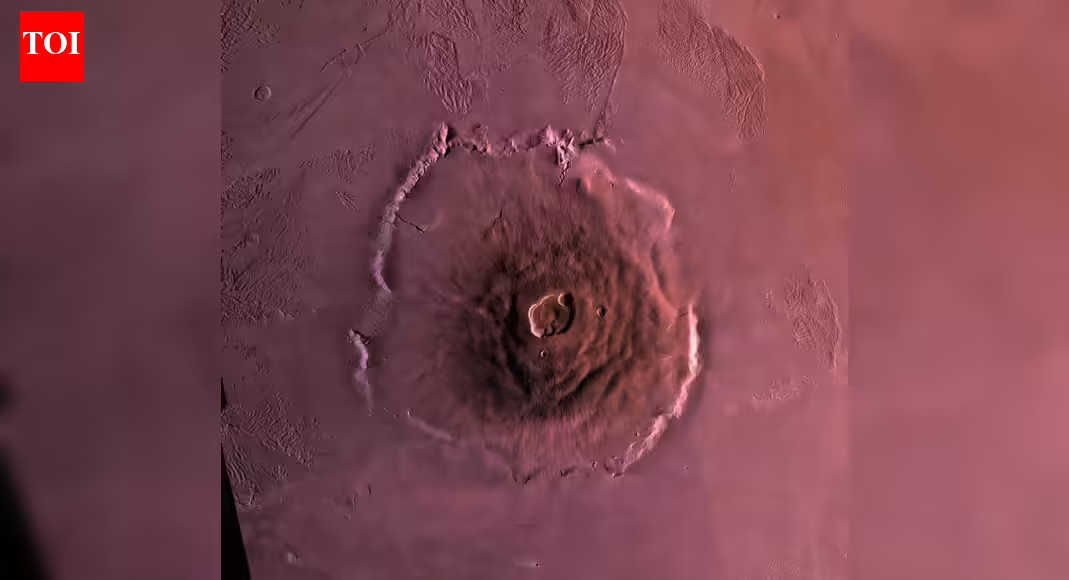
On some Mars images, Olympus Mons does not look dramatic at first glance. It sits there quietly, a wide pale rise against rust coloured plains. No sharp peak. No obvious violence. Only when scale is added does it begin to feel strange. This single volcano rises higher than anything on Earth and spreads wider than many countries, yet it does not dominate the planet in the way you might expect. NASA scientists have spent years trying to understand what this mountain is really telling us. What they have found on its summit and across its flanks has complicated older ideas about how planets behave when their crust does not move, crack, or recycle itself the way Earth’s does.
What did NASA discover on a volcano on Mars
Olympus Mons lies in Mars’s western hemisphere, close to the equator, on a raised volcanic plateau known as the Tharsis region. From the surrounding plains, parts of the volcano rise to about 26 kilometres high. Its base stretches more than 600 kilometres across, which means a traveller standing at one edge would not see the summit at all. NASA measurements describe a vast circular scarp around the volcano, several kilometres tall, with a deep central caldera made up of overlapping collapse pits. It is less a single peak and more a long, slow rise that keeps going.In 2024, researchers detected frost near the summit of Olympus Mons. The amount of water involved was small by Earth standards but still surprising. Estimates suggest it was equivalent to around 60 Olympic swimming pools. The frost appears and disappears with seasonal changes, clinging to a place once shaped by heat. It is not dramatic evidence of life or activity, but it adds another quiet detail to a volcano that continues to challenge simple explanations.
Was Olympus Mons visible before the spacecraft reached Mars
According to BBC Sky at Night Magazine, long before orbiters arrived, astronomers noticed a bright patch on Mars through Earth-based telescopes. They called it Nix Olympica, or Olympic Snow, assuming it was something reflective near the surface. Only in 1971 did NASA’s Mariner 9 spacecraft confirm that this feature was not ice but a colossal volcano. Once mapped properly, Olympus Mons rewrote the record books. Nothing on Earth came close. Even now, its scale feels awkward to describe without comparisons that sound exaggerated.
Why does Olympus Mons look so flat
Olympus Mons is a shield volcano. This means it formed from lava that flowed easily and spread out rather than piling up in steep cones. On Earth, shield volcanoes like those in Hawaii are large but limited. On Mars, the same process kept going for far longer. The lava layers stacked slowly, creating gentle slopes that stretch for hundreds of kilometres. From orbit, the volcano looks almost calm, as if it were never violent at all.
How did Olympus Mons grow without tectonic plates
Earth’s volcanoes are shaped by moving plates. Hotspots drift, eruptions migrate, and mountains rarely stay in one place for long. Mars works differently. Its crust is mostly static. Olympus Mons sat above a persistent magma source in the Tharsis region and stayed there. Lava erupted again and again at the same location. Nothing pulled the crust away. Nothing shut the system down early. Over millions of years, the volcano simply kept growing, layer by layer, until it reached a size that now feels out of proportion to the planet beneath it.
Is the volcano really dead
Olympus Mons is not erupting today, but it may not be as ancient as it looks. Some lava flows are thought to be around 25 million years old, which is recent in planetary terms. There are hints of older buried layers underneath, suggesting a long and uneven history rather than one continuous phase. Mars’s thin atmosphere and lack of flowing water have helped preserve the volcano’s shape. Very little has worn it down.