
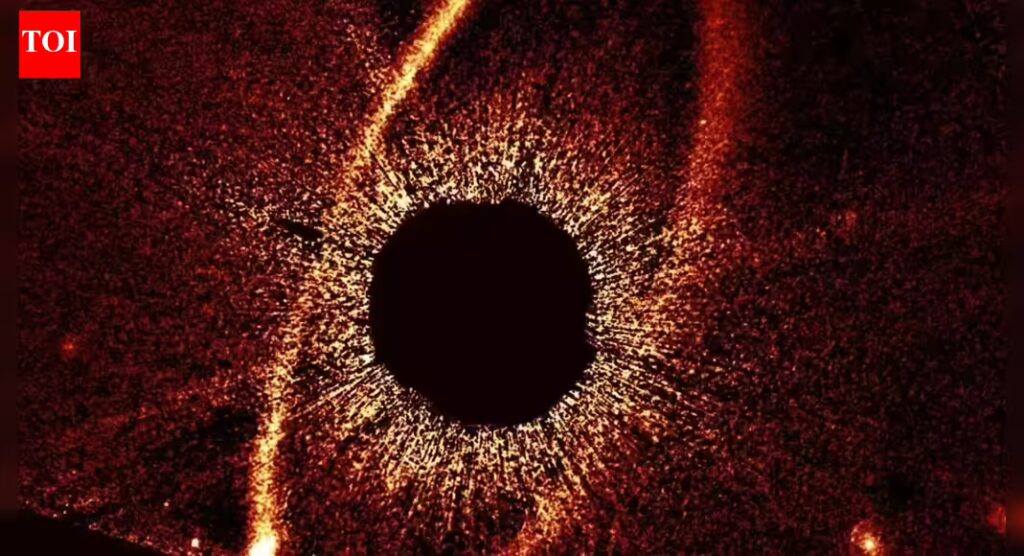
Planetary systems begin in chaos. In their primitive form, many rocky and icy objects are careening through space, smashing into each other, breaking apart, and accumulating to form planets, moons, asteroids, and comets. For many decades, planetary scientists assumed this “history of violence” ended abruptly after a relatively quick passage after planets achieved stable orbits. Recent discoveries using NASA’s Hubble Space Telescope indicate that this chaos probably continued for much longer than scientists ever realised. This dramatic photograph of a nearby star named Fomalhaut exhibits the raw violence of massive objects smashing into each other. This particular planetary system, just 25 light-years from our own Earth-based planet, shows the destructive events of our own planetary system’s youth.
NASA Hubble reveals Fomalhaut’s debris disk and the mystery of a vanishing ‘planet’
Fomalhaut is one of the brightest stars visible in the southern night sky and lies within the constellation Piscis Austrinus. More massive and luminous than the Sun, it has long drawn attention because of its extensive system of dusty debris belts. These belts resemble an oversized version of our Kuiper Belt, a region beyond Neptune filled with icy remnants from planetary formation. Such debris disks indicate ongoing collisions between smaller bodies, but until now, astronomers had never directly observed the immediate aftermath of large-scale impacts within them.Hubble’s composite image reveals a broad ring of dust encircling the star, within which faint but distinct clouds of debris can be seen. These clouds are evidence of recent and violent collisions between massive objects known as planetesimals. In 2008, astronomers using Hubble announced what appeared to be a directly imaged exoplanet orbiting Fomalhaut. Named Fomalhaut b, the object was celebrated as a breakthrough, as it was one of the first planet candidates detected in visible light. However, over subsequent years, something strange happened. The object gradually faded and by 2014 had vanished entirely.
NASA Hubble spots a second violent collision in the Fomalhaut debris disk
In 2023, astronomers analysing fresh Hubble data discovered another unexpected point of light within the debris disk. This new object, named circumstellar source 2 or cs2, appeared suddenly in a region where nothing had been seen before. Its brightness, position, and behaviour closely resembled that of the earlier dust cloud, now referred to as cs1.The appearance of CS2 suggests that a second catastrophic collision occurred within just two decades of the first. This finding stunned researchers, as earlier theoretical models predicted that such large collisions should happen only once every 100,000 years or more within a system like Fomalhaut. Seeing two massive collisions within 20 years fundamentally challenges long-standing ideas about planetary system dynamics. If impacts were truly rare, the chance of observing even one would be extremely small. Observing two suggests that Fomalhaut’s debris disk is far more active than expected.Even more puzzling is the fact that cs1 and cs2 are located close to one another along the inner edge of the debris belt. If collisions occurred randomly, their locations should be widely scattered. Their proximity hints at underlying gravitational influences, possibly from unseen planets, that funnel objects into collision-prone regions.
Hubble reveals planetesimal collisions shaping planetary systems
The growing dust clouds make it possible for astronomers to approximate the size of the bodies that collided. Approximations indicate that the planetesimal asteroids that collided have sizes of about 60 kilometres. This is approximately equal to the sizes of large asteroids that exist within our solar system.Based on these observations, scientists have gauged that potentially hundreds of millions of similar bodies could be circling in the Fomalhaut planetary system. Because of this, the Fomalhaut planetary system has become a natural laboratory for investigating the formation, interaction, and effects of planetesimals on a planetary system. Planetesimal collisions can be more than just destructive occurrences. They have a very important role in planetary development, breaking down material, transporting components, and providing substances like water ice for new planets. Planetesimal collisions in the past can be attributed to making Earth habitable.