Trend 9
A blueprint for the New Green World must put people at the centre, so that growth is inclusive and affordable, and that sustainability and climate mitigation are outcomes: Our globalised world is inter-connected and inter-dependent and we must recognise this. We have learnt through our lived and practiced experience in India that sustainable development is not possible if it is not equitable. Growth has to be affordable and inclusive for it to be sustainable. But all this will not happen, unless we articulate that the environmental challenge is not technocratic but political. We cannot neuter the politics of access, justice and rights and hope to fix the environment or indeed development.
India, like many other countries, has to ensure growth. This means providing millions with employment, healthcare, education and housing, and increasing energy supply. This has to be our development priority. But development will require taking action that meets the needs of all. So this calls for a change in strategy. We cannot afford a capital- and resource- intensive pathway that adds to environmental degradation and inequity in society. We have learnt over the past decades that we cannot adopt the western-country approach to first pollute and then clean up. We just do not have the financial wherewithal to keep repairing the damage. We have to reinvent growth and this is what many policies in India have done: they have built inclusive sustainability as an outcome of their development policy.
This is the unique opportunity for countries like India—not to pit development against climate action but to subsume it within policies designed for growth. But this also means that we need to rework growth strategies so that they are inclusive and affordable and so sustainable.
And if we achieve this, we need to hit a sweet spot—our actions to reduce local pollution and to drive green livelihoods will also reduce greenhouse gas emissions. In this way, our Nationally Determined Contribution (NDC), which puts together the package of actions to reduce emissions, would be based on co-benefits; development, if done right, will also address the urgent crisis of climate change. We know that it is in our interest to achieve this twin goal.
Take the health crisis of air pollution plaguing many of the cities of the Global South. In Delhi, which has the infamous tag of one of the world’s most polluted cities, less than 20 per cent own or drive in cars to work. But these vehicle owners take 90 per cent of the road space. The question is if the demand of just 20 per cent is leading to huge congestion and pollution, where and how can the city find the road and air space for all? This is where the environmentalism of the poor kicks in. The fact is, if the rich are to breathe clean air, we need to rework mobility for all. We cannot think of adding a few buses, trams, or metros; we need to transform mobility so that it works for the rich and the poor. This means combining affordability and convenience and safety.
The agenda is to redesign mobility because personal vehicles, however clean, take up road space and add to pollution and congestion and greenhouse gas emissions. The western world has taken the path to subsidise and electrify personal vehicles, which is leading to disruption in industries as they strive to rework supply chains and re-deploy labour for electric cars. We have the opportunity to think of another route—one that reinvents mobility so that we can move people and not cars. This means investing in electric buses and affordable transport like para-transit and two-wheelers. In this way, India’s NDC must be about up scaling and integrating low-carbon public transport, and not just counting electric cars. The policy is driven by cleaning up local air but has the added benefit of combating climate change.
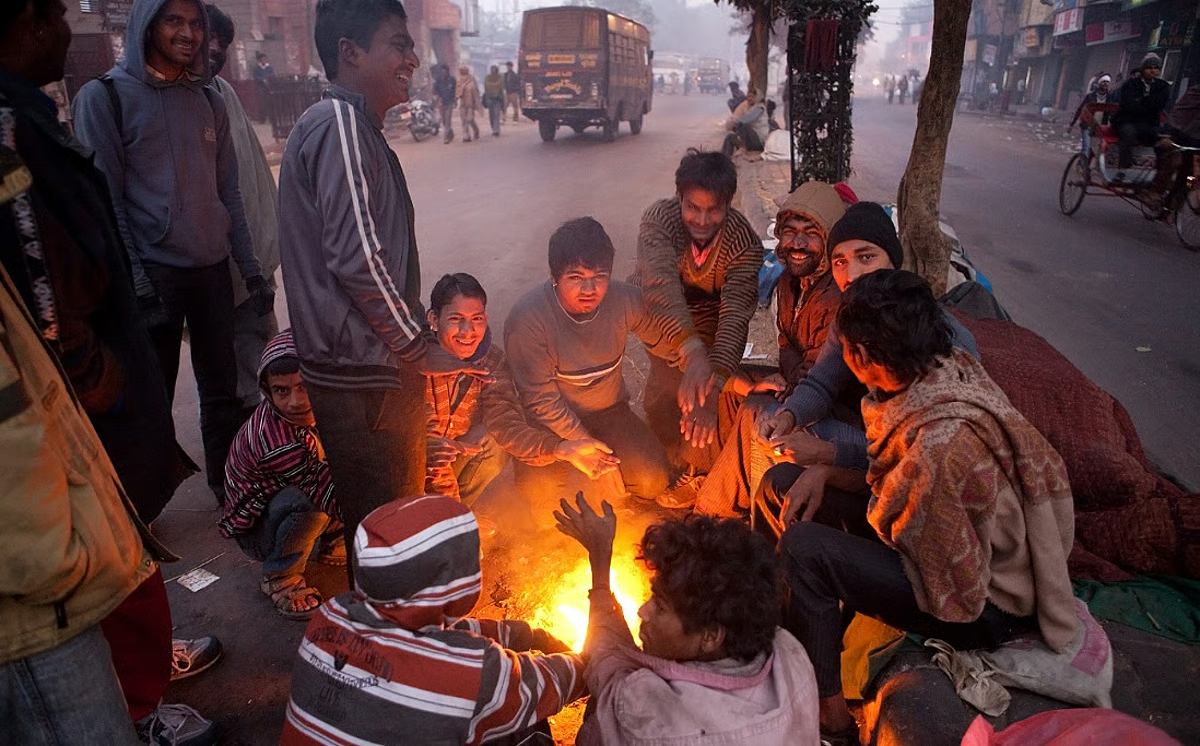
This is also the case with energy. Many households in our world still use biomass to cook food because they are poor. These air pollutants, which are killing poor people, are also contaminating the airshed they share with the rich. So, if we want clean air, we will have to get the rich out of their polluting vehicles, but we will also have to ensure that the poor households get options to move out of dirty fuels. Their energy transition to clean fuel is important for clean air. This is why without inclusive growth, we cannot have sustainability.
It is the same with the hard-to-abate industries. We know from experience that our industry will invest in technology that saves costs and increases competitiveness. The cement industry, for instance, switched to using fly ash, not to decarbonise but to use waste as raw material, substitute limestone, and reduce costs of energy. The future of low-carbon industrialisation lies in similar win-win solutions, such as the reuse of waste materials from iron ore slag to biomass to refuse-derived fuel from municipal garbage—all designed to reduce the use of coal and other fossil fuels and to improve efficiency.
The most contentious is the question of the clean energy transition. A country like India’s imperative is to provide electricity to millions for livelihood security. Even today, large numbers of households in the country are burdened by excruciating energy poverty; electricity supply is either unreliable, unavailable or is expensive. People do not have the luxury of switching on lights and women still cook with dirty biomass. Industry is similarly hit, and this is when the cost of energy determines competitiveness. This is also why Indian industry prefers its own electricity generation systems—captive power—using fuels like coal. So, we need strategies for more energy, clean energy, and affordable energy. If we get this transition right, we can move towards low-carbon growth, which will work for us and reduce the emissions that are leading the world towards catastrophe.