- A new study of tiger scats from Ranthambore Tiger Reserve compared the accuracy of new DNA metabarcoding versus traditional methods, and found that metabarcoding was able to detect a far more diverse range of prey.
- While wild prey such as chital and sambar remain important, it was found that livestock, particularly cattle, now forms a substantial part of the tiger diet.
- The results point to increasing overlap between tigers and human-dominated landscapes and underline the urgency of strengthening livestock protection and conflict mitigation beyond protected area boundaries.
Understanding what large carnivores eat is critical for conservation. For tigers, which are apex predators and require large territories and abundant prey, even small changes in diet can have far-reaching ecological and social consequences.
Most studies so far have relied on scat analysis to understand tiger diets. The method involves washing scats, extracting undigested remains such as hair or bone fragments, and identifying prey species under a microscope. While widely used, this approach has important limitations. It can miss prey species with soft tissues, overlook rare prey, and misidentify species whose hair looks similar. Results can also vary depending on observer experience.
A new study from Ranthambore Tiger Reserve (RTR) in Rajasthan now tests whether DNA metabarcoding, a molecular technique that extracts and identifies prey DNA directly from scat, can overcome these limitations and offer a clearer picture of what tigers are actually eating. “By directly comparing the two methods, we aimed to assess differences in prey detection, diversity, and taxonomic resolution (identifying species accurately). Specifically, we wanted to understand whether metabarcoding could provide a more comprehensive and less-biased picture of tiger diet, especially by detecting rarer or overlooked prey,” says Sarang Mishrikotkar, wildlife biologist, National Centre for Biological Sciences (NCBS), and co-author of the study.
Studying tiger diet in Ranthambore
Between December 2019 and February 2020, the researchers carried out field surveys across RTR, repeatedly sampling along the reserve’s forest road network. Fresh scats were collected during five survey rounds, covering more than 2,000 kilometres.
Because field identification of scats can be unreliable, genetic testing was used to confirm predator identity. Each confirmed tiger scat was then analysed using both methods — traditional mechanical sorting and DNA metabarcoding — allowing the team to directly compare how much dietary information each approach could recover from the same samples.
There were several challenges. Scat is a contamination-prone environmental DNA sample and typically contains degraded prey DNA. To minimise contamination, only fresh scats were collected using sterile gloves, surgical masks and tools.
Preservation was equally critical. “All samples intended for analysis were individually labelled, stored with silica gel in zip-lock bags, and kept frozen at -21°C. Maintaining this cold chain during transport was critical to prevent the DNA from degrading. Samples were transported on dry ice to the laboratory and stored again at -21°C until DNA extraction,” says Mousumi Ghosh-Harihar, Academic Dean, Nature Conservation Foundation, and co-author of the study.
In the lab, each scat was homogenised using liquid nitrogen to ensure DNA could be extracted from all components, including hair and bone fragments. The researchers also used a blocking molecule to prevent tiger DNA from overwhelming the prey DNA during analysis.
DNA finds more diverse prey
The difference between the two methods was striking. DNA metabarcoding detected far more prey species and nearly twice as many prey occurrences as mechanical sorting. On average, each scat contained two to three prey species when analysed genetically, compared to just over one prey species using the traditional method.
The genetic approach also detected rare prey that mechanical sorting completely missed, including rodents, red jungle fowl, and even sloth bear. “Mechanical sorting usually identifies a single prey species per scat, giving the impression that tigers feed on one prey item at a time. Metabarcoding revealed a much more complex picture,” says Mishrikotkar.
No prey species identified through mechanical sorting were missed by DNA metabarcoding, highlighting the greater sensitivity of the genetic method. Most importantly, DNA analysis reshaped the picture of what tigers in Ranthambore are eating.

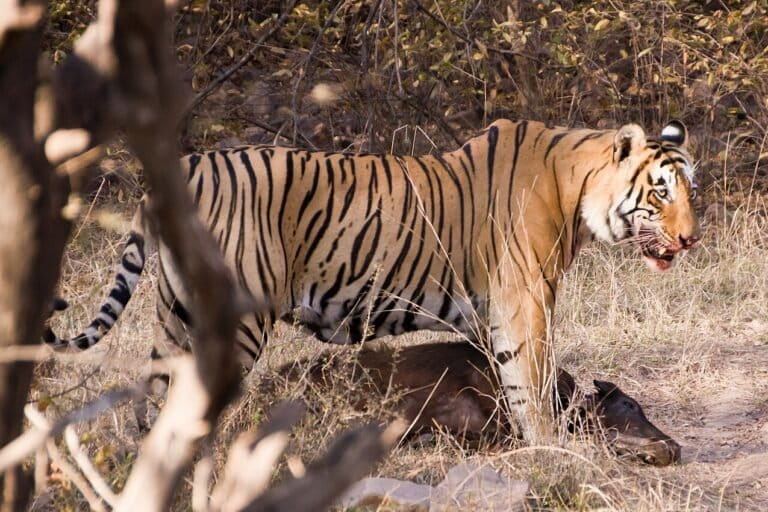
Wild prey still forms a substantial component of the diet. Chital and sambar, both large deer species, remain key food sources, alongside nilgai, wild pig and chinkara. However, domestic livestock emerged as a major component. Cattle were detected in over three-quarters of all tiger scats and contributed the single largest share of dietary biomass. When combined with buffalo, domestic animals made up nearly 40% of the total prey biomass consumed by tigers. “While mechanical sorting suggested sambar as the most frequently consumed prey, DNA analysis identified domestic cattle as the most common dietary component, followed by chital and sambar,” says Ghosh-Harihar.
To reduce the risk of bias, the researchers also used negative controls at every stage of laboratory analysis and checked whether detected prey matched what is known from the local ecosystem. “This was especially important for interpreting detections of domestic species and rarer prey, ensuring that our results reflected ecologically plausible tiger diets,” says Mishrikotkar.
What this means for conservation
The findings do not suggest that tigers have stopped hunting wild prey. Instead, they point to a growing reliance on livestock alongside natural prey, a pattern with serious implications for human-tiger conflict.
Ranthambore is a relatively small, largely linear reserve surrounded by villages and agricultural land. Tigers frequently move beyond park boundaries, while free-grazing cattle are also commonly found inside the forest. The study found that scats containing livestock were distributed across the reserve rather than being confined to its edges. The authors caution, however, that scat locations do not necessarily reflect kill sites; given the park’s linear configuration, many tigers likely range into peripheral areas where livestock depredation occurs.
Livestock depredation is already the most common form of human-tiger conflict in the Ranthambore landscape. Increased dependence on cattle could further escalate conflict, retaliation, and pressure on an already isolated tiger population.
The need for conflict mitigation beyond protected areas
Though the findings showed that DNA metabarcoding improves prey detection, some uncertainties remain. While the method reliably shows whether a prey species is present, it cannot accurately estimate how much of each prey was consumed.
Key behavioural questions also remain unresolved. Because tiger DNA was deliberately suppressed, rare events such as cannibalism or scavenging are unlikely to be detected. And while livestock consumption is clearly high, its drivers are uncertain. “It remains unclear whether the observed livestock consumption reflects a short-term, opportunistic response or a more persistent shift in prey use,” says Ghosh-Harihar.
The findings highlight the need to update how tiger diets are studied, particularly in human-dominated landscapes. For Ranthambore and similar reserves, the study underscores the urgency of strengthening conflict mitigation beyond protected-area boundaries. This includes timely and adequate compensation for livestock losses, improved livestock-guarding practices, and the potential use of insurance schemes to offset risk. Equally important is adopting participatory approaches that actively involve local communities.
“The ability to analyse an ecologically relevant trait like diet reiterates that DNA-based approaches are powerful tools for studying endangered species. Nimble, strategic application of such approaches is critical as overlap between humans, livestock and wildlife continues to increase,” says Uma Ramakrishnan, a professor at NCBS and co-researcher.
Read more: Tracking tigers as they move from comfort zones to independence
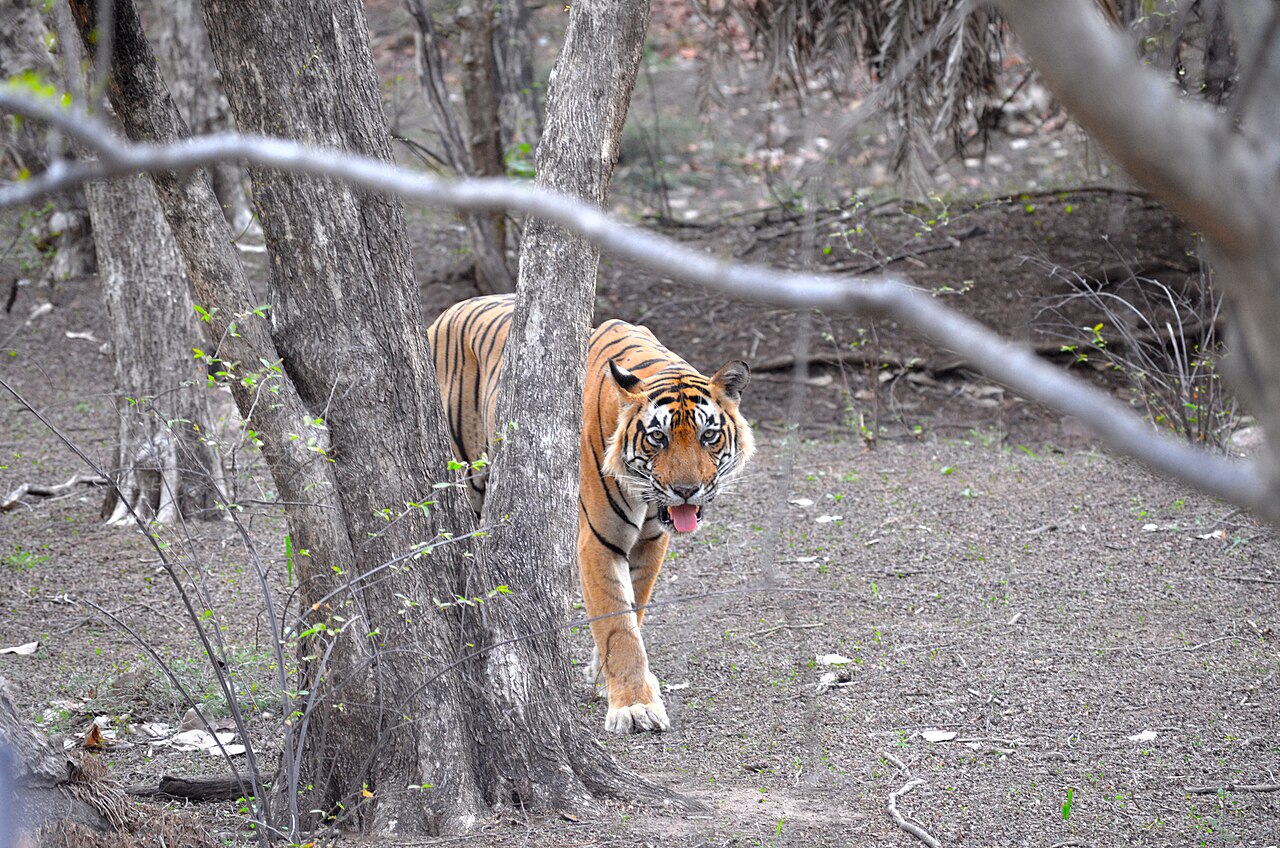
Banner image: A tiger in Ranthambore. Image by Anupal31 via Wikimedia Commons (CC BY-SA 4.0).