
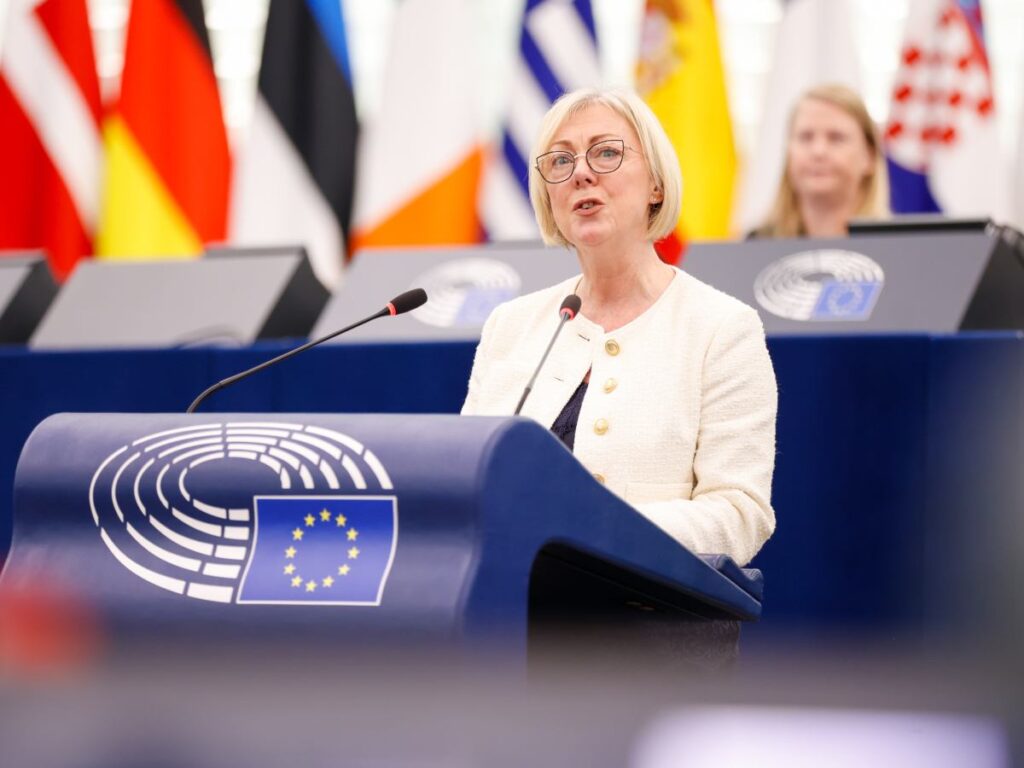
One fund with one set of rules will make it easier for the bloc’s businesses to access investments, explains MEP Regina Doherty.
The European Union has struggled to keep its home-grown businesses home. A new, nearly €450bn European Competitive Fund (ECF) is attempting to fix some of its underlying causes.
The 2024 Draghi report on EU competitiveness stated quite plainly that the bloc is “lacking focus”. It found that excessive red tape and a fragmented Single Market have cascading negative effects that push high-growth companies overseas – a move that has inadvertently made the EU more reliable on foreign innovation than it would like.
MEP Regina Doherty says that regulatory fragmentation is a result of “national interests” that have, at times, trumped geopolitical ambitions that the EU has as a bloc. “We have companies in the EU who are innovative…[but] they don’t want to have to access finances in a fragmented market of the EU,” she tells SiliconRepublic.com
To ease this seemingly self-inflicted pain, the European Commission, last year, launched the ‘competitiveness compass’, a guide to improving the innovation, competitiveness, security and resilience issues facing the EU by laying down measures to reduce red tape, coordinate policies and better mobilise funds.
One fund, one set of rules
Take investment funding streams – the EU has several. This includes the massive €93bn Horizon Europe (HE) scheme, the Innovation Fund, worth €40bn, the Digital Europe Programme, Connecting Europe Facility, the European Space Programmes, InvestEU, and so on. All these separate funding streams have their own set of rules, making it particularly hard for businesses to tap investments.
This, while administrative burdens already cost businesses and governments in the bloc up to €150bn every year and newer rules could add €124bn on top, according to a Danish government study.
Last week, Germany and Italy even published a policy paper calling for an “ambitious ease of regulatory burden.”
The paper cited data from the International Monetary Fund, which reports that overall trade costs within Europe amount to 44pc in internal tariffs for the average manufacturing sector when compared with the 15pc between US states, while services trade amounts to as much as 110pc.
The result is a slow-down in growth in EU businesses, especially in key sectors such as renewables and AI, with Europe only housing four of the top 50 largest tech companies. Not to mention, the gap between the size of the EU’s economy and the US economy stands at 30pc, doubling from 15pc in 2002.
The ECF hails itself as a part of the solution to this problem. It is essentially a one-stop-shop for businesses to access investments by consolidating the more than a dozen different funding streams into one massive pot of cash.
Doherty, a Fine Gael MEP, is the lead negotiator on the internal market committee report for this upcoming Fund, set to run during the EU’s next six-year budget cycle. Her appointment places Ireland at the centre of negotiations on how the Fund will operate and what it will prioritise.
The ECF is expected to come with just one set of regulations, making accessing investments in the EU easier. The Fund will partner with private investment organisations within the EU to mobilise additional funds, Doherty explains. She says that it will create a level playing field for all EU industries, creating a space for start-ups and scale-ups to find a secure and reliable home within the bloc.
The ECF is expected to work in conjunction with other aspects of the competitiveness compass, including a multibillion-euro scale-up fund which makes up part of the start-up and scale-up strategy, and a Savings and Investments Union strategy.
The MEP hopes that the Fund acts as a vehicle to “re-attract” companies that the EU has lost, while ensuring that the ones that are in the bloc, choose to stay. The process is in the early stages –a final blueprint for the ECF is expected in nine months’ time.
Is this enough?
The ECF is one of the biggest consolidated funds in EU’s history – it’s a “hell of a lot more money” than what the bloc has been spending on businesses in the past, Doherty says. “It’s a real recognition that we haven’t done enough, particularly for our small to medium-sized enterprises to allow them to scale up.”
In 2024, the EU spent an estimated €403.1bn in R&D, indicating a 3.6pc increase from 2023. Meanwhile, the US spent a little more than $190bn (€160.2bn), and China reportedly spent around €463bn.
Yet, money alone won’t solve the problem, explains Forrester senior analyst Dario Maisto. “Despite any money the EU may be throwing at the problem, by the time the old continent will get to where the others are now, these others will be already another 20 years ahead,” he says.
“European competitiveness will be bolstered with rules that stop regulating technologies that we in Europe do not even have and start promoting the development of truly European technologies as an alternative.”
And that is what the EU is seemingly attempting, not just with this ambitious fund, but also with the likes of the long anticipated EU Inc, a “truly European company structure” with a single and “simple” set of rules for all businesses in the Union. With this, a business can be registered in any member state within 48 hours.
“All in all, more funding is always welcome, but this funding should support operational decisions of European enterprises rather than big forward-looking projects for which we do not really have the time anymore,” Maisto says.
“My question is: whom and what will the EU fund? It’s not a money problem. It is about having a vision and being cognizant of the current situation.”
Don’t miss out on the knowledge you need to succeed. Sign up for the Daily Brief, Silicon Republic’s digest of need-to-know sci-tech news.