
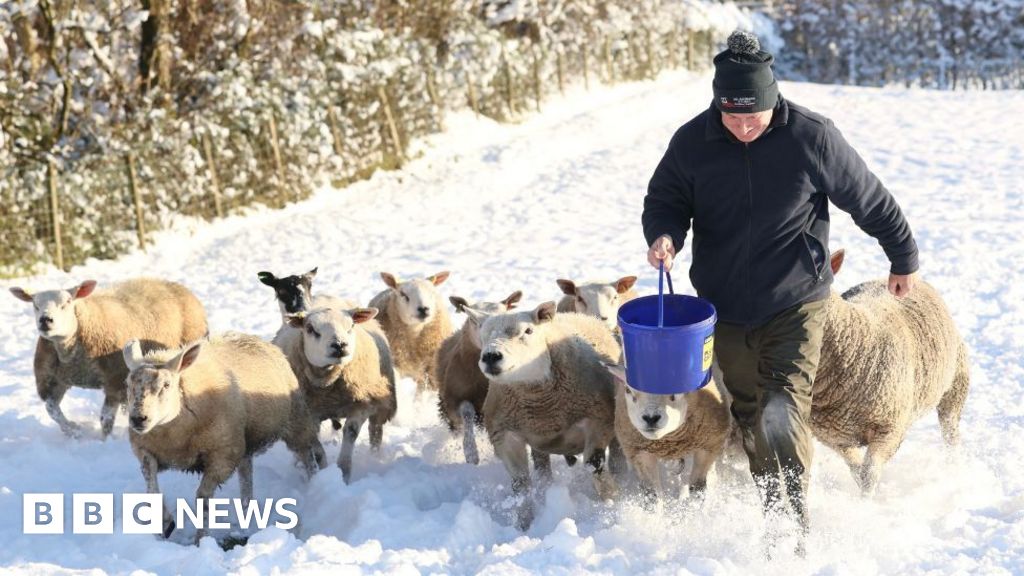
Holly Fleck and Barra BestBBC News NI

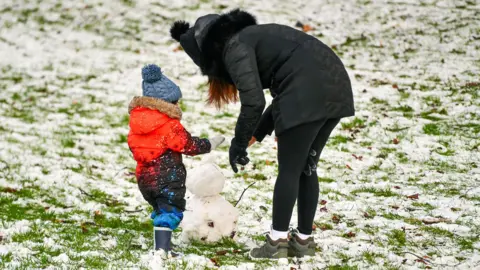
A new weather warning for ice has been issued for Northern Ireland from Monday evening until Tuesday morning.
An earlier yellow snow and ice warning caused disruption to schools and transport across Northern Ireland on Monday morning.
The new warning comes into effect at 17:00 on Monday until 10:00 on Tuesday, with the Met Office warning of sub-zero temperatures and ice forming in untreated areas, especially where showers have fallen on Monday.
More than 200 schools were closed on Monday and a small number of schools have already confirmed that they will be shut on Tuesday – a full list can be viewed here.



‘Too many risks involved’
In Killylane, County Antrim, earlier temperatures as low as -6.6C were recorded.
The principal of St Patrick and St Brigid’s College in Claudy, Phillip McCullagh, made the decision to close the school on Sunday afternoon.
He said about 500 pupils will be affected by the closure, as well as staff members.
After a risk assessment and consulting with nearby schools, Mr McCullagh deemed that there were “too many risks involved” to keep the school open.
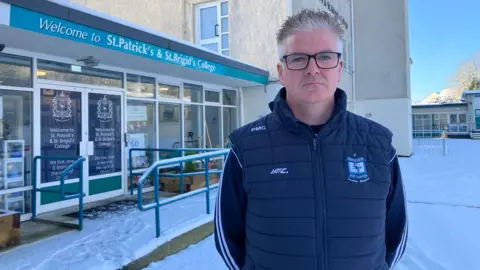
“It will take a long time for us to clear our site but also the footpaths as well.
“It’s as bad as I’ve seen it,” he told BBC Radio Ulster’s Good Morning Ulster programme.
Mr McCullagh also noted that learning is impacted as there are many pupils who want to come back and start the new school term.
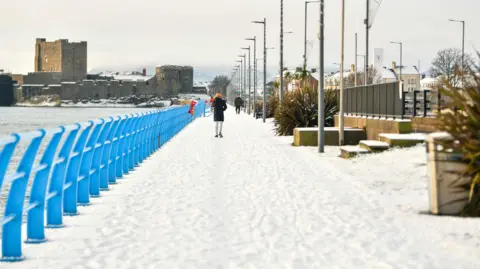
The Met Office said snow showers are expected into Monday with some fresh accumulations mainly over northern high ground, but showers will become isolated later with sunny spells before frost and ice return on Monday evening.
The Police Service of Northern Ireland (PSNI) has urged motorists to take extra care on the roads, especially in areas which may not have been gritted due to wintry conditions.
“Clear your windscreen of ice and snow before you set off on your journey, and remember to slow down and increase the distance between you and the vehicle ahead,” police said.
Roads salted ’round the clock’
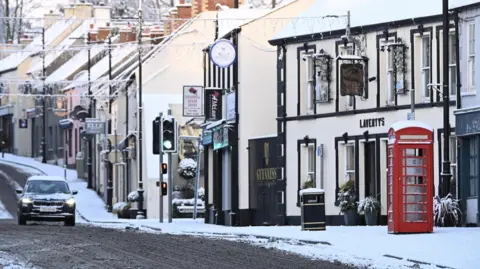
Simon Wells from the Northern Ireland Road Service said there has been “virtually round-the-clock salting of roads”.
He said the roads that are salted are passable with care and advised motorists to leave more time for journeys.
He said that, on roads that have been treated, people “need to drive over the grit for it to properly activate”.
“Some of the dual carriageways, you’ll find lane two still has some snow on it because it hasn’t really been trafficked – it has been salted, but it hasn’t been particularly trafficked, people have been sticking to the inside lane,” Mr Wells said.
Speaking to BBC Radio Ulster, he said the road service salts any road that carries more than 1,500 vehicles per day.
“That amounts to roughly 28% of our network which is over 4,000 miles or roughly 7,000 kms and that carries 80% of all traffic.”

Wells said it costs more than £100,000 each time they do a grit.
“We expect to be out again perhaps throughout the night and into the early hours of the morning,” he said on Monday afternoon.
He explained that there will be more than 100 lorries dispatched.
“They could be out several times throughout the night the night.
The staff who grit the roads go “above and beyond”, he added.
“It does take their toll on them, many were even doing it Christmas Day, Christmas Eve, Boxing Day. They are sacrificing to go out and do it.”
He said each lorry will drive 100 kilometres each, adding that they will grit for 70 kilometres of the journey.
“That’ll take them around three hours each time they go out.”
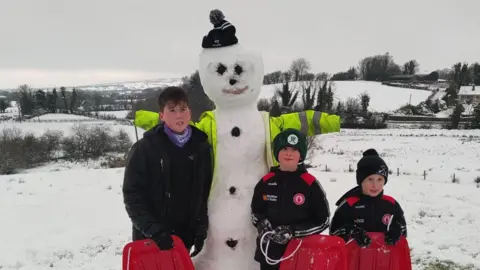
Principal of Lislagan Primary School in Ballymoney, Louise Creelman, also made the decision to close the school on Sunday.
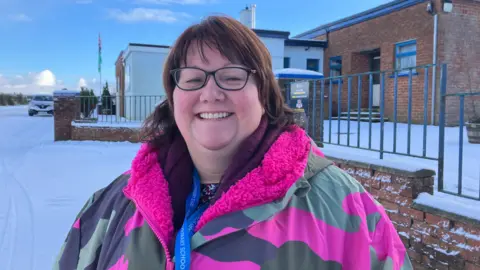
Ms Creelman said she is aware of the disruption that school closures can cause, but said the “sheer volume” of cars arriving at the school is usually “chaotic” on a normal day, never mind when there is snow and ice.
She said once the weather warning ends she will assess the conditions, and make a decision on whether it will open on Tuesday.
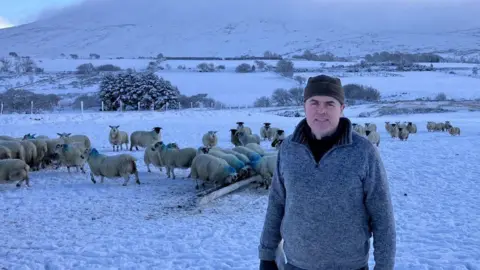
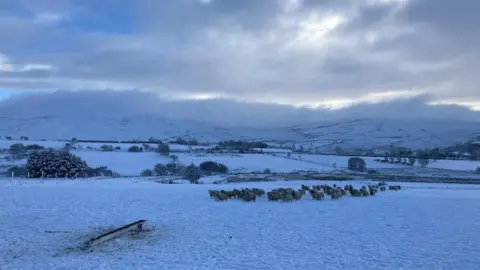
Thomas Conway, who is a farmer in Park, County Londonderry, said many roads near him are “impassable”.
He said that meant that many people in his area were unable to get to work this morning.
“The main routes are salted and they’re passable with care, but all the by-roads… we used to have local farmers employed to put snow ploughs on them, which helped immensely, but that seems to have all stopped now,” he told BBC Radio Foyle’s North West Today programme.
“We’ll get through it and we’ll hunker through it and it’ll be fine.”
Cancellations and disruption
Flights
- At Belfast International Airport, inbound and outbound flights were cancelled on Monday morning due to the weather. Flights to and from this airport are now operating as expected
- At Belfast City Airport flights to and from locations such as Glasgow, Birmingham, Liverpool, Amsterdam and Inverness have faced cancellations on Monday. Passengers are advised to check with the airline or the airport website for live updates
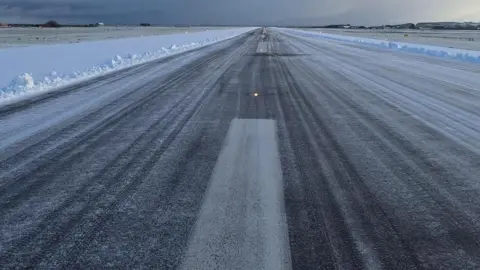
- The runway at City of Derry Airport has reopened following a closure for snow and ice clearance on Monday morning. Passengers on flights to and from London Heathrow have been advised to contact the airline
Public transport
A number of Translink bus services have been impacted by the icy conditions:
- In Magherafelt, Ulsterbus 389a and the 389d town services will not operate until further notice
- In Lisburn, the 26 service to and from Dromara will not service Rafferty’s Hill until further notice
- The 212 from Belfast at 12:20 GMT did not go ahead, and the 13:00 GMT 212 from Belfast and the 12.45 GMT 212 from Castledawson Park and Ride will also not be in operation
- The 16:25 325a from Lisburn will not operate
- Services in the Magherafelt, Lisburn, Armagh, Londonderry and Cookstown areas are operating on treated main roads only
- Several routes in the Ballymena area are also not running as normal
- The Newry town service is facing disruption
A number of trains are also facing disruption:
- Due to a fault, services are suspended between Ballymena and Ballymoney. Disruption is expected until further notice. Tickets will be accepted on scheduled bus services
- The 16:35 train from Belfast Grand Central Station to Coleraine is cancelled
- 16:10 Belfast Grand Central Station to Londonderry due 18:22 will be started from Lanyon Place, terminated at Ballymena and restarted from Ballymoney
Council areas
Derry City and Strabane Council
- Household bin collections have been suspended
- Cemeteries are closed but burials will continue to be prioritised
- Some recycling centres will have a delayed opening
- Some community centres will be closed
Belfast City Council
- Belfast Zoo will remain closed on Monday
Mid and East Antrim Borough Council
- Ballymena, Carrickfergus and Larne bin collections will not take place
Schools
A full list of school closures can be viewed here.
The Education Authority said its transport service planned to operate as normal on Monday but said there may be some disruption or delays.
Republic of Ireland warnings
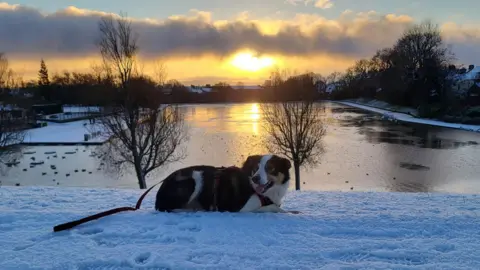
In the Republic of Ireland, new warnings for snow, ice, and low temperatures were issued on Monday.
A yellow alert for snow and ice for Donegal, Leitrim, Sligo, and Mayo lasts from 11:00 on Monday until 09:00 on Tuesday.
A second warning for low temperatures has been issued across the rest of the country for the same time period.
Irish weather service, Met Éireann, has warned of further hazardous travel conditions as well as black ice.
Where in Northern Ireland gets the most snow?
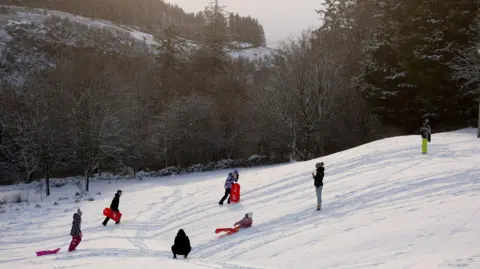
Northern Ireland’s snowiest areas are its mountains – Sperrins, Antrim Plateau, and Mournes – while coastal areas get very little snow in most years.
Snowfall increases with altitude so higher and more northerly areas tend to get more snow during the winter months.
The mountains can have over 35 days a year with sleet or snow falling, and over 30 days with snow lying.
Coastal and low-lying areas – especially near sea level – get little snow, usually fewer than 5 days a year with lying snow.
While snowfall varies hugely year to year, exceptional winters like 1962/63 and 1981/82 brought deep, long lasting snow event to coastal areas.
What is the coldest it’s ever been in Northern Ireland?
The lowest temperature ever recorded in NI was -18.7C at Castlederg in Tyrone during the big freeze of December 2010.
The lowest temperature ever recorded on the island of Ireland was -19.1C at Markree in Sligo in January 1881.