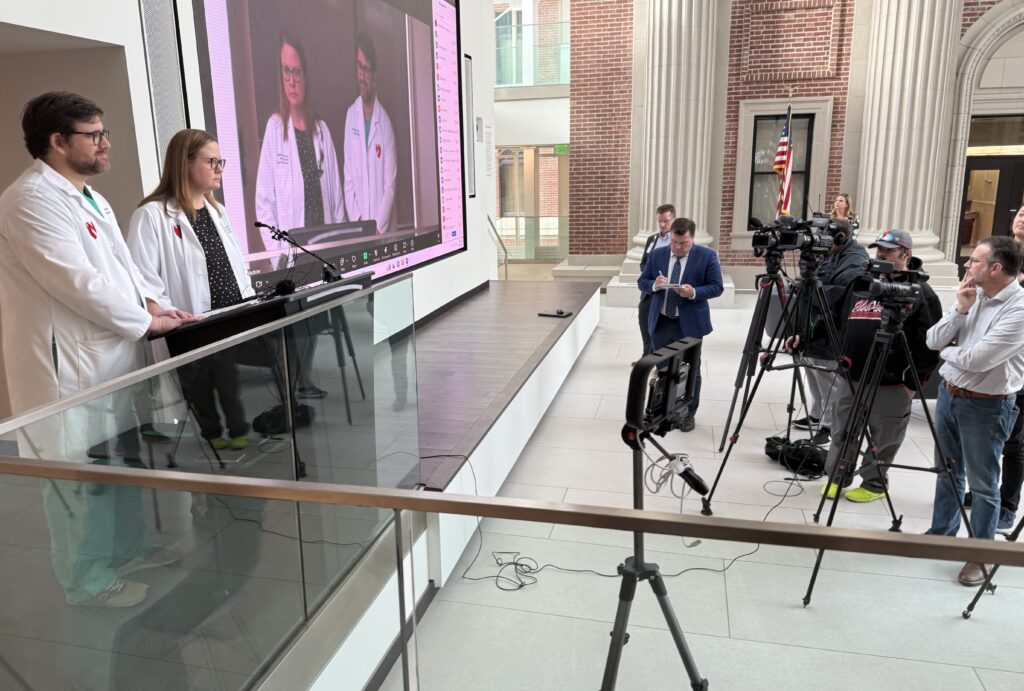
Reporters speak to Nebraska Gov. Jim Pillen’s Nebraska Medicine doctors in December 2024 in Omaha. (Aaron Sanderford/Nebraska Examiner)
OMAHA — The Nebraska Medicine board announced Sunday that it had launched an “informational website” aimed at shaping public opinion against letting one of the nonprofit’s owners sell its 50% leadership stake to the other, the University of Nebraska.
The ramping up of the now-public dispute over the group’s future governance comes as the NU Board of Regents prepares for a hearing and possible vote Friday about whether to pay Clarkson Regional Health $500 million for full control.
The regents also will consider a related $300 million transaction for several Clarkson properties in and around the University of Nebraska Medical Center’s midtown Omaha campus, bringing the total price of the buyout to $800 million.
Board argues risks
Nebraska Medicine’s board, steered by people who have led some of the state’s major businesses, appears focused on peeling regents’ support from the proposal. The new website making the group’s argument is www.protectnebraskahealthcare.org.
The site argues, among other things, that compensation for specialists, doctors, nurses and staff could be compromised by state involvement. It seeks more time to find a new private partner for NU to take Clarkson’s place.
Lance Fritz, the former Union Pacific CEO who chairs the Nebraska Medicine Board of Directors, warned in a statement Sunday that ceding control over Nebraska Medicine to the government might put patients and health care providers at risk.
“It’s important that Nebraskans have access to clear and accurate information on this issue,” Fritz said. “We hope this website helps people understand what is being considered and why it is a serious concern.”
NU leaders argue opportunity
NU leaders have argued that patients will see no difference in the quality of care provided or the costs of that care. They argue NU is simply adapting to an ownership structure that reflects most modern academic medical centers.
University leaders, including NU President Dr. Jeffrey Gold, have said they do not yet know how much of the $800 million would come from private donors versus public funds. Gold also acknowledged the difficult timing.
The broader NU system also faces the likelihood of additional budget cutting with the State of Nebraska confronting a projected budget shortfall and Gov. Jim Pillen’s push to cut at least $500 million in state spending.
Pillen, a former NU regent whose family runs a hog operation based in Columbus, supports the NU purchase and potential shift in ownership structure. He has said it will protect a vital asset for Nebraskans and their needs.
If the purchase happens, NU would be the sole owner of Nebraska Medicine, which offers hospitals and medical care primarily in eastern Nebraska. Nebraska Medicine’s board has described the push as akin to government healthcare.
Leadership structure questions emerge
Today, NU and Clarkson split leadership on the Nebraska Medicine board. NU says the independent board would still lead UNMC’s medical partner, but it was not immediately clear who would appoint the directors after Clarkson departs.
Following the sale, Clarkson, which helped the university build the core hospital building at 42nd and Dewey Streets, has pledged a $200 million gift to help replace it. Gold said none of the project’s public funding would pull from the budgets of other NU campuses. The campuses together finalized cuts last fall totaling $43 million.
Clarkson has said it plans to use the purchase-related funds from NU to grow a local private foundation focused on providing grants aimed at making Nebraska the healthiest state in the U.S. and improving how health care is delivered and carried out.
NU leadership is facing questions of its own internally, Gold wrote in an email to UNMC faculty, staff and students on Sunday afternoon. Gold announced a campus forum set for noon Tuesday at UNMC’s Truhlsen Events Center.
Gold shared a frequently asked questions document that seeks to emphasize the university does not intend to change how Nebraska Medicine is managed. The document argues Nebraska Medicine was already run by its owners. It says Nebraska Medicine employees will not become state employees.
“When [Clarkson] began to consider resigning its position in Nebraska Medicine, it approached the Board of Regents to see if the University of Nebraska would be interested in sole-member governance,” Gold wrote. “This is a tremendous opportunity for the University of Nebraska Medical Center.”
SUBSCRIBE: GET THE MORNING HEADLINES DELIVERED TO YOUR INBOX