
- The mental health effects of a disaster often last well beyond the event itself, intensifying during rehabilitation with unresolved grief and fear of recurrence, affecting daily functioning.
- A new study that analysed the mental health aftershocks following the 2024 landslide in Wayanad, finds that delays, displacement and uneven aid deepen psychological distress, fuelling helplessness and eco-anxiety.
- The study recommends embedding psychosocial support across all phases of disaster response, with sustained mental health and psychosocial support systems, rather than short-term counselling alone.
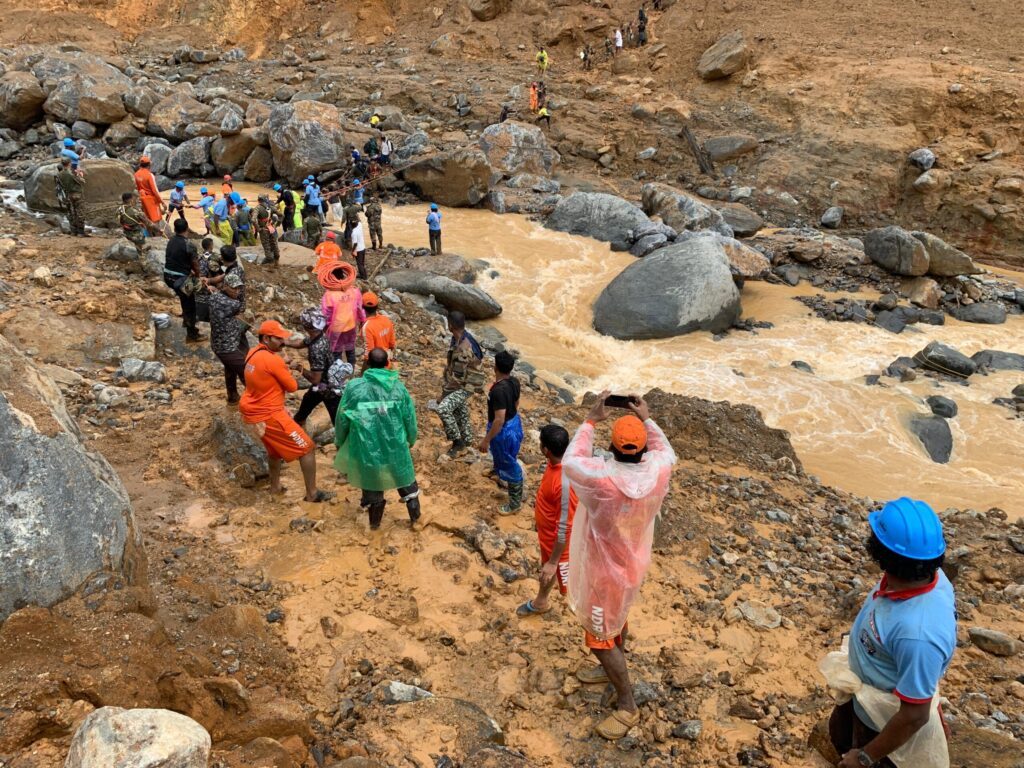
What does it mean to be caught in the middle of a disaster? A study finds that the long-term mental health impact of surviving disasters, especially ‘natural hazards’ can be deep—one that demands far more attention than it receives now. Based on fieldwork during the rescue and rehabilitation in the aftermath of a high-intensity landslide in Wayanad, Kerala, in 2024, the study takes a close look at both the short-term and long-term psychosocial impacts across demographics. The landslide was so devastating that it killed over 300 people, injured an equal number, and displaced thousands.
The newly published study notes that while the immediate effects included chaos, panic and disorientation from the sudden night-time event, the long-term impacts are far more grave, with the fear of another landslide keeping communities hypervigilant and even minor events re-triggering trauma.
“One key takeaway from the study is that mental-health impacts do not end when the emergency phase ends. They continue and often intensify during rehabilitation,” says lead author Dr. C. Jayakumar, an additional professor at the Department of Psychosocial Support in Disaster Management, NIMHANS, and former Senior Consultant at the National Disaster Management Authority (NDMA), Government of India.
Mental health impacts
The impact of disasters unfolds in phases, explains Jayakumar. In the rehabilitation phase, where the landslide survivors are now, mental health impacts often become less visible to outsiders because they manifest in subtle ways. “For instance, people may begin to experience declining physical health, loss of motivation, difficulty concentrating, or reduced ability to work or connect with others. Many stop feeling interested in their daily activities. These are not always recognised as mental health problems, but they are deeply connected to trauma and prolonged stress,” he points out. Unresolved grief is also acknowledged as an unmet need that is often invisible.
Most interventions focus on people with obvious symptoms, while large sections of the affected community silently struggle with emotional distress. This prevents collective healing and leaves many without ways to process trauma.
Since rehabilitating a large population is an intense yet slow and frustrating process that requires rebuilding thousands of homes—with land issues, legal approvals, funding delays and other practical hurdles slowing the process—the uncertainty about the future can be overwhelming for survivors. “People worry about what will happen to them tomorrow. That sense of helplessness and hopelessness weighs heavily on their thoughts, emotions and ability to function,” he adds.
The study has also looked at effects on diverse populations. Children face disrupted routines, memory loss and isolation; older adults experience numbness, guilt and care insecurity; and migrants and tourists encounter discrimination or difficulties readjusting. Persons with disabilities are often overlooked, while first responders suffer secondary trauma in the absence of debriefing. Even the loss of a pet can have a traumatic effect on survivors, says Praveen Suresh, Manager, Disaster Risk Reduction and Response, who was actively involved in animal rescue during the landslide. He recalls that some children reported sorrow and sleeplessness after losing their favourite pets in the disaster. “We searched for a pet dog for days, after which the owner chose to adopt a cat we rescued. She named it Rio, since she believed the cat was a gift of the river,” he shares.
Relief and rehabilitation
Uncertainty in rehabilitation, relocation and livelihoods fosters instability, perceived injustice from uneven aid, and “psychoterratic” responses such as eco-anxiety, ecological grief and climate trauma from forced displacement. The paper points out the possibility of negative coping mechanisms such as substance use and self-harm rising in the absence of support, alongside struggles to adapt to new, unskilled jobs, deepening vulnerabilities. It also notes the vulnerabilities in the Western Ghats due to ecological degradation, dense populations and climate-amplified rainfall.
The authors recommend that Mental Health and Psychosocial Support (MHPSS) must be embedded in all relief and rehabilitation programmes, and not treated as a short-term add-on. “Psychosocial support is usually offered only in the early days after a disaster. Counselling teams come, there is a lot of attention initially—but the support is rarely sustained. Money and material compensation alone are not enough. People’s thoughts, emotions, fears, grief and frustration also need long-term support,” Jayakumar says.
Psychosocial care must be integrated into every phase of disaster response—rescue, relief and rehabilitation. Services should be inclusive, culturally-grounded and needs-based, with strong systems for monitoring, referrals, documentation and follow-up, according to the study.
Other recommendations include a centralised system to coordinate psychosocial responses, avoid duplication and ensure uniform quality; MHPSS training for all frontline departments, especially in disaster-prone areas; using community media, folklore and traditional communication to promote psychosocial awareness, preparedness and healthy coping; and equipping youth groups, self-help groups and community forums to rebuild social bonds and resilience, among others.
Read more: Cyclone Ockhi survivors battle lingering mental health impacts
Banner image: Rescue workers at the landslide site in Wayanad in 2024. Image by Ahamedhjewadh via Wikimedia Commons (CC0 1.0).

