The Indus Valley or Harappan Civilisation of the Indian subcontinent could be over 8,000 years old, something which would make it more ancient than peers like Mesopotamia (modern-day Iraq), Egypt or China, a new paper has claimed.
The authors of the paper reached the conclusion after performing radiocarbon dating at Bhirrana in Haryana.
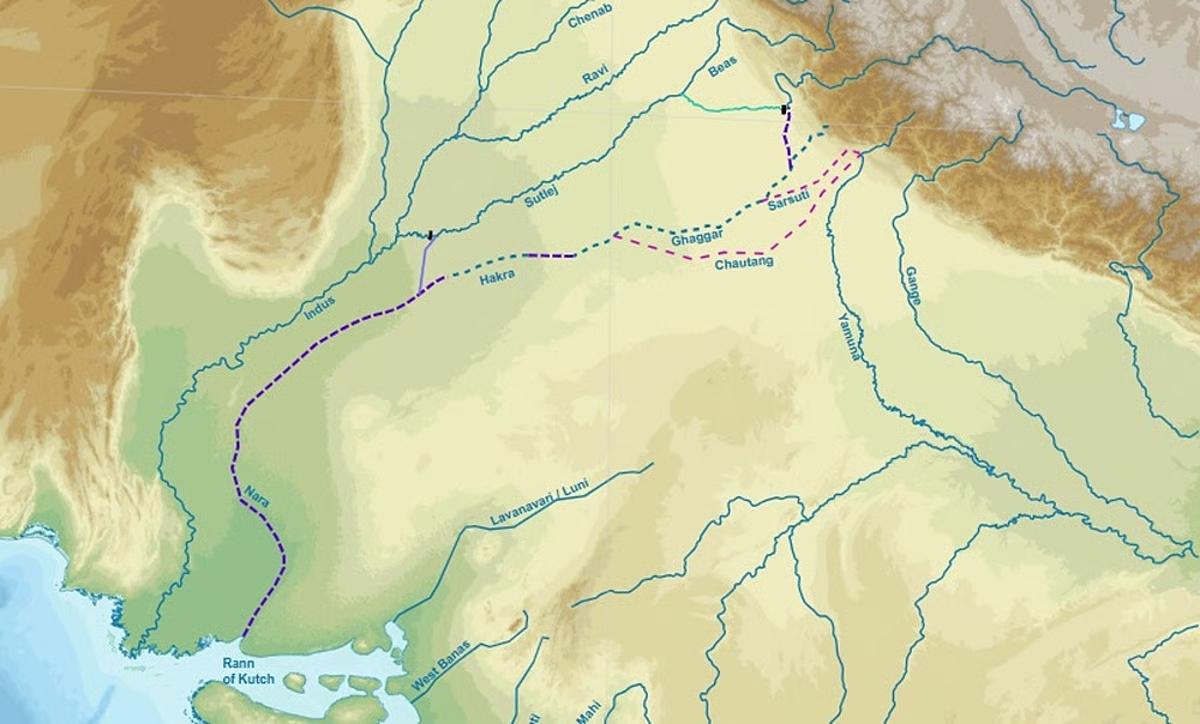
Bhirrana was part of a high concentration of settlements along the dried-up bed of the river known as ‘Saraswati’ in the Vedas. It is identified with the Ghaggar-Hakra river system today.
“Isotope and archaeological data suggest that the pre-Harappans started inhabiting this area along the mighty Ghaggar-Hakra rivers fed by intensified monsoon from 9 to 7 ka BP. The monsoon monotonically declined after 7 ka yet the settlements continued to survive from early to mature Harappan time. Our study suggests that other cause like change in subsistence strategy by shifting crop patterns rather than climate change was responsible for Harappan collapse,” the authors note.
An enigmatic civilisation
The Harappans have remained an enigma till the present day and are often the bone of contention and controversy, especially among those professing rival political views.
A post-Neolithic Bronze Age civilization, the Harappans are conventionally dated 5.7-3.3 thousand years ago before the present. This places them in the period of 2500 to 1900 Before Common Era (BCE).
The civilisation spread along the Indus Valley of Pakistan through the plains of northwest India, including into the state of Gujarat and up to the Arabian Sea.
Its decline is still the subject of speculation and extensive archaeological investigation. Hypotheses including invasion by Eurasian steppe nomads, catastrophic floods or droughts, change in monsoon and river dynamics, sea-levels, trade decline, increased societal violence and spread of infectious diseases have been proposed. But a conclusion is yet to be reached.
Experts have divided the civilisation into four ‘phases’. These include:
1) An Early Ravi Phase (~5.7-4.8 thousand years before present)
2) Transitional Kot Diji phase (~4.8-4.6 thousand years before present)
3) Mature phase (~4.6-3.9 ka thousand years before present)
4) Late declining (painted Grey Ware) phase (3.9-3.3 thousand years before present).
“While the first two phases were represented by pastoral and early village farming communities, the mature Harappan settlements were highly urbanized with several organized cities, developed material and craft culture having trans-Asiatic trading to regions as distant as Arabia and Mesopotamia. The late Harappan phase witnessed large scale deurbanization, population decrease, abandonment of many established settlements, lack of basic amenities, interpersonal violence and disappearance of Harappan script,” notes the paper.
Ghaggar-Hakra valley
The authors— Anindya Sarkar, Arati Deshpande Mukherjee, M K Bera, B Das, Navin Juyal, P Morthekai, R D Deshpande, V S Shinde & L S Rao—studied Bhirrana in Haryana for the present study.
The site is located along the dried-up bed of the Saraswati. In the Rigveda, the river is mentioned as being part of the ‘Sapta Sindhu’ (seven rivers) region in the northwest of the Indian subcontinent — Sindhu (Indus), Sarswati, Jhelum (Vitasta), Chenab (Asikni), Ravi (Parushni), Beas (Vipasa) and Sutlej or Satluj (Sutudri or Satadru).
The Saraswati later dried up. Today, it is identified with the Ghaggar-Hakra paleochannel.
“The Ghaggar (in India)-Hakra (in Pakistan) river, referred to as mythical Vedic river ‘Saraswati’ originates in the Siwalik hills, ephemeral in the upper part with dry river bed running downstream through the Thar desert to Rann of Kachchh in Gujarat. More than 500 sites of Harappan settlements have been discovered in this belt during the last hundred years. Of these several sites both in India viz. Kalibangan, Kunal, Bhirrana, Farmana, Girawad and Pakistan viz. Jalilpur, Mehrgarh in Baluchistan, Rehman Dheri in Gomal plains have revealed early Hakra levels of occupation preceding the main Harappan period,” the paper notes.
Carbon dating of charcoal and pottery revealed something totally unexpected. The Indus Valley Civilisation was found to be older than any other ‘cradle of civilisation’ including Mesopotamia, Egypt and China.
“Clearly the Bhirrana levels are few thousand years older. The 5.9 ka age at 143 cm along with the 8.38 ka age of the Hakra level below suggest that the base of the Bhirrana section, representing initiation of Harappan settlements (Hakra phase), is older than 8 ka BP (8597 to 8171 years before present),” as per the paper.
What happened at Bhirrana?
The authors have drawn a picture of how things transpired at Bhirrana, the Ghaggar-Hakra Valley and the Harappan civilisation itself.
Around 9,000 years ago, the area where the Ghaggar-Hakra is today, was not semi-arid. Rather, it was a lush, wet monsoonal environment.
Along the Ghaggar-Hakra, early Harappan settlements flourished. There was so much water that the Ghaggar-Hakra abounded with fauna.
“That the river Ghaggar had sufficient water during the Hakra period is also attested by the faunal analysis. Frequency of occurrence of aquatic fauna like freshwater fish bones, turtle shells and domestic buffalo in these early levels of trench YF-2 is higher (compared to early or mature Harappan periods; SI) indicating a relatively wetter environment,” according to the paper.
“The climate data and chronology of Bhirrana suggest that not only the Harappan civilization originated during the 8-9th millennium BP, it continued and flourished in the face of overall declining rainfall throughout the middle to late Holocene period,” it adds.
These early Harappans in Bhirrrana and along the Ghaggar-Hakra survived the ravages of time even when other settlements began to decline.
Their and indeed the civilisation’s end was not abrupt. Rather, it was gradual. And it may not have been due to invasions, disease or other reasons. Rather, it may have to do with the monsoon and agriculture, according to the authors.
“The continued survival of Harappans at Bhirrana suggests adaptation to at least one detrimental factor that is monsoon change. Although direct paleobotanical data from Bhirrana does not exist, archeobotanical study from nearby Farmana excavation, located ~100 km SW of Bhirrana clearly indicated change in crop pattern through cultural levels. At Farmana, compared to early levels a dramatic decrease in both ubiquity (from 61% to 20%) and seed density (1.5% to 0.7%) in wheat and barley in the later Harappan period has been documented. The study also indicates increasing dependence on summer crops like millet and has been inferred as a direct consequence of lesser rainfall,” according to the paper.
The authors add that such patterns have also been found elsewhere in the Indus valley where the Harappans shifted their crop patterns from the large-grained cereals like wheat and barley during the early part of intensified monsoon to drought-resistant species of small millets and rice in the later part of declining monsoon and thereby changed their subsistence strategy.
“Because these later crops generally have much lower yield, the organized large storage system of mature Harappan period was abandoned giving rise to smaller more individual household based crop processing and storage system and could act as catalyst for the de-urbanisation of the Harappan civilization rather than an abrupt collapse as suggested by many workers. Our study suggests possibility of a direct connect between climate, agriculture and subsistence pattern during the Harappan civilization,” they say.