
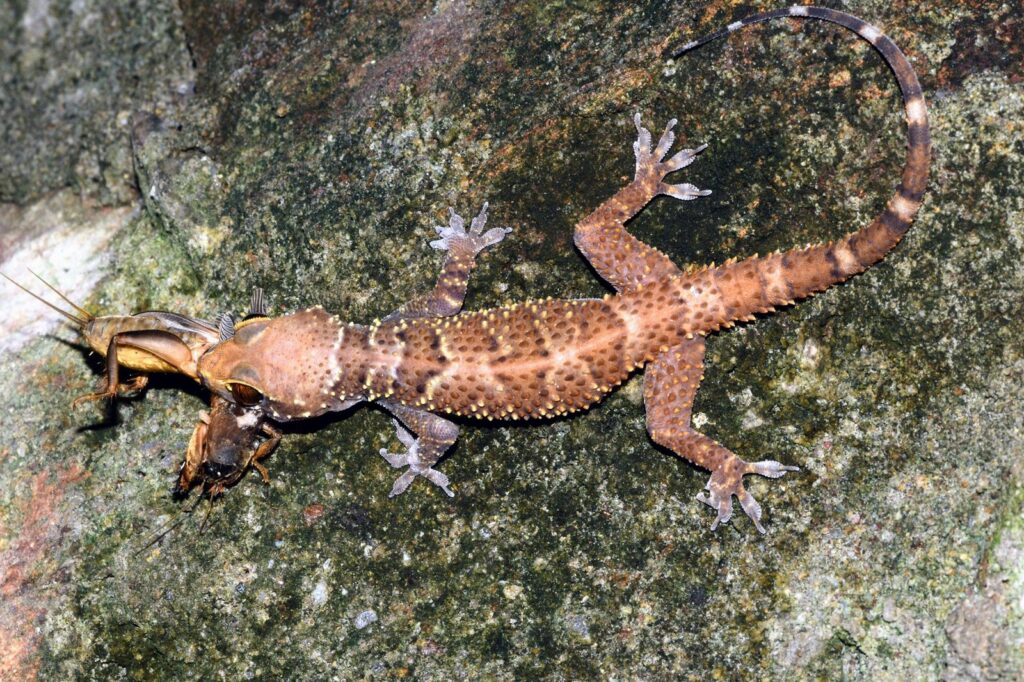
A newly described gecko species from Odisha’s Eastern Ghats is adding to growing evidence that the region’s biodiversity remains far from fully documented. The species, Hemidactylus kalinga sp. nov., formally described in the journal Herpetozoa is endemic to the northern Eastern Ghats. The gecko species is also the second endemic Hemidactylus species from Odisha, after H. paucifasciatus, and only the fourth endemic reptile recorded from the state.
Research about the Eastern Ghats is limited compared to the extensive scientific literature and decades of research focussed on the Western Ghats. However, these hill ranges are increasingly being recognised as important centres of reptile endemism. They harbour a diverse assemblage of lizards, including geckos from the family Gekkonidae, skinks from Scincidae, and a leopard gecko from Eublepharidae.
Within the genus Hemidactylus, the H. prashadi clade — of which H. kalinga is a part — is the most species-rich, currently comprising 23 species across India. Several lineages within this clade – a group of evolutionary descendants of a common ancestor – remain poorly understood, pointing to the likelihood of additional cryptic species.
“The significance of this discovery lies in the fact that we are still uncovering a remarkable number of new reptile species in India,” says lead author Pratyush P. Mohapatra of the Zoological Survey of India. “In regions such as the Eastern Ghats, systematic sampling has been largely absent, and researchers estimate that at least 10 to 15 new gecko species are still awaiting discovery.” Advances in molecular taxonomy over the past two decades, he adds, have been crucial in clarifying species boundaries and identifying cryptic diversity that was previously overlooked.
H. kalinga itself was known to scientists earlier but had never been formally described. “This discovery provided an opportunity to address that gap and give the species a scientific identity,” Mohapatra says.
The Kalinga rock gecko is a large-bodied, rock-dwelling species, reaching a snout–vent length of about 105 mm. It has an olive-brown body marked by four pale transverse bands. The species is found among rocky outcrops and forested hill slopes in moist and dry deciduous forests at elevations between 156 and 746 metres and has been recorded from several districts in Odisha. It takes its name from the Kalinga region of Odisha where it was found.
Beyond taxonomy, the discovery also highlights conservation concerns. Mohapatra points to the example of Hemiphyllodactylus minimus, a tiny gecko found in a sacred grove in Maharashtra, whose habitat was degraded after temple renovations introduced artificial lighting. “Even small, seemingly protected landscapes can be highly vulnerable,” he notes.
Understanding new species and their ecological roles, researchers argue, is essential for designing effective conservation strategies — especially in fragile and understudied landscapes such as the Eastern Ghats.
Banner image: Hemidactylus kalinga sp. nov. Image by Pratyush P. Mohapatra.