
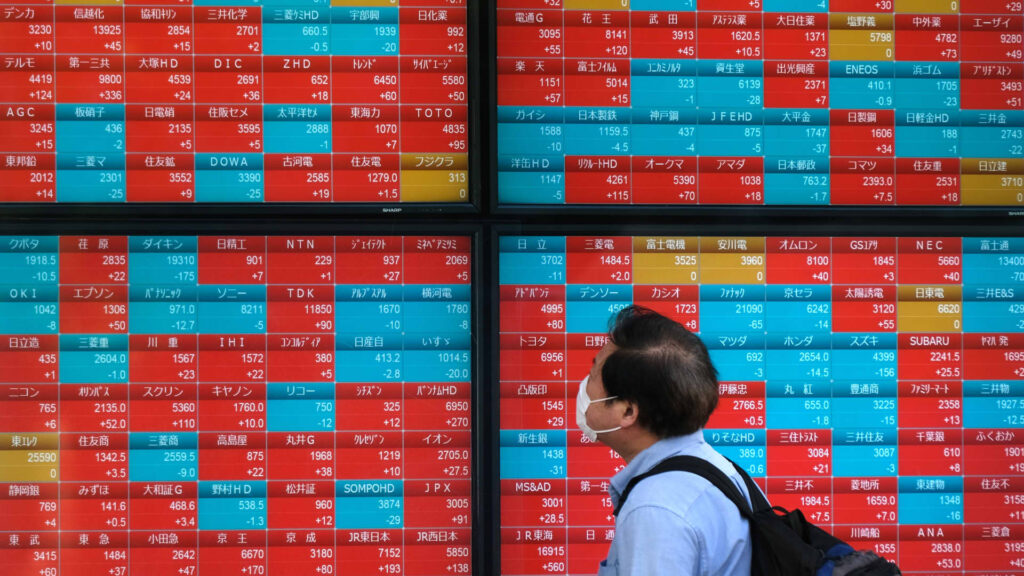
A pedestrian looks at an electronic quotation board showing numbers of the Nikkei 225 index in Tokyo on September 11, 2020.
Kazuhiro Nogi | AFP | Getty Images
Japan’s Nikkei 225 hit a record high Wednesday while Asia-Pacific markets were broadly lower amid concerns that the Middle East conflict could drag, even as President Donald Trump extended the U.S. ceasefire with Iran.
“Based on the fact that the Government of Iran is seriously fractured, not unexpectedly so and, upon the request of Field Marshal Asim Munir, and Prime Minister Shehbaz Sharif, of Pakistan, we have been asked to hold our Attack on the Country of Iran until such time as their leaders and representatives can come up with a unified proposal,” Trump said in a Truth Social post.
He added that the ceasefire would be extended until Tehran submitted a proposal or discussions were concluded, and that the U.S. military would continue its blockade of Iranian ports.
However, the timeline remains uncertain. Negotiators from Tehran said they wouldn’t attend the talks with the U.S., calling them a “waste of time,” Iranian state media reported on Wednesday.
The uncertainty also delayed Vice President JD Vance’s trip to join peace talks, according to reports from Axios and The New York Times, citing U.S. officials with knowledge of the situation.
West Texas Intermediate futures were 1.05% lower at $88.73 per barrel as of 2:38 a.m. ET. Brent crude declined 0.79% to $97.70 per barrel.
Japan’s Nikkei 225 hit a record and ended the session 0.4% higher at 59,585.86 following the release of its latest trade data. The country’s exports rose for a seventh straight month, posting a trade surplus of 667 billion yen ($4.18 billion) in March, compared with a surplus of 1.1 trillion yen forecast, data from Reuters showed. The focus will also be on the Bank of Japan’s policy meeting next week. The Topix, however, lost 0.63%.
Shares in SoftBank Group Corp. rose as much as 10%. Rene Haas, the chief executive officer of SoftBank-owned Arm Holdings, will assume the extended role of SoftBank Group International’s CEO, with effect from April 21, the company said in a statement.
South Korea’s Kospi rose 0.46% to 6,417.93. The small-cap Kosdaq added 0.18%. Tech major SK Hynix saw shares drop nearly 1% following report that it will invest 19 trillion won ($12.90 billion) to build an advanced chip packaging plant in the country, as memory chip demand soars on artificial intelligence boom.
The country saw producer prices in March rising at their fastest pace in over three years, supported by higher oil prices amid the conflict in the Middle East, central bank data showed.
Mainland China’s CSI 300 index gained 0.50%, while Hong Kong’s Hang Seng index declined 1.27%.
India’s Nifty 50 slipped 0.48%. Shares of IT company HCL Technologies dropped 8.87% after its fourth-quarter earnings missed expectations.
Australia’s S&P/ASX 200 fell 1.18% to 8,843.6.