
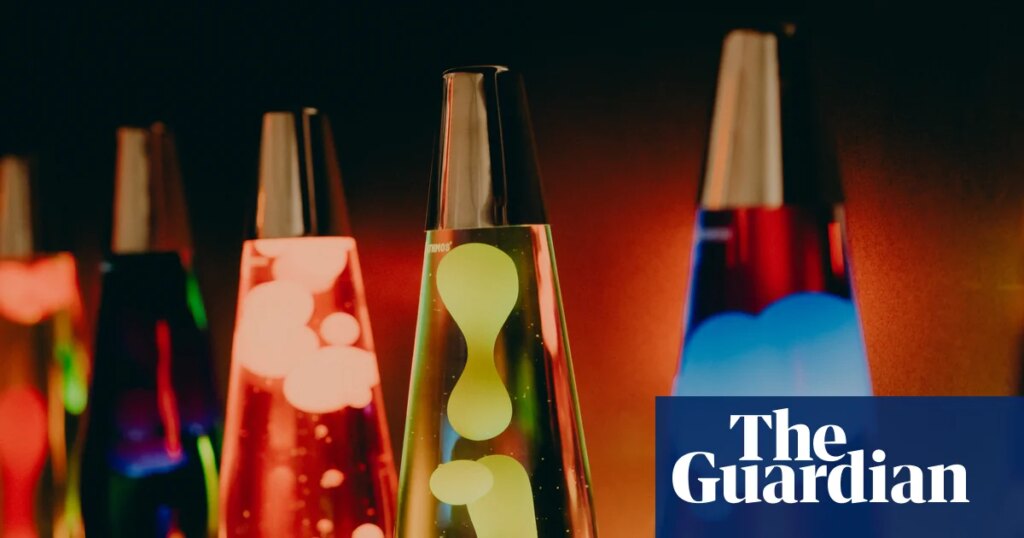
Depending on your age, you may remember them from Doctor Who and The Prisoner in the 1960s, or from TFI Friday and the Big Breakfast in the 90s. Or if you’re young enough, you might not remember them at all. But now it seems lava lamps are back.
Rising sales would suggest a third wave of the lava lamp phenomenon is on the horizon, thanks to the ongoing trend towards mid-century interiors and gen Z’s fascination with the late 90s and early 2000s.
Cressida Granger, the managing director of the British lava lamp pioneers Mathmos, said there had been a surge in interest in its lamps. “It feels like they’re in the current conversation in a way they haven’t been.”
Sales have been rising steadily in recent years and 2025 is set to be a huge festive season. Mathmos has oversold in the run-up to Christmas, which means the company will be short of stock come January.
So what does Granger put this appeal down to? “They’re sort of nostalgic, aren’t they? So that’s comforting when the world’s changing,” she said.
“They are just very calming, they’re very analogue. They take two hours to warm up. They don’t demand anything of you, they’re very soothing. People use them for mindfulness and focus.
“[In the case of Mathmos], people really like that we’re the real thing and they’ve always been made here and we invented them. So that feels also secure and authentic, and we really work hard to make them the best.”
Mathmos was founded in 1963, by the inventor of the lava lamp, Edward Craven Walker.
Walker was an eccentric, a nudist who was married four times before his death at the age of 82 in 2000. He was responsible for the early success of the company, which was then called Crestworth, with his wife Christine, but when sales collapsed in the 1980s, his successor Granger oversaw the renaissance.
Formerly a vintage dealer, Granger initially approached Walker to buy the formula but ended up taking over the business in 1989.
Though much about Mathmos has changed, the secret recipe is still loosely based on Walker’s designs and the bottles are still filled by hand.
The factory, at Poole in Dorset, bears all the quirks expected of somewhere making such an unusual product.
Upstairs, customer service staff speak multiple languages to engage with customers from its 10 international websites. Downstairs, a mesmerising showroom of lava lamps of different colours and designs enraptures anyone who enters.
Adjacent to that is where the magic happens, where the bottles are filled and the lava lamps are assembled – sometimes even personalised – and boxed, ready to be shipped in time for Christmas.
The original model, the Astro with the classic lava lamp shape, is still the bestseller but others such as the rocket-shaped 90s Telstar are popular, and a number of newer models including ones lit by candles have also proved a success.
“I suppose it is unusual to have a job that no one else really has in Europe,” says Alan Staton, the only person outside China who spends his working day putting the lava into the lamps.
The “lava” is essentially a type of brightly coloured wax suspended in water, which is heated by a bulb and rises to the top, falling again when it cools, creating its characteristic hypnotic effect.
Customers who bought a Mathmos lamp anytime in the last 30 years will have a product that was filled by Staton.
His younger colleague Henry Currer has only worked at the factory for a few months – “I’m getting my head round it I think!” – having come from running a bronze casting factory in Birmingham. “What enticed me to it is that it’s a British heritage brand, something that’s made here,” he says.
“Every other lava lamp’s made in China,” says Granger. There have been periods where innovative products were copied which devastated sales, and the small company did not have the funds for legal action. But Granger has a philosophical view: “If you’re not being copied you’re not doing anything successful.
“We did a silicon ball that squeezed on and off, called Bubble, that got copied by Target in America. You can’t do a lot against Target.
“But actually I spent a long time looking for the new lava lamp,” she says, “before I realised that the new lava lamp was the lava lamp.”
The company has collaborated with various designers and artists, including the photographer Rankin, the band Duran Duran and the dutch designer Sabine Marcelis.
Every one of these has sold out within hours, including most recently a limited edition red Rolling Stones collaboration, for which only 1,000 were made, which led to a huge queue at the band’s Carnaby Street store on the day it was released in November.
“They were going for more money than people bought them for during the time we were selling them,” says Granger.
Perhaps surprisingly, Mathmos’s customers are not one-offs. “They’ve often got more than one and they often gift them. We’ve got quite a big collecting community and they’re quite active. We do have some collectors who’ve got hundreds.”
She says: “It’s like a vinyl record, you have to take it out of its sleeve and there’s a ceremony to it, which is kind of nice.”