
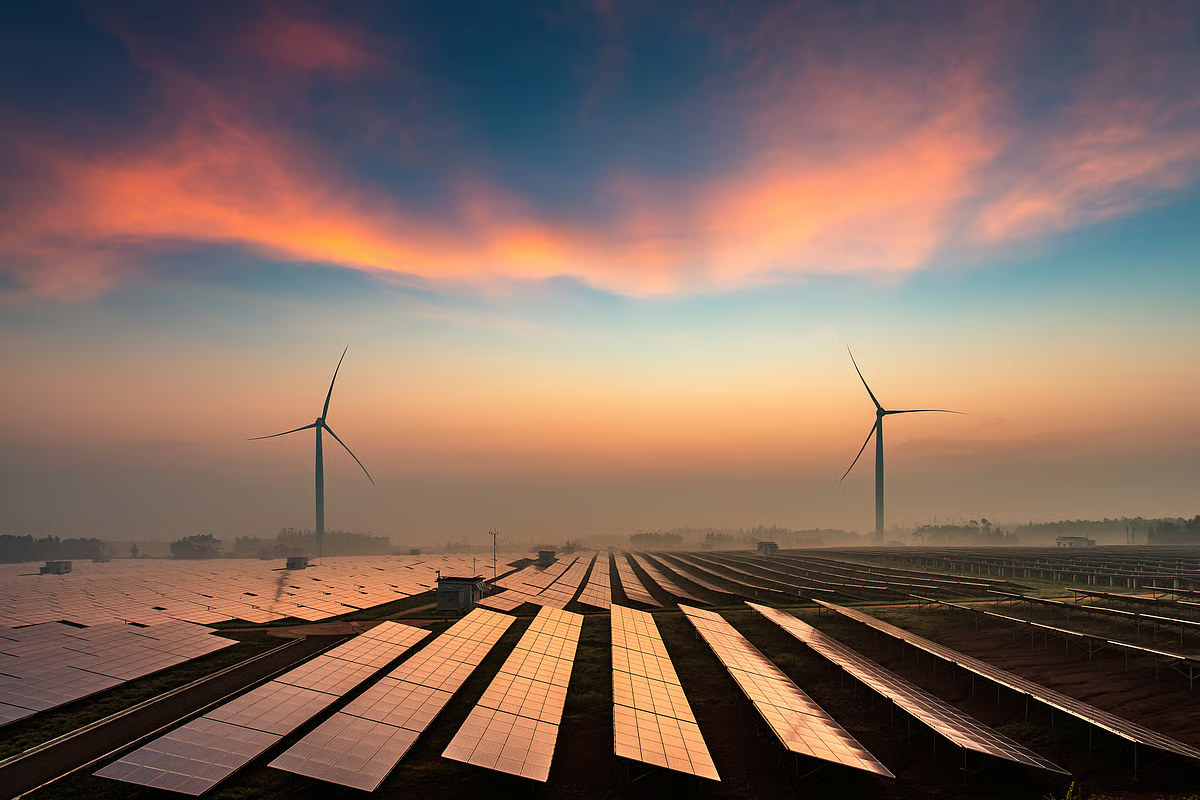
Tamil Nadu, long regarded as India’s wind power pioneer but now overtaken by states such as Gujarat, Karnataka and Maharashtra, is entering a decisive phase in its energy transition. Massive capacity additions, grid modernisation and energy storage deployment must now keep pace with rapidly rising demand, even as legacy bottlenecks threaten to slow momentum.
The state still accounts for nearly a quarter of India’s wind capacity, with about 12 gigawatts (GW) installed, and ranks fourth nationally in total renewable energy capacity at roughly 26.5 GW. It has also laid out one of the most ambitious roadmaps among Indian states — sourcing 50 per cent of its electricity from renewables by 2030 — while simultaneously pursuing its goal of becoming a $1 trillion economy.
Officials and industry executives say, however, that the challenge is no longer simply about adding wind turbines and solar parks. The real test now lies in evacuation infrastructure, firm power availability, land access and financial viability.
Grid stress meets ambitious expansion
Tamil Nadu’s peak power demand is projected to rise by nearly 71 per cent, from about 20.7 GW today to 35.5 GW by 2034-35. To address this, the state is formulating a comprehensive Integrated Renewable Energy Policy focused on reducing fossil fuel dependence, promoting energy storage, strengthening grid efficiency, ensuring reliable supply, mitigating climate change impacts and supporting economic growth.
Under its Resource Adequacy Plan (RAP), reviewed by Down To Earth (DTE), Tamil Nadu estimates it will need close to 98 GW of contracted capacity — almost three times current levels — and plans to install 40.6 GW of additional capacity from conventional and renewable sources by 2034–35. The RAP envisages additions of around 11 GW of coal, 18 GW of solar, 12 GW of wind and 11.7 GW of energy storage capacity to ensure system reliability and supply adequacy, underscoring the complexity of integrating variable renewables at scale.
The state is doubling down on transmission to prepare for this expansion. Green Energy Corridor Phase I enabled the evacuation of 6.6 GW of wind power between 2011 and 2016. Phase II, now under implementation, will add 624 circuit kilometres of transmission lines and two substations at Ottapidaram and Samugarengapuram, supporting another 2.8 GW by 2025-26. In parallel, new 765 kilovolt (kV) substations at Virudhunagar, Coimbatore, North Chennai and Ariyalur are intended to ease congestion that has historically caused renewable curtailment during peak wind seasons.
Yet developers argue that grid readiness remains uneven. While southern districts such as Thoothukudi and Tirunelveli are relatively well served, delays in commissioning substations and persistent right-of-way issues continue to slow projects in newer renewable zones.
Storage becomes the linchpin
Recognising that wind and solar alone cannot meet evening peak demand, Tamil Nadu is placing energy storage at the centre of its next power-sector phase. The state has lined up more than 1.4 GW / 3.5 GWh of battery energy storage systems (BESS), partly supported by central viability gap funding (VGF), alongside more than 4 GW of pumped storage capacity at Kundah, Vellimalai and Aliyar.
Key BESS projects include a 375 MW / 1,500 MWh system backed by central VGF, a 500 MW / 1,000 MWh project with VGF covering 40 per cent of capital costs, and a 30 MW / 90 MWh solar–BESS hybrid designed to absorb midday solar surplus of around 500 MW and supply power during evening deficits that can reach 1.5 GW. All three projects are awaiting final regulatory approvals, with commissioning targeted for May 2027.
On the pumped storage front, a 500 MW project at Kundah is scheduled for commissioning by April 2026, a 1.1 GW project at Vellimalai is in advanced stages of execution with forest clearance under way, and a 2.4 GW project at Aliyar is moving towards tendering by the end of the year.
These storage initiatives are being complemented by a 34.75 MW wind–solar hybrid project under the tariff-based competitive bidding route and a 200 MWp rooftop solar programme across government buildings in four districts, with 40 MWp already tendered. State officials view storage as essential for meeting resource adequacy norms while limiting dependence on new coal plants, even as the roadmap still includes about 11 GW of thermal capacity additions.
Repowering and land constraints
A large part of Tamil Nadu’s wind fleet is ageing. Capacity utilisation factors of older turbines remain at around 10-15 per cent, far below what modern machines can deliver. The state’s Wind Repowering, Refurbishment and Life Extension Policy 2024 aims to address this by mandating action once turbines cross 20 years of operation and by relaxing micro-siting norms.
While repowering could raise capacity utilisation to 25-30 per cent, progress has been slower than anticipated. Developers cite disputes over banking charges, grid connectivity during transition periods and uncertainty surrounding amended policy provisions. Land availability is another major constraint, as acquiring contiguous parcels for larger turbines or hybrid projects remains difficult despite single-window clearance systems and designated renewable energy zones.
Acknowledging these challenges, Mangat Ram, additional chief secretary of Tamil Nadu, told DTE in October that the state is refocusing on attracting new investment. He said a revised policy framework, currently under review, aims to reduce development charges and simplify repowering procedures, stressing that Tamil Nadu “cannot afford to waste a national resource”.
Even where developers are ready to proceed, infrastructure remains a bottleneck. “For repowering, the real problem is evacuation,” Tamil Nadu Electricity Board chairman J Radhakrishnan told DTE. “Even a 10 km gap in connectivity can stall progress.” Many older turbines are connected to 11 kV or 33 kV feeders, which are inadequate for multi-megawatt machines.
In addition, several legacy turbines do not comply with modern grid code requirements such as reactive power control, low-voltage ride-through and high-voltage ride-through. The Centre for Wind Energy Technology — now the National Institute of Wind Energy — is working with developers and the Wind Energy Association to study pathways for bringing these machines up to code. New guidelines are expected, particularly as many turbines have already exceeded their 20-25 year design life.
Industry dependence and financial risks
Nearly 85 per cent of Tamil Nadu’s wind generation is consumed by industry, with textile mills alone drawing close to 3 GW through captive arrangements. This has given the state a competitive advantage, as captive wind power significantly lowers energy costs for industry. At the same time, it exposes the renewables sector to fluctuations in industrial demand and to payment delays from the distribution utility.
Although transparent tariff orders and open access policies have attracted billions of rupees in private investment, developers continue to raise concerns about payment security and the need for stronger escrow mechanisms or letters of credit.
Offshore wind and global partnerships
Tamil Nadu’s offshore wind push marks the next phase of its three-decade renewable journey, especially as land constraints limit further onshore expansion. With onshore wind capacity already exceeding 11.5 GW, offshore projects offer larger scale, higher plant load factors of 40-45 per cent, and proximity to coastal industrial hubs. Of India’s estimated 91 GW offshore wind potential, the National Institute of Wind Energy assesses that around 35 GW lies off Tamil Nadu’s coastline.
However, offshore wind remains at a pre-commercial stage due to multiple structural barriers. High upfront costs and tariff uncertainty continue to deter investors, particularly in the absence of long-term power purchase agreements and robust payment security. Transmission readiness is another major hurdle, as offshore wind will require new coastal substations, high-capacity evacuation corridors and port-linked grid infrastructure, much of which is still at the planning stage.
Port capacity and logistics add further complexity, with existing facilities needing upgrades to handle turbine assembly, heavy-lift vessels and offshore installation equipment. Social and environmental concerns — especially from fishing communities worried about restricted access to traditional fishing grounds — also remain unresolved, as rehabilitation and compensation frameworks are yet to be clearly defined.
Institutional coordination is another weak link, with offshore wind straddling both central and state jurisdictions and involving multiple agencies. Industry stakeholders warn that without a clear nodal authority and faster pilot projects, Tamil Nadu risks losing momentum just as global competition for capital, equipment and installation vessels intensifies.
After scrapping India’s first offshore wind tenders in Tamil Nadu and Gujarat, the Centre has now committed to supporting the first 1 GW of offshore capacity — 500 MW each in Tamil Nadu and Gujarat — through a Rs 7,500 crore viability gap funding scheme. At the seventh edition of Windergy in Chennai in October, renewable energy minister Pralhad Joshi announced that the next Tamil Nadu offshore wind tender would open by February 2026, following completion of NIWE’s LIDAR survey in Dhanushkodi by January 2026.
A decisive decade ahead
Tamil Nadu’s trajectory illustrates that early leadership in renewables does not guarantee a smooth transition to the next phase. The state has policy clarity, strong technical institutions and sustained investor interest, but faces growing pressure to synchronise generation, transmission, storage and demand growth.
If it succeeds, Tamil Nadu could offer a blueprint for operating a high-renewables grid at scale in a fast-growing economy. If it falters, grid bottlenecks and financial stress could turn ambition into constraint. Either way, the next five years will determine whether the state remains India’s renewable pathfinder — or becomes a cautionary tale of transition growing pains.