
- An oleum gas leak at an industrial unit in Tarapur MIDC in Maharashtra’s Palghar district prompted the evacuation of nearby schools and factories as authorities moved quickly to contain the incident.
- The leak spread to a radius of 5 km in Boisar and nearly 2600 people had to be evacuated.
- The leak could not be stopped immediately as the charging valve broke when one storage tank fell on the other the tank due to the cement support corroding.
In the Tarapur unit of the Maharashtra Industrial Development Corporation (MIDC) at Boisar, in Maharashtra’s Palghar district, gas leaks are not uncommon. Yet no one was quite prepared for over a ton of liquid oleum leaking into the atmosphere and creating a dense fog-like situation on the afternoon of March 2, ironically, just two days before National Safety Week which aims to promote safety and prevent accidents in workplaces. While a few suffered the toxic effects and were admitted to nearby hospitals, there were no fatalities reported.
Oleum is a corrosive liquid, a mix of sulphuric and sulphur trioxide, used in the production of sulphuric acid. It is a raw material for manufacturing dye intermediates in which Bhageria Industries specialises. The leak occurred from two day-tanks at Bhageria Industries Limited.
The Directorate of Industrial Safety and Health (DISH), Maharashtra which is investigating the leak, found that about 1,200 litres or 1.2 tonnes of oleum was stored in these two tanks at the unit and they were placed on cement structures on four legs. One of the legs broke possibly due to the corrosive ambience, and one of the tanks with 800 litres of oleum, tilted and collapsed onto the other tank which contained 400 litres, breaking the charging valve. As a result, the liquid oleum spilled out, forming a dense gas when it came into contact with outside air. The liquid vapour spread due to the wind direction, and many people started running away from the vapour that was rapidly engulfing a section of the town.
The steel tanks have been replaced since then and DISH has issued prohibitory orders to remove the hazardous material and equipment safely from the acid manufacturing unit, which is closed for now. The Maharashtra Pollution Control Board (MPCB) has also issued a voluntary closure directive to the company to stop production till the investigation is complete.
Emergency response and evacuations
The leak occurred in the afternoon when workers were still at the plant and people in town were about their regular day.
The fire brigade received a call at 2.58 pm and arrived at the plant. The team entered the storage room equipped with self-contained breathing apparatuses (SCBA). However, they couldn’t see much as the fumes were thick. It was also not possible to close the valve as it was corroded and they had little choice but to allow the chemical to spill out till the tank was emptied. As the leak could not be arrested, the oleum also spilled onto the floor of the storage room, forming a 1.5-inch-thick layer. The spill was covered with dry sand to stall it and ensure it did not vapourise into the air.
While workers and others were evacuated from the factory, the population of 50,000 in Boisar was also at risk from the impacts of the leakage. The fire brigade which has 20 SABC sets used about 9 of them in the operation — each SABC lasts for 40 minutes or so. Safety officials from other companies also helped and it was till 8 pm before the spill was brought under control.
Schools in the vicinity were quick to issue orders to their students and their parents to evacuate. Opposite Tarapur Vidya Mandir and Junior College near the MIDC, the open ground was fast filling with fog, and school authorities used Whatsapp groups to inform parents, especially those of primary school sections, to pick up their children. School buses were deployed to ferry students home and about 2,000 children from the institution were rushed to safety. Other nearby schools and factories also evacuated their premises. In total, over 2,600 people, mainly students and workers were evacuated from areas near the leak.
Walking in dense fog with no protective equipment, the police too stepped in to control the situation and inspector Sunil Jadhav of the Boisar MIDC police station took to the streets with a megaphone warning people to move away from the leak. All the units near Bhageria Industries were evacuated as a precautionary measure.
One of the victims of the gas leak, Sunita (name changed) was in her place of work when her manager told her and four other women to leave due to the gas leak. She was walking home when she felt dizzy and fainted. She was in hospital till a few days later and still feels the after effects of the choking gas. She can barely walk or eat. She said she was picked up by an ambulance which dropped her half way to the hospital and she was taken further from there by a relative. She has filed an FIR against the proprietors of the company for the gas leak under Bharatiya Nyaya Sanhita’s (Indian criminal code) Section 280 which relates to making the atmosphere noxious to health, Section 286, for negligent conduct with regard to toxic substances, and Section 289 which deals with negligent or rash conduct involving machinery that endangers human life or causes injury. Additionally, under section 125, any person who acts in a rash or negligent way that endangers human life or the personal safety of others is punished with imprisonment of a period up to three months to three years, or a fine ranging from ₹2,500 to ₹10,000 or both, depending on the nature of the harm.
The National Human Rights Commission (NHRC), has taken suo motu cognizance of media reports and issued a notice to the state Chief Secretary, calling for a detailed report on the matter within two weeks.


An industrial accident
Bhageria Industries, formerly known as Bhageria Dye Chem Limited, was incorporated in 1989. It is a leading manufacturer of specialty dyes and dye intermediates in India, with units at Vapi (Gujarat) and Tarapur-Boisar (Maharashtra). It exports nearly 20-30% of its production to major global markets including the U.S., Europe and East Asia. As per the Annual Report 2024-25, the company recorded a turnover of over ₹600 crores, a bulk of it from the dyes and dye intermediates and chemical business. It also generates and distributes solar power, produces active pharmaceutical ingredients, among other activities.
In an intimation to the National Stock Exchange, the company described the leak incident caused by a tank containing oleum falling, adding that “Situation was controlled within time and fortunately, there were no casualty and injury to life. All personnel were safely evacuated from the affected area as a precautionary measure.” The company has said, in the notification, that as per the directions by MPCB, it will conduct the safety audit and obtain the required approvals from MPCB and Directorate of Industrial Safety and Health (DISH). The company did not give a comment to Mongabay-India.
The 1000 hectare Tarapur MIDC in Boisar, about 100 km from Mumbai, which was mainly an Adivasi area was developed in 1975 as a major industrial centre. The Tarapur Atomic Power Station is nearby and there is a cluster of mega infrastructure projects proposed here such as the proposed Vadhavan Port project, the Mumbai-Ahmedabad bullet train project, the Western Dedicated Freight Corridor, the Delhi Mumbai expressway and Fourth Mumbai, a proposed urban expansion project. In the last 40-odd years, there have been over 800 industries, 615 of them chemical, according to D. K. Raut, President of the Tarapur Industrial Manufacturers Association (TIMA). He told Mongabay-India that the oleum leak incident was not a case of negligence and it was a sheer accident. There are standard operating procedures to maintain such tanks and replace valves. There are regular safety drills in place and there is a tremendous improvement in safety and response. This was the first time that this has happened since the MIDC was established in 1975, he added. TIMA’s safety committee also stepped in to bring the situation under control.
However, he said storing highly corrosive acids requires appropriate material of construction to handle acids. When oleum leaks and comes into contact with air or water or moisture it becomes acidic and it can irritate the skin.

Longstanding pollution concerns
Residents of Boisar and adjoining Tarapur have suffered the impacts of pollution for a long time. Walking through the MIDC which has poor quality roads, there is an unmistakable stench near the chemical industries. Large open garbage dumps full of burning waste can be seen at places and clearly there is a lack of waste management. A digital board by the MPCB proclaims all pollution parameters are under approved limits but residents claim otherwise. The Citizens Forum of Boisar has another view about the MIDC and the industrial units. Suryakant Sankhe, president of the Forum said that “this oleum leak is the tip of the iceberg”. The pollution and lack of management of the area has been a bone of contention and the Forum has been fighting it since the last 13 years. It has demanded that MIDC set up a solid waste management plant in the area and it has also approached the Lokayukta, an independent, state-level anti-corruption ombudsman of Maharashtra in January 2023.
“This gas leak is not new, it is a daily story in this area,” he remarked. The oleum leak has grabbed nationwide attention because it was something visible and shocking but gas leaks are common here. “As a small NGO we have explored all possible avenues for justice, even a letter to the Prime Minister but nothing changes. MIDCs are supposed to keep plots reserved for civic amenities and managing a solid waste management plant as they collect revenue from local bodies. They have also changed the reservation for open space from 30 percent to ten percent,” he pointed out. While the MIDC claims there was no space for a solid waste management plant, an application under the Right to Information Act filed by the Forum revealed that the MIDC had sold more than 100 new industrial plots from 2016 to 2021. However, in the case before the Lokayukta, it claimed it hadn’t. The Lokayukta has issued notices to government officials to explain their position in this matter.
Manish Sankhe of Paryavaran Dakshata Manch, Thane, said that there was no safety audit of the industries and they violated basic norms. Even the space between industries to allow for the fire brigade was sometimes very narrow. Old equipment was refurbished and reused using unskilled labour, he added. He said in the last one year there were multiple leaks. He said the oleum leak occurred in the daytime, if it had occurred at night it would probably pass unnoticed and there would be little discussion on it.
Recent Gas Leaks in MIDC Tarapur

Apart from the Citizens Forum of Boisar, the Akhil Bhartiya Mangela Samaj Parishad, a fishers’ body in 2016, had approached the National Green Tribunal (NGT) with petition on industrial pollution in their fishing waters off the coast of Tarapur, caused by the MIDC. The Parishad contended that there was severe environmental and ecological degradation of the water bodies situated in the vicinity of the Tarapur MIDC caused by the discharge of untreated sewage and industrial effluent in MIDC and the release of unauthorised volume of effluent in excess of the permitted limit by the MPCB in the Arabian Sea at Navapur as well as in the water bodies in the vicinity of Tarapur MIDC from the Common Effluent Treatment Plant. The industrial area was identified as a critically polluted area in 1996 by the Central Pollution Control Board. In 2019, the NGT fined over 101 companies over ₹180 crores, and ordered an expert committee report on the situation which suggested an action plan and remedial measures for the MIDC. However, the industries have managed to get a stay on the order and the Parishad’s appeal is coming up for hearing later in March, according to Narendra Naik of the Parishad. The NGT passed a good order holding companies to account and payable for pollution but unfortunately, it was stayed, he said.
Envisaged as a growth centre, the ramshackle Tarapur MIDC which has witnessed repeated leaks, could do with stronger industrial safety measures, regular audits and clean-ups. The situation assumes significance as a Fourth Mumbai, a planned, urban expansion project near the Vadhavan port in Palghar district, which is being strongly opposed along with the port and other developments in the region. While this time the leak did not result in casualties, impermissible quantities of a highly corrosive liquid was released into the atmosphere, and it is an incident that should serve as a caution to the grave lacunae in industrial safety and management in this MIDC.
Watch: Tainted Waters: a long battle against coastal pollution in Tarapur MIDC
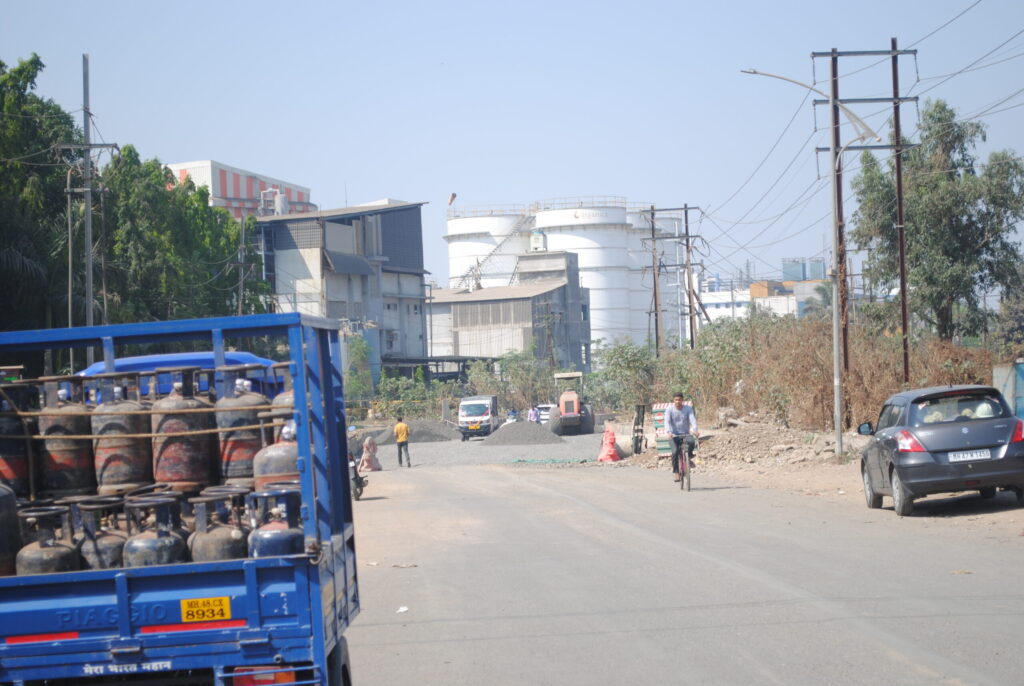
Banner image: A view of the Tarapur MIDC in Boisar. Image by Meena Menon.

