
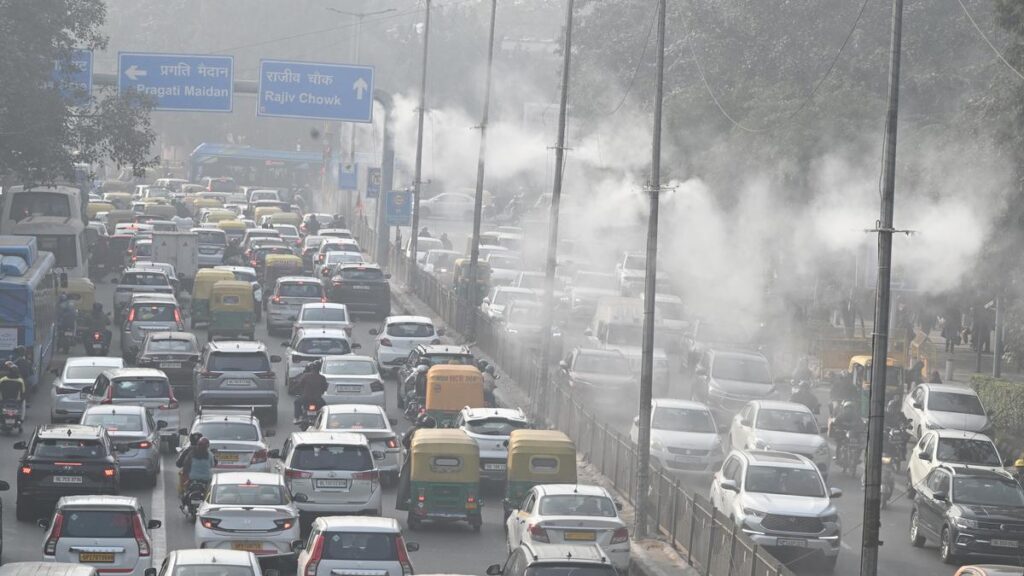
Come winter and the national capital wakes up with thick smog and severely low air quality, which cripples the city and poses serious health challenges. The directions given by the Delhi government and the Directorate of Education to ensure work from home and to run classes in schools in hybrid mode respectively do not bring much succour, as possible health hazards continue to haunt Delhiites and those living in the National Capital Region (NCR) districts.
Some of the major causes of air pollution include the burning of fossil fuels, transport, industrial processes, waste management, demolition and agriculture. However, particulate matter is the most deadly of them all causing major health hazards like stroke, heart and lung diseases which kill large number of people every year.
Severity of particulate matter
Particulate matter is defined for the purpose of quality regulations. Particles having a diameter of 10 microns or less (PM 10) may enter the body through breathing and adversely affect health. On the other hand, fine particulate matter includes particles having a diameter of less than 2.5 microns (PM2.5). Particles emitted from the burning of diesel called DPM (Diesel Particulate Matter) are mostly less than 1 micron in size and constitute a sub-category of PM2.5. These cause severe health hazards, even in children. In this context, the Commission for Air Quality Management (CAQM) has amended the Graded Response Action Plan (GRAP) and made it mandatory to close schools in Delhi and NCR districts under Phases 3 and 4 of the plan. Earlier, the decision to implement these measures was at the discretion of the State government. Moreover, as an additional directive under Phase 3 of the GRAP, State governments will now have to stagger the timings of public offices and municipal bodies in Delhi and NCR districts.
Constitutional provisions
Though the original Constitution did not mention any provisions for environmental protection, the concepts of natural justice and protection of nature were enshrined in the entire constitutional scheme. This is the reason why, by way of literal interpretation, the Supreme Court gave its opinion that clean environment shall be included in the meaning of life under Article 21 in Maneka Gandhi versus Union of India, 1978.
However, over the years, especially after growing demands for proper safeguards for the protection of the environment and sustainable development, India has adopted policies for which it needs proper and effective constitutional provisions. This led to the insertion of Articles 48A and 51A (g) as responsibilities of the state and citizens respectively. A significant aspect of Article 48A is that the Constitution intends to make agriculture and environment compatible. In Subhash Kumar versus State of Bihar, 1991, the Supreme Court read Articles 48A and 51A (g) with Article 21, and inferred that the state is constitutionally obliged to take steps to protect and improve the environment so that every citizen is able to enjoy his right to pollution-free air and water, which are necessary for a meaningful life.
However, since the mid-1980s, increasing privatisation and economic liberalisation have degraded the environment on a large scale due to which the judiciary had to step in to provide guidelines to strike a balance between economic development and environmental protection. The judiciary’s commitment to social good in general, and environmental protection in particular, has resulted in the innovative use of Public Interest Litigations (PILs) under Articles 32 and 226 of the Constitution, as a tool for social and environmental justice.
Moreover, a healthy environment is also one of the elements of a welfare state. Under Section 2(a) of the Environment (Protection) Act, 1986, ‘environment’ includes water, air and land, and the interrelationship which exists between the three and human beings, other living creatures, plants, microorganisms and property. The right to live in an environment free of danger of disease and infection is an important attribute of the right to live with human dignity.
The right to live in a healthy environment as part of Article 21 of the Constitution was first recognised in Rural Litigation and Entitlement Kendra versus State of U.P., 1985. In 1987, the Supreme Court in M.C. Mehta versus Union of India treated the right to live in a pollution free environment as part of the fundamental right to life under Article 21 of the Constitution.
Disasters and environmental protection
During times of disasters and calamity, whether natural or man-made, the issue of protecting the environment assumes greater significance. The concept of ‘absolute liability’ was introduced for disasters arising out of the storage, leak or use of hazardous substances such as in the Oleum Gas Leak case. While strict liability is the concept that makes a defendant responsible for the consequences of an action, even if he did not intend to cause harm or was not at fault, absolute liability is the imposition of legal responsibility on a party for damages caused, regardless of fault or negligence, but with certain exceptions. Moreover, strict liability is used in both criminal and civil law.
Two more principles that assume significance in cases of disasters which affect the environment include the ‘precautionary principle’ and the ‘polluter pays principle’. These concepts were explained in the Vellore Citizens’ Welfare Forum versus Union of India, 1996. The precautionary principle is an approach wherein states should adopt precautionary measures if there are serious threats to the environment. According to the United Nations, this principle needs to be widely adopted by nations according to their own capabilities. In cases where there are threats of serious or irreversible damage, a lack of full scientific certainty shall not be used as a reason for postponing cost-effective measures which could prevent environmental degradation. The precautionary principle is a part of the law of the land and should be applied when there is a threat of serious or irreversible environmental damage. The traditional concept that development and ecology are opposed to each other, is no longer acceptable. Sustainable development should be prioritised.
On the other hand, the polluter pays principle is the commonly accepted practice that those who are responsible for the pollution should bear the costs of managing it to prevent damage to human health or the environment. For instance, a factory that produces a potentially poisonous substance as a by-product of its activities is held responsible for its safe disposal. The polluter pays principle is part of a set of broader principles to guide sustainable development worldwide.
Public trust doctrine
Another major idea behind the principles of environmental protection is the public trust doctrine. In M.C. Mehta versus Kamal Nath, the Supreme Court explained the doctrine as a reflection of a social contract between the state and the people, in which the state serves as the trustee while the people or the communities own the resources. Although the state holds certain rights over said resources, it shall not utilise them for personal gains and shall be used only for the benefits of the people.
In India, Clause (b) of Article 39 provides that material resources shall be owned by the community and Clause (c) of the Article says that the state shall have the responsibility to prevent any concentration of the means of production. Further, when the state takes steps for the welfare of the people, the citizens have a duty to allow the state to do so. Thus, the relationship of the state and citizens is guided by jus publicum, or public law. It also refers to the right, title or dominion of public ownership which means that the government has the right to own resources for the benefit of the public. This is very well articulated in the Constitution, especially in the Directive Principles.
For example, in Radhey Shyam Sahu, the Supreme Court held that the doctrine of public trust emanates from the provisions of Article 21 of the Constitution protecting the life of the people and put the state under the obligation to maintain public parks for the citizens.
So far as the effects of climate change are concerned, the top Court in M. K. Ranjitsinh versus Union of India, 2024 recognised the right against adverse effects of climate change as being part of the right to life under Article 21 and also with the right to equality under Article 14 of the Constitution.
Despite the fact that national and foreign governments have claimed to have taken steps for the protection of the environment, their claims have been far from satisfactory. Moreover, as judicially recognised rights cannot be directly claimed unless linked to any of the rights provided in Part III of the Constitution, the state may also become reluctant to take steps with concern. It is therefore, the opportune moment to expressly include the right to a clean and healthy environment in the Constitution to make both the state and the citizens equally responsible.
The author is President, Centre for Applied Research in Governance, Delhi
Published – December 23, 2025 08:30 am IST