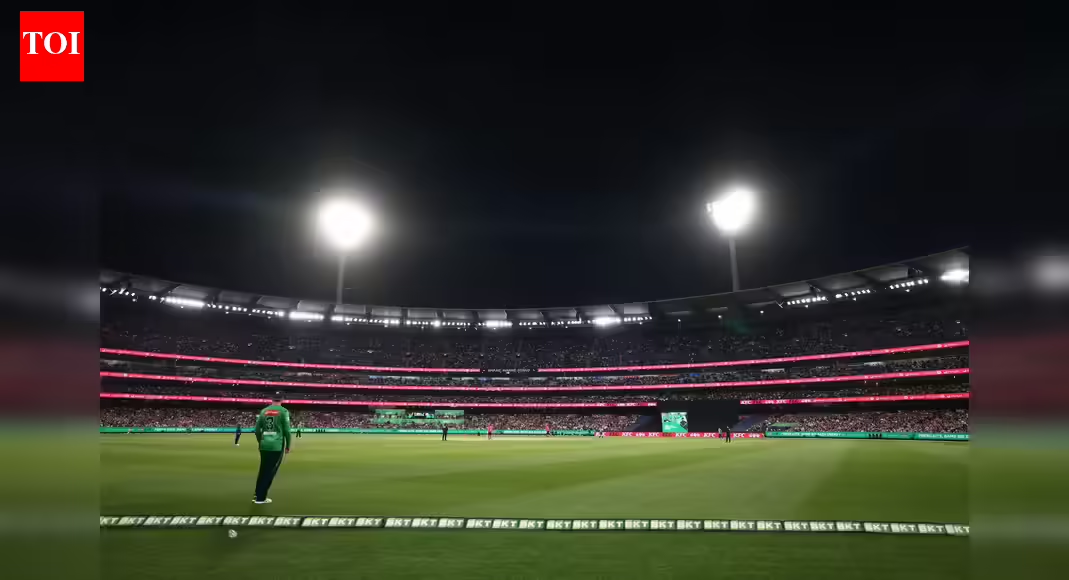
On This Day, 55 years ago, the game of cricket gave birth to a new form of international match when Australia hosted England at the Melbourne Cricket Ground in what turned out to be the first official One-Day International (ODI). It was a stop-gap solution to salvage a rain-washed Test at the MCG and, much to the surprise of the Australian cricket board, 46,000 fans turned up to watch the contest. With that, a new format of the game was born — by a happy accident.Go Beyond The Boundary with our YouTube channel. SUBSCRIBE NOW!The year was 1971, and the third Test between Australia and England was washed out due to rain. The teams decided to play a 40-over-a-side match instead. The grand reception to the game led to the birth of an exciting new format, which gained popularity in no time and witnessed its first World Cup just four years later, in 1975.
Cricket has evolved significantly since then, including the emergence of Twenty20 Internationals in February 2005, first played between Australia and New Zealand. Even shorter formats of T20 are now being experimented with in franchise cricket, but officially, three formats remain active internationally — Tests, ODIs and T20Is.ODI cricket became an epitome of the commercialisation of the game, bringing in more money long before franchise-based T20 leagues became the toast of the town.That 40-over-a-side contest between Australia and England more than five decades ago has resulted in 13 World Cups so far, with the next scheduled for 2027.
Poll
Which cricket format do you prefer the most?
Australia are the most successful team in World Cups, held every four years, with six titles. India and West Indies have won it twice each, with the Caribbeans claiming the first two editions. England, Sri Lanka and Pakistan have each lifted the trophy once.Apart from the World Cups, the ICC — cricket’s world governing body — organised the highly successful ICC Champions Trophy, formerly known as the ICC KnockOut Trophy. The tournament, which began in 1998, has seen nine editions so far, with India the most successful side, winning it three times. They are also the reigning champions after lifting the trophy in 2025.India’s batting maestro Sachin Tendulkar is the most successful batter in ODIs with 18,426 runs and 49 hundreds in 463 matches, closely followed by modern-day great Virat Kohli with 14,557 runs, including a record 53 centuries in just 308 games. Among bowlers, Sri Lankan legend Muttiah Muralitharan leads the wicket-takers’ list with 534 scalps from 350 matches, followed by Pakistan great Wasim Akram with 502 wickets from 356 games.All these extraordinary developments began from a humble stop-gap match on this day — January 5, 1971 — at the MCG. And here’s how the first-ever ODI played out:In front of 46,000 spectators, Australia won the toss and captain Bill Lawry sent England in to bat.Geoffrey Boycott and John Edrich opened England’s innings in the first ODI. The stand was short-lived as Boycott was dismissed for 8 off 37 balls by Alan Thomson, reducing England to 21 for 1.Edrich then steadied the innings with a 66-run partnership for the second wicket alongside Keith Fletcher, who scored 24 off 47 balls before being dismissed by Ashley Mallett. Edrich held one end firmly, scoring the first-ever ODI half-century.A 37-run stand for the third wicket with Basil D’Oliveira (17 off 16) followed, but England then lost wickets at regular intervals. From 87/2, they slid to 156/7 with the dismissal of Edrich for 82. His 119-ball knock included four boundaries.England were eventually bowled out for 190 in 39.4 overs. Ashley Mallett (3/34 in 8 overs) and Keith Stackpole (3/40 in 8 overs) took three wickets each, while Graham McKenzie (2/22 in 7.4 overs) ended the innings by dismissing Alan Knott for 24 off 31 balls.Chasing 191 from 40 overs, Australia made a shaky start, losing opener Stackpole for 13 to Ken Shuttleworth, caught and bowled. At 19/1, Lawry and Ian Chappell added 32 runs before Lawry fell for 27 off 49 balls, leaving Australia at 51/2.Ian Chappell scored the second half-century in ODI history and added 66 runs for the third wicket with Doug Walters to keep the chase on track. Walters scored 41 off 51 balls, hitting six fours, as Australia reached 117/3.A further 41-run stand between Chappell and Bill Redpath (12) took the hosts close to victory. Chappell was eventually dismissed for 60 off 103 balls, with Australia needing 26 more runs and five wickets in hand.Greg Chappell (22 not out) and Rod Marsh (10 not out) then guided Australia home in 35 overs, sealing a five-wicket win with five overs to spare.Despite the defeat, England’s John Edrich was named Player of the Match for his 82 off 119 balls, becoming the first to get the award in limited-over cricket.