 EPA
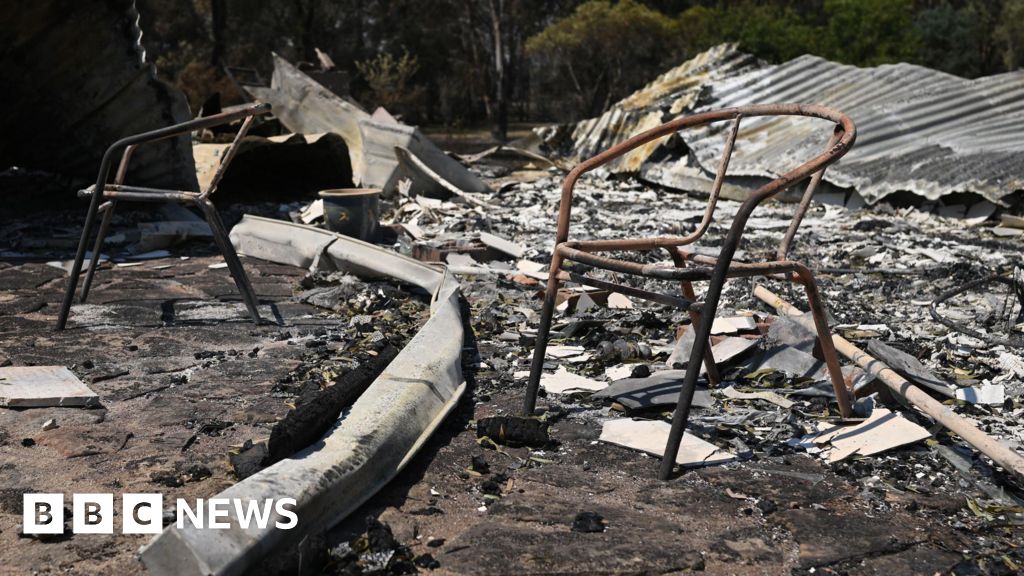
EPAOne person has died and 300 properties have been destroyed in bushfires that have torn across south-east Australia.
The fires have raged in dozens of locations across the country for several days, mostly in the state of Victoria, but also in New South Wales, burning through land almost twice the size of Greater London.
A state of emergency has been declared in Victoria as thousands of firefighters and more than 70 aircraft battle the blaze. Residents in more than a dozen communities have been advised to leave their homes.
Authorities fear the fires, which are being fuelled by very hot, dry and windy conditions, could burn for several weeks.

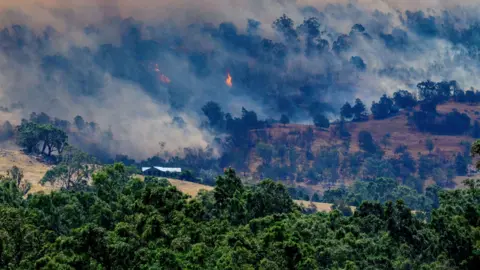 AAP/Michael Currie via REUTERS
Victoria’s Premier Jacinta Allan said 30 active fires were burning across the state, 10 of which were of particular concern.
She said 350,000 hectares had been burnt across the state as of 08:00 local time on Sunday (23:00 GMT on Saturday).
“We will see fires continue for some time across the state and that is why we are not through the worst of this by a long way,” she told Australian media.
“There are fires that are continuing right now that are threatening homes and property.”
Human remains were found in the village of Gobur, near the town of Longwood, some 110km (70 sq miles) north of the state capital Melbourne, police said. The victim has not yet been identified.
Allan praised the emergency workers who worked to retrieve the body. “This is difficult and confronting work, and it takes a heavy toll.”
“The Gobur community is grieving,” she said.
Bushfire smoke is impacting air quality in many areas across Victoria, including metropolitan Melbourne.
Authorities said the fires were the worst to hit the south-east of Australia since the 2019-2020 blazes that destroyed an area the size of Turkey and killed 33 people.
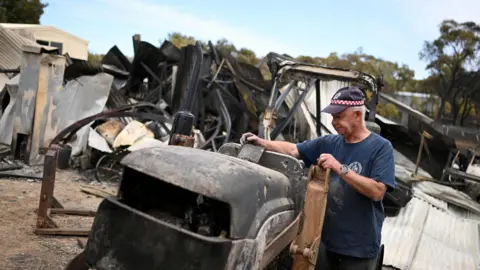 Reuters
One of the worst-affected places is the small town of Harcourt in the central highlands of Victoria, where firefighter Tyrone Rice lost his own home in the blaze. He was out fighting one of the bushfires when he learned it was on fire.
He told Australian media it was “like a kick in the guts, but I’m not the first person to go through it, and I won’t be the last”.
The destruction in Harcourt was “gut-wrenching”, local fire captain Andrew Wilson said.
A reporter for Australia’s 9 News, Jack Ward, told the BBC World Service he had visited the damage in several towns across Western Australia.
What he saw was “catastrophic”, he said, and in many places, “all that’s left of these houses is a tin roof lying on the ground”.
While it is hard to link individual wildfires to climate change as how humans manage the land can play a factor, scientists say climate change is making the hot, dry weather conditions conducive to bush fires more common.