
Data revealed in Parliament shows a high number of pending cases in the National Green Tribunal, a specialised statutory body dedicated to resolving environmental disputes. Together, all five benches of the NGT have over 5,000 cases pending in the courts, Kirthi Vardhan Singh, Minister of State for Environment, Forests, and Climate Change told Parliament on December 15.
The NGT was set up in 2010 under the NGT Act for the speedy disposal of environmental legal disputes, to reduce the burden of cases in higher courts. It specialises in disputes related to environmental rights and protections, damages, and compensation, and has a presence across each region of the country.
The Principal Bench, based in New Delhi, reported the highest pendency from 2020 to 2025, with 1939 pending cases as of November, the data showed. The Western bench in Pune had the second highest pendency, at 1933 cases over the same time period, followed by the Southern bench in Chennai (846 pending cases), the Eastern bench in Kolkata (411 pending cases) and Central zonal bench in Bhopal (320 pending cases).
“In order to increase the disposal rate of cases, the Government has supported NGT to upgrade the digital infrastructure at their all Benches by facilitating the virtual court proceedings and e-filing of cases through a dedicated portal,” Singh told the Parliament in response to a question.
The Tribunal is led by a Chairperson who sits at the Principal Bench and includes at least ten and up to 20 judicial and expert members each, who play an equal part when it comes to making decisions to resolve disputes. However, the NGT currently has six vacancies for judicial member posts and four vacancies for expert members.
“In the absence of full strength of judicial and expert members in regional benches of the Tribunal situated in Chennai, Pune, Bhopal and Kolkata, the Principal Bench in New Delhi is hearing applications from other jurisdictions remotely by video conferencing to meet the needs of the litigants,” the FAQ page of the NGT says.
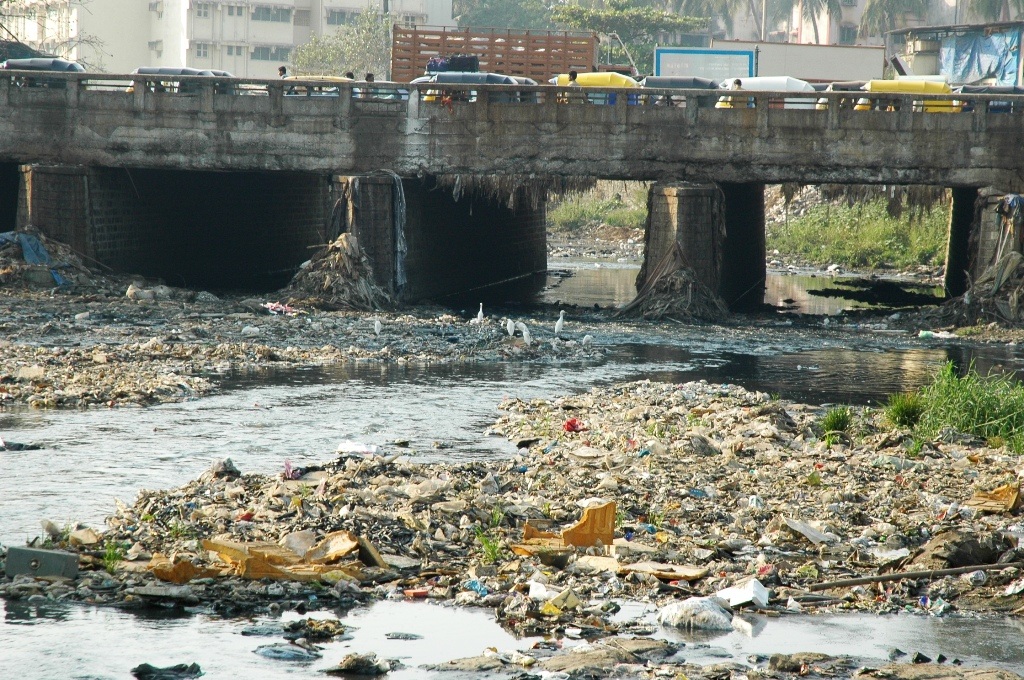
Banner image: A polluted river in an Indian city. Image by Jan jörg via Wikimedia Commons (Public Domain).