- A Parliamentary Standing Committee report found little improvement in India’s air pollution levels and recommended revisions to standards, better monitoring, and coordinated action across sectors and states.
- The report highlights gaps in implementation, uneven monitoring networks, and limited scope of current programmes, while urging long-term measures, crop diversification, and incentives for cleaner transport and electric vehicles.
- Experts stress that if the recommendations are implemented in a time bound manner within an accountable framework, it will definitely help reduce air pollution levels.
A Parliamentary Standing Committee tabled a strongly worded report on India’s air pollution management strategy on December 11, noting that “little improvement” had been made in pollution levels despite several programmes and schemes aimed at addressing the issue for more than a decade. The Committee made a host of recommendations, including changes in fuel use, public infrastructure, and crop diversification to improve air quality.
Air quality management is marred by poor capacity for implementation and siloed approaches to emission sources, Mongabay-India earlier reported. The National Clean Air Programme, the country’s flagship scheme setting targets to reduce pollution levels, only applies at the city level and is geared towards larger particulate pollution from dust (PM10), as opposed to the more toxic, harmful emissions from transport and industry (PM2.5).
Air pollution levels over the National Capital Region and adjoining areas worsened in early November and have hovered at poor to severe levels. On December 14, the Air Quality Index crossed 450, prompting several emergency meetings by the Commission for Air Quality Management (CAQM) and Ministry of Environment, Forests, and Climate Change (MoEF&CC).
Environment minister Bhupender Yadav directed officers to carry out site inspections to “eliminate pollution sources,” as per a press release. However, the Committee’s report notes that tackling air pollution requires long-term, sustained measures that “can only be met through the unwavering participation and coordinated action of all stakeholders.”
Standards and monitoring
The Committee first took note of the number of Continuous Ambient Air Quality Monitoring System machines and their distribution across the National Capital Region, noting that they are “heavily skewed towards the central and southern parts of the city, which are relatively less populated, greener and affluent than the rest of the city.”
Even though Delhi has the most dense network of CAAQMS in the country, numbering 38, the uneven distribution “systematically [excludes] the more polluted, densely populated, and less affluent localities,” resulting in a “distorted and non-representative dataset,” the Committee noted. The lack of an equitable monitoring network makes measuring compliance and implementing targeted measures difficult, experts say.
The National Clean Air Programme set targets for cities to reduce their PM10 air pollution concentrations by 20 to 30% this year, compared to 2017 levels. By 2026, cities are expected to reduce their pollution emissions by 40%, to meet the national standards of PM10 particles – 60 micrograms per cubic meter. However, the Parliamentary Standing Committee noted that the air quality standards themselves required revision, since they were last revised in 2009.
Current standards recommend PM10 levels don’t cross 60 micrograms annually and PM2.5 levels stay below 40 micrograms, which the Centre for Science and Environment told the Committee was “too lenient.” The World Health Organisation revised its standards to reflect the documented health impacts at minimal levels of exposure, recommending PM2.5 not exceed 5 micrograms per cubic meter and PM10 stay below 15 micrograms per cubic metre on an annual basis.
While achieving the WHO’s standards “seems very challenging and remote,” the Committee nonetheless urged the government to expedite the process of revising the standards, which have been under revision since 2021. India’s current air quality standards don’t factor in new evidence of the impacts of air pollution on health.
The Committee reprimanded the government for imposing high Goods and Services Tax on HEPA filters and air purifiers, which “effectively monetizes a public health failure,” and recommended either a reduction or complete abolishment of the tax.

Crop diversification
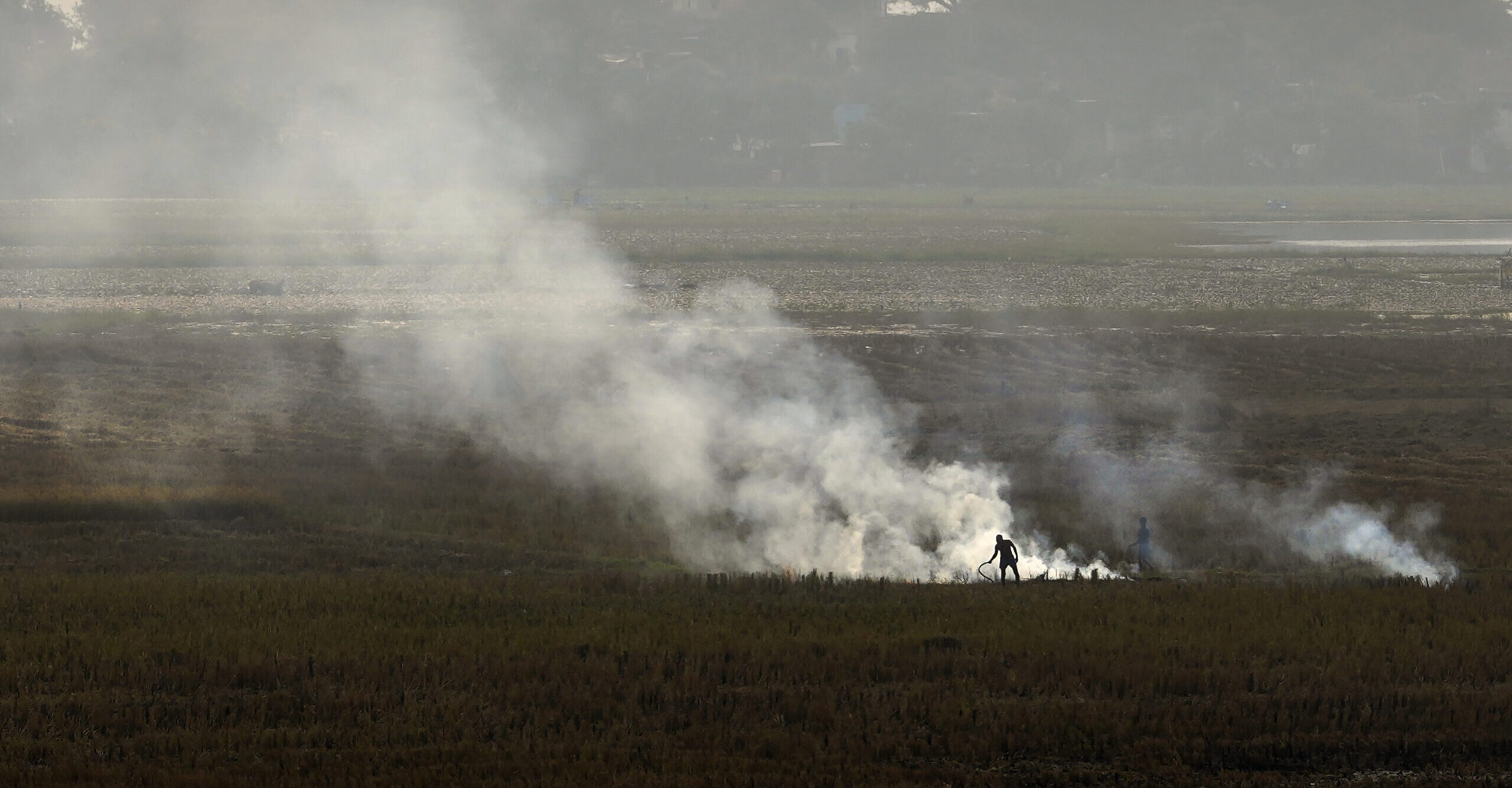
Apart from monitoring and standards, the Committee also made recommendations on agricultural practices in order to reduce emissions from crop residue burning. A long-term assessment of air pollution emissions sources found that the biggest sources of year round pollution came from transport, road dust, and industries. During the winter months, however, crop residue burning also contributes substantially to deteriorating air quality over the short-term.
Farmers burn their crop residue at the end of the kharif season, before sowing wheat for the onset of the rabi season. The window between sowing and harvesting periods was shortened when the Punjab government introduced the Preservation of Subsoil Water Act, 2009, to align paddy sowing with the monsoon season, to reduce groundwater extraction.
In its report, the Committee said that while the legislation was “well-intentioned,” it had “done more harm than good.” It commended the Punjab government’s recent announcement to schedule sowing based on canal water availability but said that the state government must ultimately “encourage diversification away from water-intensive paddy.”
To do this, the Committee recommended crops like millets, maize, pulses, and oilseeds with a premium Minimum Support Price, which would “make them financially more attractive than water-guzzling paddy on a per-hectare basis.” Additionally, the government would need to establish a guaranteed post-harvest value chain to procure these alternative crops and provide a direct benefit transfer of water saved against paddy cultivation, which could “provide a powerful and multifaceted economic signal for change.”
Haryana and Punjab have initiated schemes to incentivise crop diversification away from paddy, like the Mera Pani Meri Virasat (Water is my Heritage) scheme, which provides farmers who replace paddy with financial assistance of ₹7,000 per acre. However, media reports show that there are few takers because of paddy’s promise of procurement.
The Committee recommended the Delhi-based Commission for Air Quality Management — which governs the airshed over the NCR region — implement a joint action plan on crop residue management, to improve inter-state action, including banning long gestation and high residue varieties of paddy.

Infrastructure and electric vehicles
The Standing Committee also made recommendations to improve road transport infrastructure to reduce vehicles on the road and incentivise the adoption of electric vehicles. This included a recommendation to start a premium, aggregated bus service to “meet the expectations of commuters seeking a higher standard of comfort and reliability.”
To incentivise EV adoption, the Committee recommended introducing income tax benefits and reduced interest rates for EV loans. It also urged the government to fully operationalise the Delhi Meerut Rapid Transport System and prioritise the establishment of the Delhi-Gurugram-SNB and Delhi-Panipat-Karnal corridors to reduce congestion on the roads.
“The parliamentary committee report on air pollution is a positive addition to air pollution discussions, and if these recommendations are implemented in a time bound manner within an accountable framework, it will definitely help reduce air pollution levels,” said Sunil Dahiya, founder of Envirocatalysts, a data research organisation focussed on air pollution. “The only thing we have to keep in mind is that none of these solutions are new. Where we have failed till now is implementation. The big question is whether we have the political will to act aggressively and decisively on emission sources guided by data, and whether this opportunity of bringing political consensus on air pollution will meet the same fate as previous efforts.”
Banner image: A farmer burns crop residue after harvest near Bundelkhand expressway, around 330 km from New Delhi. (AP Photo/Manish Swarup, File)