- There is a growing trend of productive people leaving polluted metros for smaller cities, leaving behind growth prospects and their roots for cleaner air.
- Pollution is driving people to shift either in the short-term, to avoid bad air quality days; seasonally, to avoid the pollution season, or a full-fledged relocation, experts say.
- The ability to exit, however, is unequal. The affluent can afford to distance themselves from pollution, while poor households remain disproportionately exposed.
Air quality did not enter Amitabh Chawla’s life as a statistic; it arrived as grief. By the time his mother died in 2024, eight years after his father, the Gurugram-based multimedia professional had started seeing air pollution as a generational toll.
“My grandparents lived into their 90s. My teetotaller parents did not make it past their 60s. The difference, I believe, is the air,” says Chawla, 44. “Somehow, a fear has seeped into me that if we continue to breathe this poisonous air, it is going to take a toll on my family and me. For a generation that grew up in a polluted environment, I don’t think our bodies can endure for long.”
Over the past two years, this concern has changed how the Chawlas live. Summers are spent at their ancestral home in Dugri village, Ludhiana, Punjab, away from Haryana’s Gurugram, a thriving business destination home to multinational corporations, manufacturing clusters, IT firms, and startups, among others.
When the stubble-burning season begins around September and air quality starts to deteriorate in North India, the family rents a house away from the region, such as in the coastal town of Puri in Odisha, for weeks.
“For the last two years, we have been living like nomads to escape pollution,” says Amitabh Chawla, who is currently in Puri, a coastal town known for its long stretches of greenery, pristine beaches, and Lord Jagannath Temple.
To overcome this ordeal, the family is now exploring permanently shifting to an East Asian country, a decision, according to Chawla, is driven by “better air quality than aspirations.”
“You don’t understand what pollution steals from you until you start struggling to breathe and do basic chores,” says Arvind Kumar who works with a New Delhi-based think tank.
When Arvind Kumar started working in Delhi, following his European education, he embraced the metropolitan’s intensity as part of growth, until air pollution began taking a toll on his health. A regular jogger, he started struggling within 500 metres. “I felt breathless and had to make several stops during my jog,” he recalls.
Morning jogs often became indoor workouts, his throat felt like sandpaper, weekends became recovery days, and frequent sinus flare-ups became the new normal.
“The situation was bad,” he said, adding that the breaking point came when one day, while buying vegetables, he saw a brown layer of dust settled on them. “It was impossible to ignore.”
Kumar requested a location transfer and moved to Kolkata in October 2025, trading Delhi’s grey haze for air that is not as hell. “The change was immediate — my sinus issues subsided, my stamina was restored, and I am in parks for morning jogs,” says Kumar.
Chawla or Kumar are not isolated cases. There is a growing trend of internal migration, triggered by the environment, where productive people are leaving polluted metro cities for smaller cities or cleaner places, not driven by better growth prospects or the pull of their roots, but by cleaner air.
According to a recent survey conducted by community-based civic engagement platform LocalCircles, at least 8% of the 16,454 respondents in Delhi NCR stated they are likely to move out due to the worsening air quality. Around 82% of 8,090 respondents claim they had/have one or more individuals in their close social network with a severe health condition induced due to air pollution. To gauge the public sentiment, the survey was conducted in early December 2025 via the “LocalCircles platform, and all participants were validated citizens who had to be registered with LocalCircles to participate.” The survey received over 34,000 responses from residents of Delhi, Gurugram, Noida, Faridabad, and Ghaziabad to its various questions, claimed Local Circles, of which 64% were men and 36% were women.
Delhi recorded no “good” air quality days in 2025. From October onwards, the air quality started deteriorating. In November and December, pollution levels frequently exceeded the “severe” and “hazardous” thresholds.
In search of cleaner air
As people move away from polluted air, the trend is emerging in three ways: short-term, seasonal, and permanent. While some people leave the city or travel for a few weeks during severe pollution episodes, seasonal movers move out of the city for a few months to avoid the peak pollution season. Meanwhile others permanently shift to another city by switching their jobs or professions.
“I work in Kolkata, and my family is in Delhi. This year, out of pure concern for air pollution, I brought my wife and daughter to Kolkata for almost four weeks from late November. You can call my family a short-term pollution migrant, but this crisis is real and altering our lifestyle decisions,” explained an area sales manager of a leading automobile manufacturer, who declined to be named due to his company policy.
Advocate Prashant Kalra, who permanently shifted from Delhi to Goa, started a real estate agency six years ago. Delhi’s worsening air quality had begun to take a visible toll on his three-year-old daughter. Nights broken by breathlessness and regular nebulisation became part of everyday life. So did the worry. “My daughter was constantly unwell… the pattern had become unmistakable that pollution was making her sick. So, we decided to relocate,” says Kalra over a telephone interview from Goa.
“I didn’t leave Delhi in search of a better career or lifestyle. I left the city because I realised my daughter deserved a better environment. No parent should have to choose between their home and their child’s health,” he laments.
Explaining the psychology behind such decisions, Stuti Kumar, a Pune-based psychologist, says air pollution, conventionally an abstract and invisible issue, has now become tangible and visceral.
“The physical experience pushes people from ‘we should manage’ to ‘we must leave’. It is a typical fight-or-flight response,” Stuti Kumar says.
“When people experience pollution as a constant threat to their health, children and future, the body and mind react, much like it would in case of danger. People first display fight response by trying to control or reduce the threat — wearing a mask, investing in an air purifier, etc. But once the danger feels unavoidable or overwhelming, they migrate, they exhibit the flight response,” she explains, adding that she is getting queries from residents of Pune and Mumbai about air pollution-related stress and anxiety and of possible pollution-induced migration.
So, what pushes people to make the move?
Three factors — capability, opportunity and motivation — affect pollution-driven migration, says Arvind Kumar, who is also a behavioural science expert.
Awareness of the problem and its consequences play as crucial a role as the opportunity for livelihood and social acceptance of their choice. The final trigger is often the immediate discomfort and health issue caused by pollution. The unspoken anxiety about pollution’s long-term impact on quality of life is a constant feeder here, he explains.
The cost of leaving
The ability to exit, however, is unequal. The affluent can afford to distance themselves from pollution, while poor households remain disproportionately exposed and forced to move when livelihood options disappear or health costs spiral. Daily wage workers in the informal sector also face significant job losses and financial distress when construction activities are halted due to pollution control measures. However, it is not easy for them to migrate.
Like most migrants, Khalida Khatun came to Noida, Gautam Budh Nagar, from a remote village in West Bengal in search of a better life and higher wages. She is happy with her ₹10,000 monthly income, almost five times more than her village days, but the toxic air is affecting her eight-year-old daughter, who often falls sick and struggles with respiratory ailments. “But going back is not a choice I can make yet — the livelihood option back home is very limited. But I am saving money to return to my village in a few years,” says Khatun, who has a goat-rearing business in mind.
Mumbai-based marketing consultant, Chintan Bhiwandhar, has spent the last five years contemplating whether the worsening air pollution is reason enough to migrate. “The air quality is a real threat. But there is an opportunity cost to leaving a metro city for a smaller town. Metros continue to concentrate high-paying jobs and growth opportunities. You don’t just leave pollution behind, you also leave income and career growth,” says Bhiwandhar.
“Remote work is not a viable option for professionals of every industry,” he says, further adding that for elderly dependent parents, migration equals uprooting them from their social life and familiar healthcare.
Another hidden opportunity cost of pollution-induced migration is children’s education, explains Mumbai-based Smriti Singh, a writer-director in the film and TV industry. “At times, I wish to leave Mumbai’s polluted environment, but feel trapped by the lack of competitive education options in smaller cities. I am ready to compromise on my career, but I can’t ask my son to settle for lesser opportunities.”
From an economic perspective, this ‘green flight’ from cities due to pollution could mean a near-term talent leakage and labour supply chain imbalance in future, if not immediately, explains K.R. Shyam Sundar, a former professor at Xavier School of Management (XLRI) Jamshedpur and a labour economist based in Mumbai.
A recent corporate development that drew headlines reflects the talent leakage Sundar was hinting at. Rajkumar Bafna, the finance head of pharma company Akums Drugs and Pharmaceuticals, resigned from his position in December, citing Delhi air pollution as the reason.
“Cities do not function in isolation. For example, Mumbai depends on Greater Mumbai, Navi Mumbai and other adjoining areas as reserve zones for both manpower and capital. The same reference can be found in other megacities, such as Delhi NCR. Environmental stress in the core economic zone inevitably transmits economic stress to other areas,” says Shyam Sundar.
These people, who are moving out and planning to do so, possess specialised skill sets; their migration means leakage of human capital during their most productive years. Treating pollution-induced migration as a temporary disruption would be a clear miscalculation, he says.
Read more: Air pollution smothers productivity
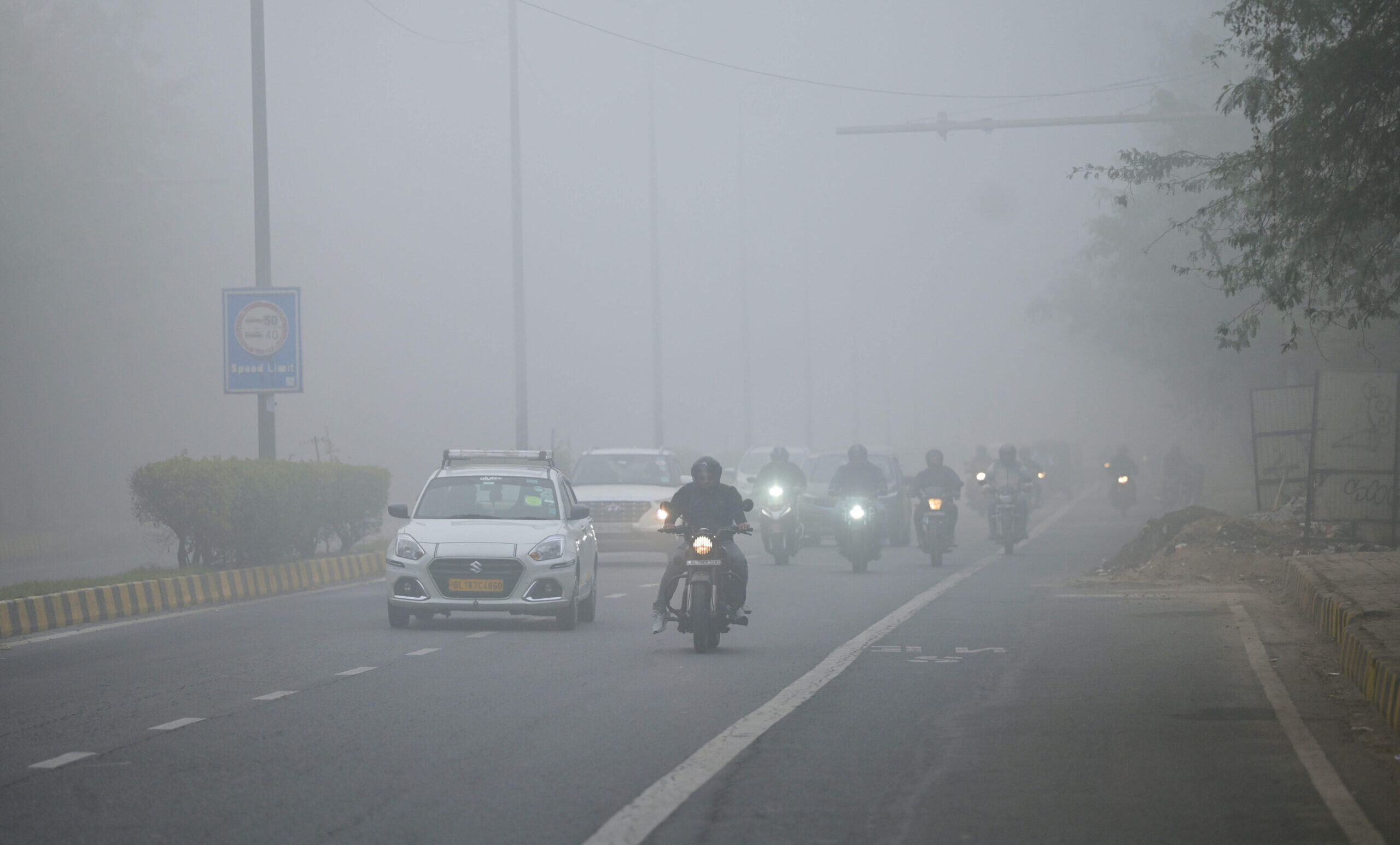
Banner image: Vehicles move through dense smog in New Delhi in December 2025. (AP Photo)