
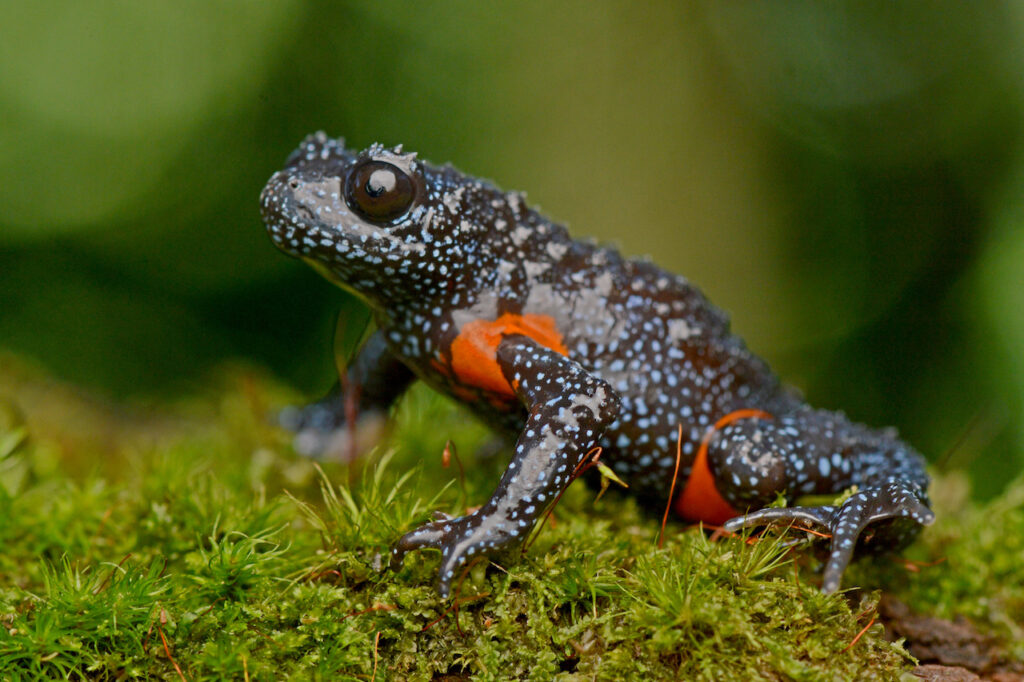
- A population of rare galaxy frogs disappeared from the Western Ghats in Kerala after photographers overturned logs, trampled vegetation and handled animals improperly, a new study reports.
- Researchers suggest managing photography tourism with measures such as restricting animal capture and handling, limiting the use of high-intensity lights, avoiding habitat disturbance, training licensed guides in ethical practices and imposing penalties for violations.
- Galaxy frogs are the only member of their genus on the evolutionary tree of life, making them one of the world’s most unique threatened species.
Seven threatened galaxy frogs (Melanobatrachus indicus) are gone from a research site in the Western Ghats in Kerala after photographers seeking images of the rare, star-patterned amphibians destroyed their delicate forest floor habitat, according to a short article published in Herpetology Notes.
Researchers found the seven tiny frogs beneath rotting logs at the site in March 2020. Upon returning in August 2021, the team discovered that the 25 logs had been overturned, the surrounding vegetation was trampled, and all seven frogs were gone.
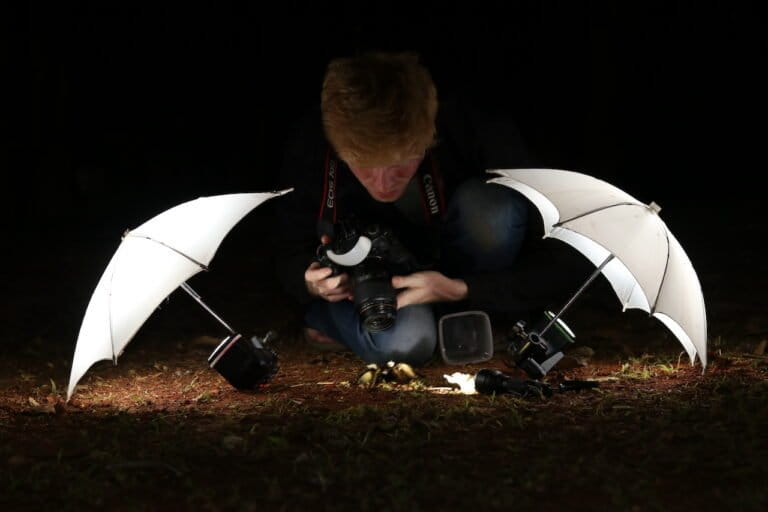
An anonymous informant reported that multiple photographer groups had visited the site between June 2020 and April 2021. According to the informant’s account, photographers turned over logs to find the frogs, used high-intensity flash photography and handled multiple individuals without gloves — practices that can cause dehydration and stress to the frogs as well as risk disease transmission.
Groups of four to six photographers would each photograph the same individuals, with sessions lasting approximately four hours. The informant reported that two small frogs died during photography sessions, though researchers could not verify this claim.
The galaxy frog measures just 2-3.5 centimetres and lives only in the southern Western Ghats, where it nestles under logs and stones on the forest floor at elevations above 900 metres.
“Named after their stunning resemblance to images of space, these beautiful yet rare frogs are unlike anything else on our tiny corner of the universe,” said K.P. Rajkumar, lead author of the study and fellow of the Zoological Society of London’s EDGE of Existence Programme. “Without careful and responsible management, we risk them disappearing off the face of the planet for good.”
These frogs represent the sole member of their genus on the evolutionary tree of life, making them classified as an evolutionarily distinct and globally endangered (EDGE) species, a designation for the world’s most unique threatened species. The species is currently listed as vulnerable on the IUCN Red List.
The Western Ghats harbour exceptional biodiversity found nowhere else on Earth. This UNESCO World Heritage site has proven extraordinarily rich for finding new-to-science species in recent years.
Biologist Zeeshan Mirza has found more than 60 new species, including snakes, tarantulas and geckos across the region. On a single expedition, Mirza found four new tarantula species. However, this biological richness faces mounting threats.
However, “some species may not even get named before they go extinct,” Mirza, who was not involved in the galaxy frog study, told Mongabay.


Human population growth is among the major threats to biodiversity hotspots, including the Western Ghats, according to Mirza. “Nearly all issues that threaten biodiversity globally are linked to the human population,” he said.
The conversion of Western Ghats forests into agricultural land for coffee and tea cultivation has already led to habitat loss for the galaxy frog. Now, well-intentioned but destructive photography tourism presents an additional threat.
“This sad event is a stark warning for the consequences of unregulated photography,” Rajkumar said. “While their colouring and rarity makes the galaxy frog a sought-out subject for photographers, it’s vital that those wishing to photograph these unique frogs don’t inadvertently contribute to their extinction — it would be a tragic irony if a drive to capture their likeness on camera today turned them into a thing of the past.”
The risks of publicising rare species extend beyond photography. When Mirza and colleagues described a tarantula with metallic lustre (Chilobrachys psychedelicus), “this species was unknown to the world until the description, and sadly, eight months after the description, the species was on sale across online pet stores in the U.S. and Europe,” Mirza said.
Such incidents explain why researchers increasingly withhold precise location data, as the authors of the galaxy frog study did. “Pet traders and collectors rely on new species description papers to get information on the distribution and specific localities,” Mirza explained.
The study authors say that while nature photography can raise awareness, it requires careful management. The researchers recommend restricting animal capture and handling, limiting high-intensity lights, avoiding habitat disturbance, training licensed guides in ethical practices and imposing penalties for violations.
“Done correctly, photography can be a huge asset to helping conservationists build our understanding of areas such as animal distribution or behaviour — plus, the resulting pictures can help educate others about these incredible species,” Rajkumar said. “However, irresponsible photography can turn this asset into a hazard.”
India has already implemented some photography restrictions following similar incidents. Unethical actions by nature photographers led to a ban on bird nest photography in competitions and restrictions on photographing the great Indian bustard (Ardeotis nigriceps) during breeding seasons.
The galaxy frog became the flagship species for Mathikettan Shola National Park in Kerala in 2021, raising its profile among photographers — and potentially increasing pressure on populations.
“A picture can inspire someone to care, to learn more, to take action,” said Benjamin Tapley, ZSL’s curator of reptiles and amphibians and study co-author, “but that picture-perfect moment should never come at the cost of the animal’s well-being or its home.”
This story was reported by Mongabay’s global team and first published here on our Mongabay global site on December 18, 2025.
Banner image: Galaxy frogs in the Western Ghats. Image by K.P. Rajkumar/ZSL.

