
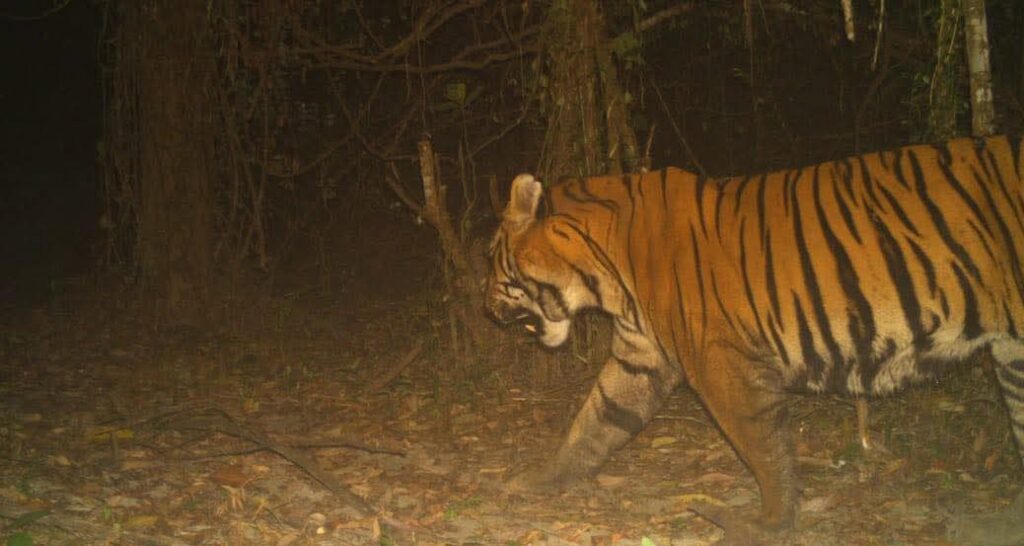
- After unconfirmed reports of tiger presence, there is now photographic evidence of the Bengal tiger in Dibru Saikhowa National Park and Biosphere Reserve in Assam.
- The photographs, obtained through a camera trapping exercise using 60 cameras, are the first documented evidence of the big cat’s presence in this region.
- Conservationists say this should prompt authorities to tighten anti-poaching measures in the region.
The first photographic evidence of the Bengal tiger (Panthera tigris) was recently recorded in Dibru Saikhowa National Park and Biosphere Reserve in Assam.
The region had tigers in the 1990s, but there has been no documented evidence to establish the status of the tiger population. Small camera trapping exercises in earlier years did not bear fruit until recently, when around 60 cameras were installed and a tiger’s presence was successfully documented.
The Dibru Saikhowa National Park and Biosphere Reserve comes under the Tinsukia Wildlife Division. In 1997, the biosphere reserve, with an area of 765 square kilometres, was declared. Then, in 1999, its core area of 340 sq km was declared a national park.
“Since the inception of the national park, this is the first time a tiger has been caught on camera in Dibru Saikhowa,” Bibison Tokbi, the Divisional Forest Officer (DFO), Tinsukia Wildlife Division, tells Mongabay-India. “We captured the tiger twice on camera trap, first on December 14, 2025, and then on January 1, 2026. Both the images were of the same tiger.”
He adds that the staff have recently discovered some pug marks of another tiger as well, indicating the presence of multiple big cats.
There have been prior unconfirmed reports of tiger presence in the region, says Tokbi, whose team set up many cameras to increase the chances of photographing the tigers.
“In 2009, our staff had seen pug marks of a tiger. The incumbent DFO set up two cameras but nothing was captured on it. In 2024, DFO KN Das also tried the camera trap exercise but that didn’t show anything either. When I took charge in September last year [2025], the staff told me about seeing pug marks of tigers. I arranged cameras from the Digboi division and installed 60 cameras. Finally, we tasted success this time,” he says.
In addition to tigers, the camera traps also recorded species such as the black panther, leopard, leopard cat, wild buffalo, wild boar and porcupines.


According to local environmentalists, there used to be signs of a good population of tigers in Dibru Saikhowa in the 1990s. “In 1992-94, I was posted in Tinsukia, and I myself saw tiger pug marks several times in Dibru Saikhowa,” says Anwaruddin Choudhury, a retired bureaucrat and environmentalist. “I had raised the demand of making Dibru Saikhowa a tiger reserve at that time.”
Additional Secretary to the Chief Minister of Assam, K.K, Dwivedi, who was Deputy Commissioner (DC) of Tinsukia in 2007-09, adds that he too regularly received reports of tiger sightings in Dibru Saikhowa at that time. “But we didn’t have camera traps to confirm its presence,” he says, adding that having photographic evidence of tiger presence is a positive development.
Where did the tigers go
Former Honorary Wildlife Warden of Tinsukia, Joynal Abedin, shared with Mongabay-India that Dibru Saikhowa had 27 tigers in 1993 and 37 in 1997. There isn’t evidence for what happened to those tigers. Choudhury suspects the tigers may have been lost to unreported poaching and loss of habitat.
Being a low-lying flood plain, the park is surrounded by Brahmaputra and Lohit Rivers in the north and Dibru River in the south. “So, as the intensity of the floods increased, tigers moved elsewhere, most probably across the border to Arunachal Pradesh,” says Choudhury.
Researcher Shamikhu Changmai, who studies the famous feral horses of Dibru Saikhowa, feels that the lack of prey couldn’t have been the reason for the tigers moving away. “I don’t think finding prey is an issue for tigers here, as there are hundreds of khutis (traditional shelters for semi-nomadic herders) or cattle farms inside the forest, apart from wild prey like swamp deer and wild buffaloes,” he says.


Environmentalist Mridu Paban Phukan claims that a lot of unreported poaching occurs. “Not just tigers, other animals are killed by poachers in Dibru Saikhowa. I have myself seen bullet-ridden carcasses of wild buffalo,” he says.
Conservationist Niranta Gohain, who lives in the fringes of Dibru Saikhowa, supports the poaching theory. “We hear gunshot sounds here regularly at night. There should be proper investigation regarding the source of those sounds,” he says.
DFO Tokbi, however, says there have been no incidents of poaching during his five-month tenure.

Living with tigers
A unique feature of Dibru Saikhowa National Park is the presence of two designated forest villages — Laika and Dhadiya — inside the forest, in addition to 38 villages in the buffer zone of the park.
“Dibru Saikhowa became a protected forest later. We have been living here before independence,” says Bilas Sing Regon, an inhabitant of Laika. “There is a school here where they teach up to Class 8. There is no primary health centre, pharmacy or market. For any essentials or emergency, we have to go to the river ghat in our boat and from there hire a vehicle up to Tinsukia, a ride which takes an hour.”
Kadhai Sahni, who runs a khuti since three decades, says indirect encounters with big cats do occur. “I have a khuti with around 70 cows. We don’t see the tiger but feel its presence when it preys on our cattle. We don’t ask for compensation as we live in forest land and this is the loss we have to bear,” he says.
Apart from threats from wild animals, the villagers also face frequent displacement because of floods. Some of the inhabitants of Laika were rehabilitated by the government to Jagun, a locality near Margherita in Tinsukia district. “160 families from Laika were rehabilitated and there are still 400 families here. In Dadhiya, there will be around 800 families,” says Regon.
He adds that in the 90s, when there were a lot of tigers in Dibru Saikhowa, they would kill cattle regularly. “Now, if they return again, it will hurt our pockets. But this is definitely a news we welcome because what good is a forest without a tiger,” he says.
Read more: New DNA analysis reveals tigers feeding on more diverse prey
Banner image: Recently, the first camera trap image of a tiger in Dibru Saikhowa was captured by the forest department. Image courtesy of Chandra Mohan Patowary.

