
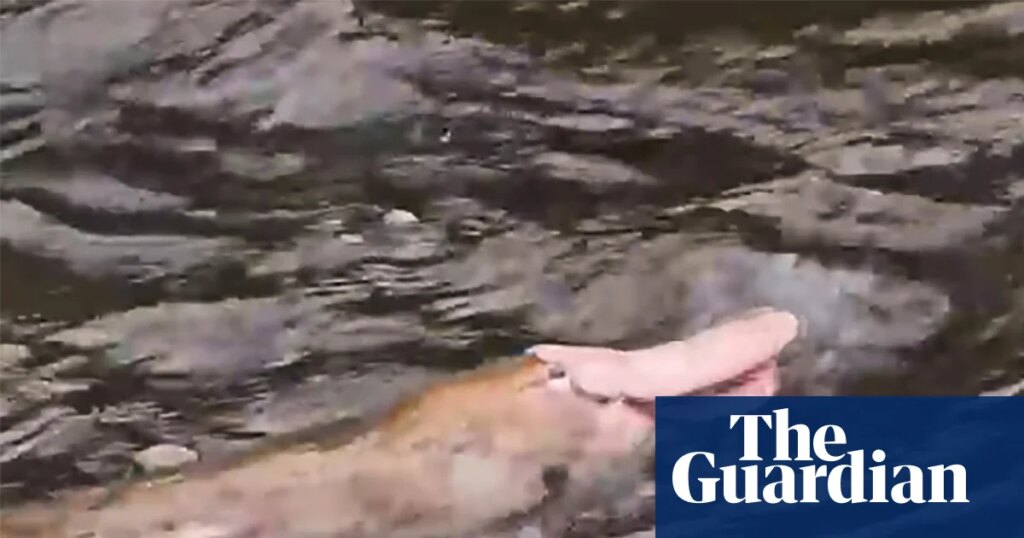
Cody Stylianou thought he saw a huge trout. But, skimming just below the surface, it was moving differently than a fish would.
The creature surfaced and, amazed, the Victorian fisher reached for his phone. Swimming in front of him was a pink platypus.
Stylianou regularly fishes in the Gippsland spot, which he is keeping secret to protect the rare animal. He thinks it could be the same one he saw years ago, just older and bigger.
“The bill and feet are super obviously pink,” he says. “When he did go a bit further into sunlit areas, he was easy to follow underwater, which is how I got so many videos of him surfacing.”
Stylianou had been on his first trout fishing trip of the season in September when he saw the platypus, which he has nicknamed “Pinky”. He watched it feed at the top of the tannin-stained river for about 15 minutes.
Sign up: AU Breaking News email
“I’ve seen other platypus in the same river system, just regular coloured ones,” he says. “Probably about five to eight of them over the years, from memory. Normally, they just pop up at the top of the water and then disappear once they see me.”
After Stylinaou shared footage of the monotreme, commenters online speculated that it could have been a rare albino platypus. But the biologist Jeff Williams says it is just lighter in colour than what most would expect.
“Platypus do vary a lot in colour,” the director of the Australian Platypus Conservancy says. “And this one’s at the extreme end of the light ones. It’s not one that we consider should be added to the list of albino and leucistic ones.”
Just as humans have different coloured hair or skin pigment, platypus also come in different variations, Williams says. He said the platypus captured on video was “unusual but not exceptional”.
“What I’ve seen and what every other leading platypus person has looked at, it says, is that it’s well within the sort of variation in colour that one would expect,” he says.
“Let’s put it this way, it’s cute, but it’s not a breakthrough … We think this is just one of the extreme ends. Every so often, you will get a genetic anomaly that just throws up things, just as it does with some humans, who have more freckles and so on.
“It’s somewhat unusual, but it’s nothing to get particularly excited about, we’re afraid.”
The platypus is listed as near-threatened on the International Union for Conservation of Nature. There has also been a decline in Victorian populations, making them more vulnerable, Williams says.
“Platypus were in significant decline up until about the 1990s when all the impact of European settlement on our waterways was becoming apparent,” he says.
“We messed up pretty much the flow of every river we’ve got. We cleared native vegetation along most of our waterways, and, not surprisingly, that put a lot of pressure on the platypus population.”
Replanting programs along the waterways, and consideration of environmental impacts near rivers, have started to help the population come back.
“We’ve still got a way to go, and we can’t be complacent,” Williams says.
“But the good news at the moment is most of the survey work that’s being done around the place is suggesting numbers that are coming back, certainly the number of sightings in some places where there was concern.”