
- A new study using drone-based monitoring in Delhi found that PM2.5 concentrations were up to 60% higher at around 100 metres above ground than at street level during hazy mornings.
- Researchers say ground-based monitoring alone may underestimate pollution exposure in high-rise urban areas, especially under shallow boundary layer and high-humidity conditions.
- The widely used WRF-Chem air quality model underpredicted PM2.5 by over 50% during haze episodes, largely due to humidity bias and incomplete representation of aerosol chemistry.
On hazy winter mornings in Delhi, the air people breathe at street level may not tell the full story.
A new peer-reviewed study published in Nature npj Clean Air reports that PM2.5 concentrations were up to 60% higher at around 100 metres above ground compared to surface levels during severe haze episodes. The findings suggest that pollution can accumulate not only near roads and traffic corridors, but also higher up at an altitude where many residents and office workers in high-rise buildings spend much of their time.
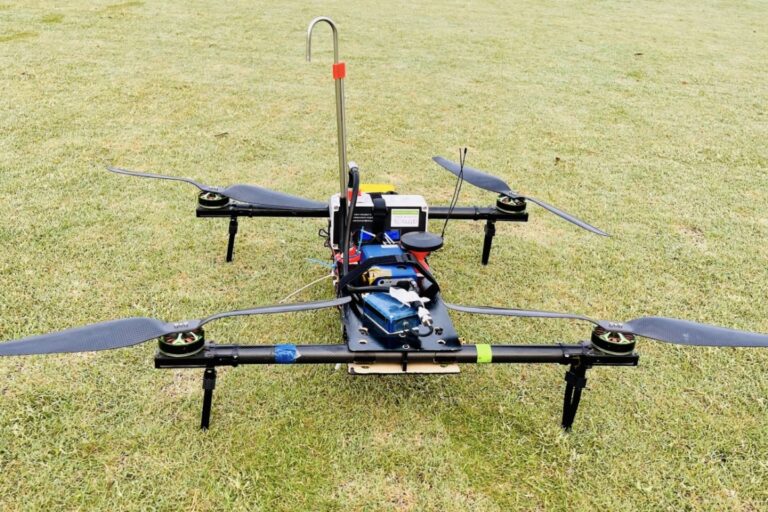
Using a custom-built drone equipped with low-cost particulate matter sensors, researchers conducted multiple flights over South Delhi in March 2021. On one hazy morning, PM2.5 levels reached around 160 micrograms per cubic metre at 100 metres, compared to roughly 100 micrograms per cubic metre at ground level.
Ajit Ahlawat, Assistant Professor at Delft University of Technology and lead author of the study said about the finding, “This indicates that ground-based monitoring alone substantially underestimates actual exposure to pollution in the lower urban boundary layer, especially during haze episodes.”
Traditional air quality monitors typically measure pollutants around five to ten metres above the ground. “This misses vertical gradients in shallow nocturnal boundary layers that trap pollutants aloft,” Ahlawat said, referring to the different heights in the layer of air close to the ground that forms at night which can go up to 300 metres or higher.
He added that hygroscopic particle growth, where particles absorb moisture and grow, and secondary aerosol formation often occur at higher elevations. “Populations living or working on higher floors in urban environments may be exposed to PM2.5 concentrations much higher than ground monitors indicate, especially during haze conditions,” he said, warning that they could underestimate health risks and policy frameworks that rely solely on ground-based monitors.
Why pollution builds up overnight
Delhi’s early morning haze is linked to the layer of air close to the ground that forms overnight and high humidity. At night, when that layer of air drops below 200 metres, the wind speeds weakens and pollutants emitted from traffic, industry, and waste burning remain trapped.
A major reason driving the early morning haze in Delhi is the aerosol hygroscopic growth, where the pollution particles absorb moisture and grow in size, explained Ahlawat, adding that particle growth increased when there was high relative humidity, above 70%, and when certain hygroscopic inorganic chemical compounds such as ammonium nitrate and ammonium chloride were present. In the humid pre-sunrise hours, this moisture-driven growth of pollution particles can make pollution levels higher in the air higher above than close to the surface.
Current air quality models don’t capture this variation in pollution levels depending on height in the air.
Models missing the morning spike
The researchers compared drone measurements with simulations from the widely used WRF-Chem air quality model. During haze, the model underestimated relative humidity by over 30% in the atmospheric layer about 100 metres from the ground. It also estimated about 50% lower PM2.5 than actual amount.
Ahlawat explained that the WRF-Chem model has a humidity bias that is leading it to underestimate the PM2.5 mass compared to the drone findings. He said that the model does not adequately represent multiphase chemistry and particle phase transitions. Larger particles rich in chloride and nitrate absorb water and significantly enhance secondary aerosol formation under high humidity, processes that current model configurations do not fully simulate.
Co-author of the study, Mira Pöhlker, a professor at Leibniz Institute for Tropospheric Research (TROPOS) and Leipzig University, said in a statement that the discrepancy “may be due to the dry bias of the model, which limits its ability to simulate aerosol hygroscopic growth at high humidity values.” Dry bias is a systemic error where the model predicts less precipitation than actually observed.
If forecasting systems underestimate early-morning pollution spikes, public health advisories may not fully reflect peak exposure conditions.

Drones could complement monitoring systems
India’s air quality monitoring network is predominantly ground-based and designed for regulatory compliance. It does not routinely capture vertical pollutant distribution within the atmospheric boundary layer, a dimension critical for understanding dispersion, chemical transformation and pollutant build-up under stagnant conditions, when the air speed is low and pollution is trapped near the ground.
Prachi Goyal, an air quality professional and Clean Air Asia representative in India, said drone-based vertical profiling is technically feasible as a supplementary platform to the existing air quality monitoring.
“These unmanned aerial systems can sample multiple altitudes within short timeframes, enabling characterization of vertical gradients, mixing heights, and pollutant layering over urban areas,” she said.
She noted that such measurements are particularly relevant for Indian cities that experience shallow boundary layers, strong winter inversions and enhanced secondary aerosol formation.
However, to use drones regularly in the monitoring system, there would need to be clear rules for checking and calibrating the sensors, correcting the data for humidity and temperature, ensuring data quality, and getting proper permissions from aviation authorities.
“In practice, drone-based systems would be most valuable during high-pollution episodes to characterize boundary layer suppression and early morning concentration build-up that fixed ground monitors alone may not fully resolve,” Goyal said.
Low-cost sensors, she added, cannot replace regulatory-grade stations. “Regulatory decisions should continue to rely on reference-grade data,” she said. But when properly calibrated, such sensors can generate high-resolution spatial and vertical datasets useful for model validation, forecasting improvements and evidence-based emission strategies.

Exposure in high-rise cities
The findings also raise questions about exposure to air pollution in cities dominated by multi-storey buildings.
Most exposure frameworks, that assess how people encounter pollution, assume relatively uniform near-surface concentrations of pollutants. However, under strong temperature inversions and shallow mixing conditions, substantial vertical gradients can develop.
“Exposure can vary with height,” Goyal said, explaining that pollutant concentrations may increase or decrease across building floors depending on atmospheric stability and proximity to emission sources.
In the short term, city-wide public health advisories may not require structural changes, she said. However, incorporating vertical variability into exposure modelling, indoor–outdoor infiltration studies and building ventilation guidance could improve long-term health risk assessments in dense urban environments.
“Integrating drone-based vertical profiling with low-cost sensors is scientifically and operationally promising,” Ahlawat said. “These profiles revealed structures and processes that were missed by ground monitors and coarse models.”
While regulatory and operational challenges remain, he believes the technology is mature enough to complement existing systems. “Thanks to advances in sensors and drones, growing scientific interest, and support from authorities, I believe that researchers in India will be able to frequently monitor vertical profiles of air pollutants over the next decade.”
Read more: Drones take wildlife conservation to new heights
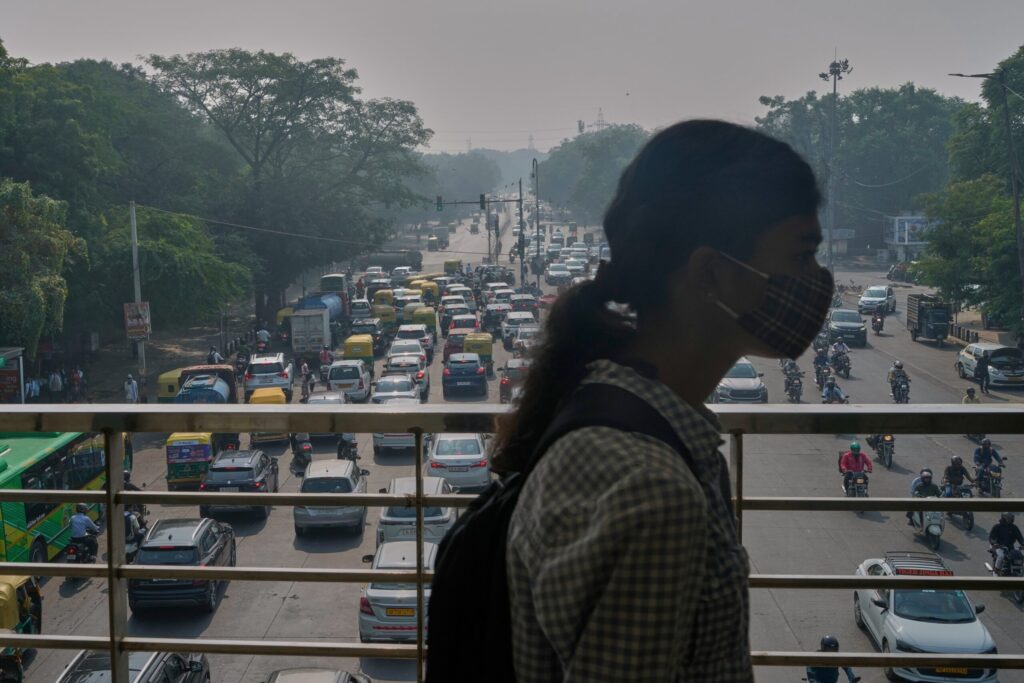
Banner image: A school girl wearing a face mask walks across a foot over bridge amidst smog in New Delhi in November, 2025. (AP Photo/Manish Swarup)

