“We didn’t know the organisation from where the food was coming. For us, it was the ‘Iskcon food’ truck, which entered school at 10 am. The aroma, especially of Saturday’s sweet Pongal, kept us motivated,” says 25-year old Vigneshwara V, who studied at a government school in Karnataka’s KG Halli and was an Akshaya Patra mid-day meal beneficiary from Classes 1 to 10.
Years later, in 2021, when Vigneshwara left his corporate job due to Covid, a friend told him about an opening at Akshaya Patra Foundation’s admin department – the place Vigneshwara was well accustomed to. “I went for the interview and the selection felt like a full circle,” he says at an event at Rashtrapati Bhavan to commemorate the organisation’s 25 years of service.
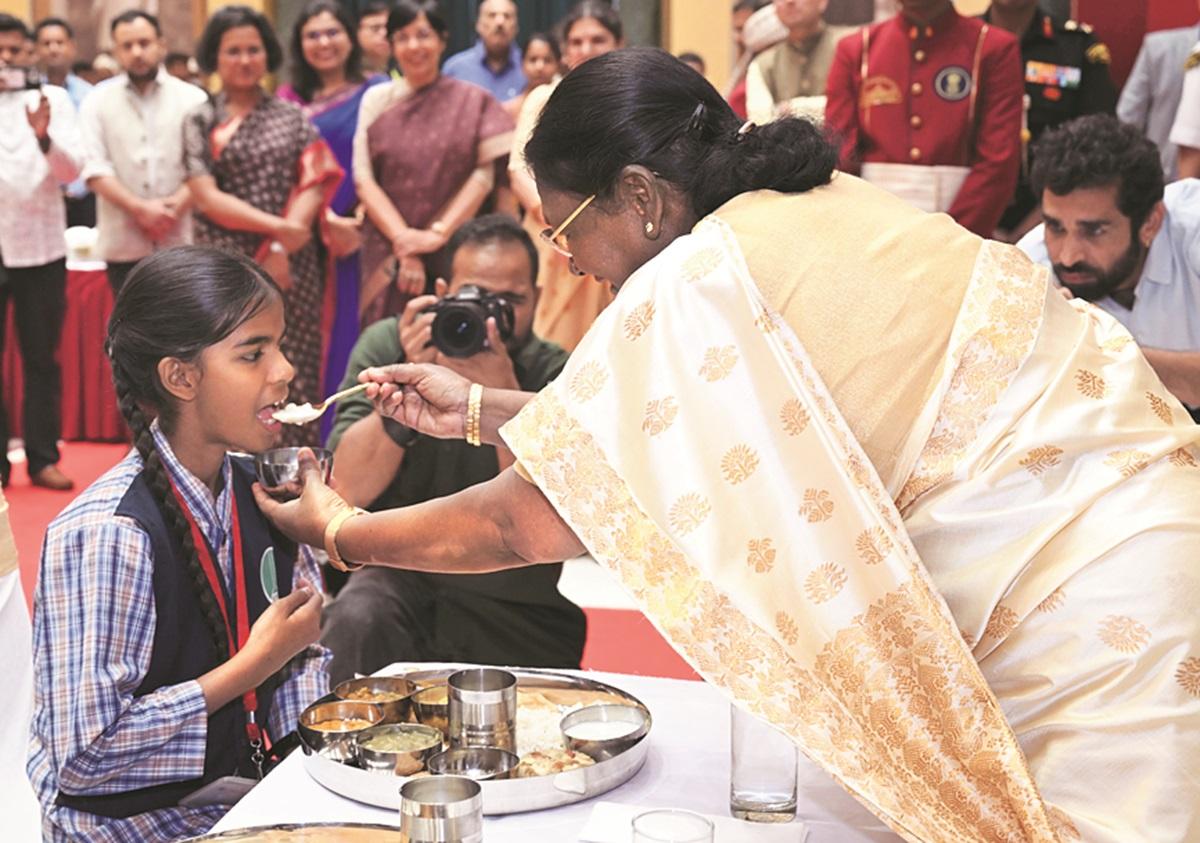
On Tuesday, the Rashtrapati Bhavan Cultural Centre, where the 5 billionth meal was served by President Droupadi Murmu, resonated with stories such as Vigneshwara’s.
Akshaya Patra today runs the world’s largest kitchen network and school lunch programme.
Engineers, PhD scholars, and teachers across Karnataka, Telangana, and Uttar Pradesh had joined the milestone event of the organisation, which not only fed them but, on some days, motivated them to attend school.
Among those who attended the event at Rashtrapati Bhavan were Education Minister Dharmendra Pradhan, Akshaya Patra founder Madhu Pandit Dasa and Vice-Chairman Chanchalapathi Dasa.
Started in 2000 from an Iskcon kitchen in Bengaluru, the foundation is now feeding 2.35 million children in 2,500 schools every day. This is done through its kitchens in 78 locations across 16 states and three union territories.
The organisation is the implementing partner for the flagship PM Poshan initiative and aspires to feed 3 million children every day by 2030. It now has over 9,000 employees, which it calls the hunger warriors.
“We identified that the pain of hunger is universally the same across religion, caste, and nationality,” says Pandit Dasa, adding that the aim is to bring the cost of each nutritious meal down through partnerships and technology so that more children can be fed.
“Even saving 10 paisa per meal gives us a chance to serve 4,000 more children annually,” he adds.
Currently the cost of an average meal is ₹17.44 with a government subsidy of ₹9.53. Over the period of 25 years, the organisation has received ₹3,681 crore in government subsidy and ₹4,612 crore as part of donations.
The foundation has also adopted artificial intelligence (AI) to streamline operations, including logistics, administration and nutrition study.
“Around 80 per cent of our kitchens are now semi-automatic. Operations like invoice reconciliation used to take days but AI has brought it down to hours. Moreover, we are developing our own AI tool called Yantra for captive consumption. It will generate instant analytics for the organisation,” Shridhar Venkat, chief executive officer (CEO) of Akshaya Patra told Business Standard.
Even after government subsidies and corporate support, the organisation is aware of the challenges. Hurdles like Covid and now the temporary LPG shortage have kept the organisation on its toes.
“Out of our 78 kitchens, 25 run on LPG. We are constantly in touch with the government and our suppliers. We have been assured of uninterrupted supply and the government is actually treating mid-day meals as a priority service,” he adds.
He says soon schools will have summer vacations, which is a slight relief as far as the crisis is concerned.
According to him, the idea is not only to grow but to sustain the growth because a child once fed, comes every day with the hope of getting a nutritious meal. “We try to keep the finance flow in check. Moreover, the aim is to remain passionate and be an organisation for which people want to work.”
Even with better technology and resources, the ground research, including timely school visits to access requirements of children, remains crucial.
Another beneficiary-turned-employee, Abhishek TC, school relationship officer for the organisation’s Mysuru region, says they often visit schools for quality check and sometimes understand preferences of the children.
“We have a fixed menu. It comprises a simple sambhar-idli-rice on most days and special sweets and bhaat on Saturdays. However, children sometimes put up demands and we have to do some convincing,” he says jokingly.
According to Venkat, quality is of utmost importance to the organisation — 52 out of its 54 kitchens received a 5-star rating in the last audit by the Food Safety and Standards Authority of India. “There are regular trainings and quality checks and each kitchen is assigned a quality officer,” he adds.