
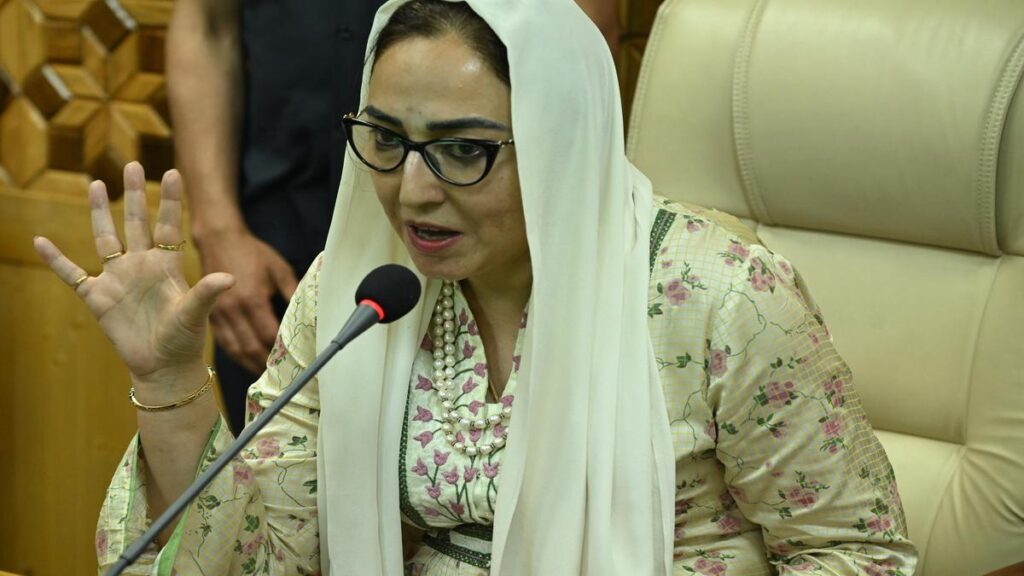
J&K Waqf Board chairman Darakhshan Andrabi addresses mediapersons at a function in Srinagar.
| Photo Credit: Imran Nissar
Jammu and Kashmir Waqf Board chairperson Darakhshan Andrabi on Friday (January 16, 2026) joined other Bharatiya Janata Party (BJP) leaders in Kashmir in defending the police move to profile mosques in the Valley.
“Verification of properties should not be viewed with suspicion. Just as land ownership in a household requires proper documents, religious properties like mosques, shrines, and gurdwaras also need verification. Imams, maulavis, and mosque committees need not to panic,” Ms. Andrabi said.
Stating that there was no political agenda behind the process of profiling mosques, Ms. Andrabi said, “When the Waqf Development Act was introduced and passed, it too was termed as interference in the religious affairs. There are a few people who do their politics on such issues. The fact is that J&K has emerged as a leading Union Territory in the registration of Waqf assets.”
“There is no need to politicise mosques or mislead people on this issue,” she added.
BJP spokesman Altaf Thakur said that for accountability and transparency of all institutions, surveillance and vigil was must. “Past experience tells us that mosques were used in Kashmir by maulvis to ask people to come out and hold pro-Pakistan rallies. Though it has been stopped in 2019 but still some elements use mosque as political platform and for propaganda,” Mr. Thakur said.
He said there was nothing wrong with finding out who was funding the mosques, the nature of the land on which a mosque was built and the ideology followed. “Wahabi ideology is the same as ‘sar tan say juda’ ideology. We need to know what is taught in these mosques. There should be no objection to it,” Mr. Thakur said.
The BJP leader said mosques in Kashmir were used in the 1990s to play pro-Pakistan songs. “Pakistan used local molvis in Kashmir in the 1990s. Recently, a doctors’ terror module was busted and traced to a moulvi,” Mr. Thakur said, while referring to the Red Fort blast in November last year.
The BJP’s stand followed a statement by the Muttahida Majlis-e-Ulema (MMU), a conglomerate of Islamic religious organisations in Jammu and Kashmir, which described the police profiling as “intrusive”.
According to the MMU, the police were distributing multi-page forms and sought details, including private identification details, family particulars, financial information, phone details, digital and social media profiles, passport details, travel history, and even phone IMEI details and other personal data of all those connected with the running and management of mosques.
The profiling of mosques was opposed by the ruling National Conference, the Opposition Peoples Democratic Party (PDP), J&K Peoples Conference, and the Communist Party of India (Marxist) in Kashmir.
Published – January 16, 2026 10:01 pm IST