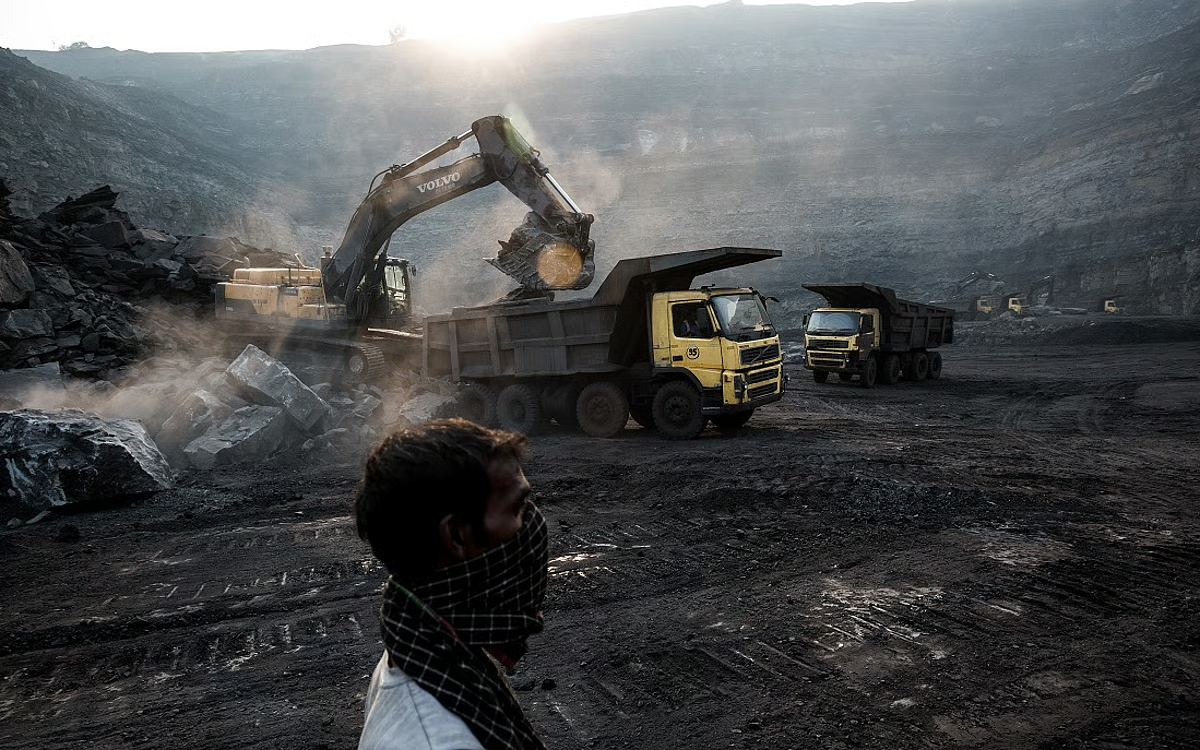
- A sloth bear conservation reserve and a thermal power plant are proposed at the same location in the Vindhyan forests in Uttar Pradesh.
- Even as legal proceedings are pending, wildlife conservationists say that the work on the coal-based plant, including clearing of vegetation and the construction of an approach road, is ongoing.
- Sloth bears have historically inhabited the dry deciduous forests and hilly terrain of Mirzapur. Protecting their habitats is key to the species’ survival.
A proposed conservation reserve for the sloth bear in Uttar Pradesh is caught in a prolonged battle with a thermal power plant. Even as scientific studies and forest officials support the proposal for a sloth bear reserve in the Vindhyan forests of Mirzapur, work on a 1,600-megawatt coal-based plant has advanced in the in the area, despite multiple legal challenges.
Sloth bears have historically inhabited the dry deciduous forests and hilly terrain of Mirzapur. Endemic to the Indian subcontinent, the sloth bear is the only species of ursid that has adapted to feeding on ants, termites and fruits, a trait critical for it to thrive in small home ranges, often in harsh conditions and with a degree of tolerance to human disturbances. Protecting the bear’s prime habitats is key to its survival.
“If the (thermal power plant) project is established at the proposed location, it would necessitate a railway line, water pipelines, transmission lines and approach roads, all through the contiguous forested landscape,” said Debadityo Sinha, co-founder of Vindhyan Ecology and Natural History Foundation (VENHF) and a graduate from the South Campus of the Banaras Hindu University (BHU) that adjoins the forest ranges. “It would spell disaster for the forest.”
A legacy of wildlife
Mirzapur has long been an important administrative and trading centre on the river Ganga. Its forests are rich in wildlife, and till about a century ago, there were even cheetahs reported from the savannah landscapes.
In 2019, a camera trap survey recorded the sloth bear and the Asiatic wild cat, the first ever record of the cat in Uttar Pradesh. This study, co-authored by the Divisional Forest Officer (Mirzapur) and Sinha amongst others, formed the basis of the proposal for the conservation reserve with the sloth bear as its flagship species. The reserve would be spread across three forest ranges, Marihan, Sukrit and Chunar, which are also important corridors for the protected areas that surround them.
Besides the sloth bear, the study also mentioned the presence of leopard, Bengal fox, striped hyena, Asiatic wild cat, rusty spotted cat, sambar, chinkara, blackbuck and mugger crocodile. There have also been reports in the local media of tiger movement from the adjoining protected areas such as Kaimoor and Chandraprabha Wildlife Sanctuary.

A coal power plant in a forest
Formerly owned by Welspun Private Ltd., the plant was acquired by Mirzapur Thermal Energy (UP) Private Ltd., a subsidiary of Adani Power Limited (APL). It seeks to establish two 800-MW coal-based plants that will use 6.4 million tons of coal per year. It is estimated to cost ₹18,300 crores. The site of the power plant is in the vicinity of the Marihan range, one of the three forest ranges integral to the proposed Sloth Bear Conservation Reserve, according to wildlife activists.
“The land where the company is setting up the plant was unscrupulously taken from farmers of Dadri Khurd village by local land mafia in 2011-2012 at very low prices,” alleged Santosh Giri, a journalist who is also part of the VENHF. He claims that the land was sold at a higher price to Welspun that originally owned the plant.
An earlier Environmental Clearance (EC) for a 1,320-MW plant proposed by Welspun Energy was challenged in court by Sinha and two others. The EC was eventually set aside by the National Green Tribunal (NGT) in December 2016, citing serious irregularities in the Environmental Impact Assessment (EIA) and concealment of critical information. It prohibited Welspun from carrying out any developmental work at the project site and asked it to restore the area to its original condition.

Around eight years later, in June 2024, the Adani subsidiary company applied for a fresh Environmental Clearance.
Sinha alleges that even before receiving the EC, “they cleared vegetation from forest land, did extensive earthwork, land levelling, erection of boundary walls and construction of an unauthorised approach road through reserve forests.” He pointed out that since project capacity has increased from 1,320 MW to 1,600 MW, the project proponent is required to obtain Forest Clearance (FC) for each component before the grant of EC, according to the legal requirement under the Forest (Conservation) Act 1980.
For projects requiring both FC and EC, forest clearance is to be obtained before the grant of environment clearance under the EIA Notification, 2006.
“According to a 1952 UP Gazette notification, the land proposed for this power plant in Dadri Khurd had been transferred to the Forest Department,” Sinha said. “Yet, the MoEFCC accepted the project proponent’s claim that the area does not involve forest land since it is not a notified Reserve Forest. The Supreme Court clearly states that the Forest Conservation Act 1980’s guidelines are not limited to just notified forests.”

Power plant cites legal land possession
In a previous response to the National Green Tribunal (NGT), the Mirzapur Thermal Energy (UP) Private Limited (MTEUPPL) said that all allegations filed against it were “false, incorrect and baseless”. The response stated that it was in “legal possession of the land” and therefore it had the right to fence it with a boundary wall.
A letter annexed with the same document, stated that the company had only conducted repairs to the existing boundary wall that had been built by Welspun, and that no work on the building of the power plant had begun on site. The response also said that the pictures submitted by Debadityo Sinha, Santosh Giri and others, as part of the report to NGT were “not geotagged and could therefore be misleading”.
In an earlier media interview, Dinesh Singh, the project manager of the plant, rejected allegations of building the plant on forest land. He told the news outlet that “the plant is on barren, rocky land with no rivers or irrigation potential”.
Giri, however, contradicts the statement saying that the plant is in the middle of the jungle and can be accessed only through one approach road, and is heavily monitored and secured. “So, it is not possible for people to know what is happening inside the plant’s boundary.
Mongabay-India reached out to Adani Power and the Mirzapur Forest Department for their comments but did not receive a response at the time of publishing.

The pending legal challenges
On September 23, 2025, Mirzapur Thermal Energy (U.P) Private Limited, was granted a fresh Environmental Clearance by the MoEFCC. The document mentions that the project boundary is 8.3 ha (0.8 sq.km.) which includes the water pipeline and the approach road. Stage-I Forest Clearance had been obtained for this on September 9, 2025.
Accepting the presence of Schedule-I wildlife species in the buffer zone during field survey and secondary sources, the EC states that a Wildlife Conservation Plan has been prepared and submitted for further approval to the State Forest Department.
“All parties were asked to respond by September 17, but so far only the MoEFCC has filed a reply, stating that they have recently granted the project an EC, and Stage-I FC for the approach road and water pipeline,” says Sinha.
Since the work by MTEUPPL had already commenced on-ground, it cannot be reversed. “Therefore, we have filed a fresh stay application supported by the recent photographs to bring the violations to the notice of the Supreme Court,” he added.
The next hearing in the Supreme Court was scheduled for November 11, 2025, a date that has since been pushed. “Ultimately what the Supreme Court decides can take a long time. Regardless, our team will keep the fight going for saving this land from any non-forest activity,” Sinha said, highlighting that the VENHF team is not against development, but it does not want the plant at that particular environmentally-sensitive location.
Read more: Supreme Court rolls back order banning post-facto environmental clearance
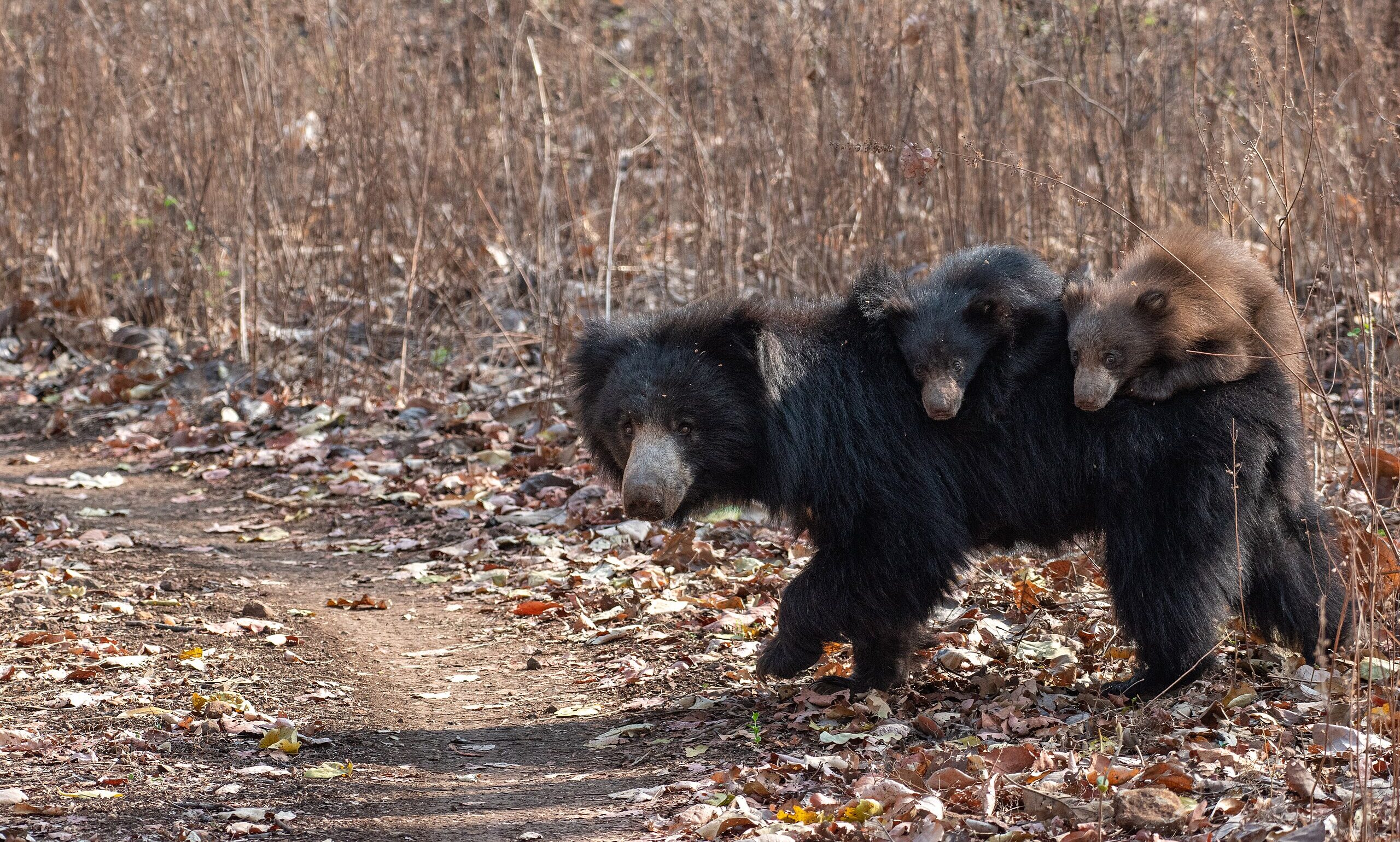
Banner image: A sloth bear with her cubs in Maharashtra. Representative image by Rohit Sharma via Wikimedia Commons (CC BY-SA 4.0).