New research suggests that the rapid expansion of protected areas worldwide is giving a misleading picture of progress, with biodiversity continuing to decline inside many sites designated for protection.
The report released December 2025 has called for a fundamental shift in how conservation is financed, urging governments and donors to prioritise long-term, predictable funding for management, enforcement and restoration.
Protected areas are widely seen as the world’s most powerful tool to halt biodiversity loss, and governments have pledged to protect 30 per cent of land and oceans by 2030 under the Kunming-Montreal Global Biodiversity Framework. The agreement, adopted by 196 countries at the UN biodiversity summit in Montreal in 2022, aims to halt and reverse nature loss by the end of this decade.
According to Protected Planet data from the United Nations Environment Programme, about 17.6 per cent of land and inland waters and 8.4 per cent of the world’s oceans are currently under some form of protection.
On paper, this appears to mark significant progress, with countries continuing to announce new national parks and marine protected areas. But researchers warn that many of these designations are failing to deliver real ecological protection, allowing biodiversity loss to continue within protected boundaries.
However, a growing body of scientific research is raising doubts about whether the rapid global expansion of protected areas is actually safeguarding nature, warning that headline gains are masking deeper structural failures in conservation.
Protection on paper, loss on the ground
Biodiversity continues to decline within many protected boundaries, ecosystems are being reshaped by climate change, and pressures such as fishing, invasive species and habitat degradation remain largely unchecked.
Researchers warn that global conservation efforts are increasingly focused on counting protected areas rather than ensuring they actually protect nature.
Marine protected areas are central to international conservation strategies. Yet a published in npj Ocean Sustainability found that many such areas protect lines on maps rather than marine life in the water.
The study, led by R R E Stanley of the Bedford Institute of Oceanography at Fisheries and Oceans Canada, with co-authors from Europe and Australia, found that most countries measure success by the size of ocean areas designated as protected, not by whether fishing pressure has declined or ecosystems are recovering.
As a result, many marine protected areas continue to allow industrial fishing, bottom trawling and other damaging activities.
Europe offers a striking example. More than 80 per cent of marine protected areas in the European Union have only weak restrictions on human activity. In many cases, fishing pressure inside protected areas is higher than in surrounding unprotected waters.
Despite this, these areas are still counted towards global conservation targets, creating what researchers describe as a misleading picture of progress.
Climate change undermining protected areas
On land, evidence suggests protected areas are also under growing strain. A published in Nature Sustainability shows how climate change is undermining conservation efforts from within.
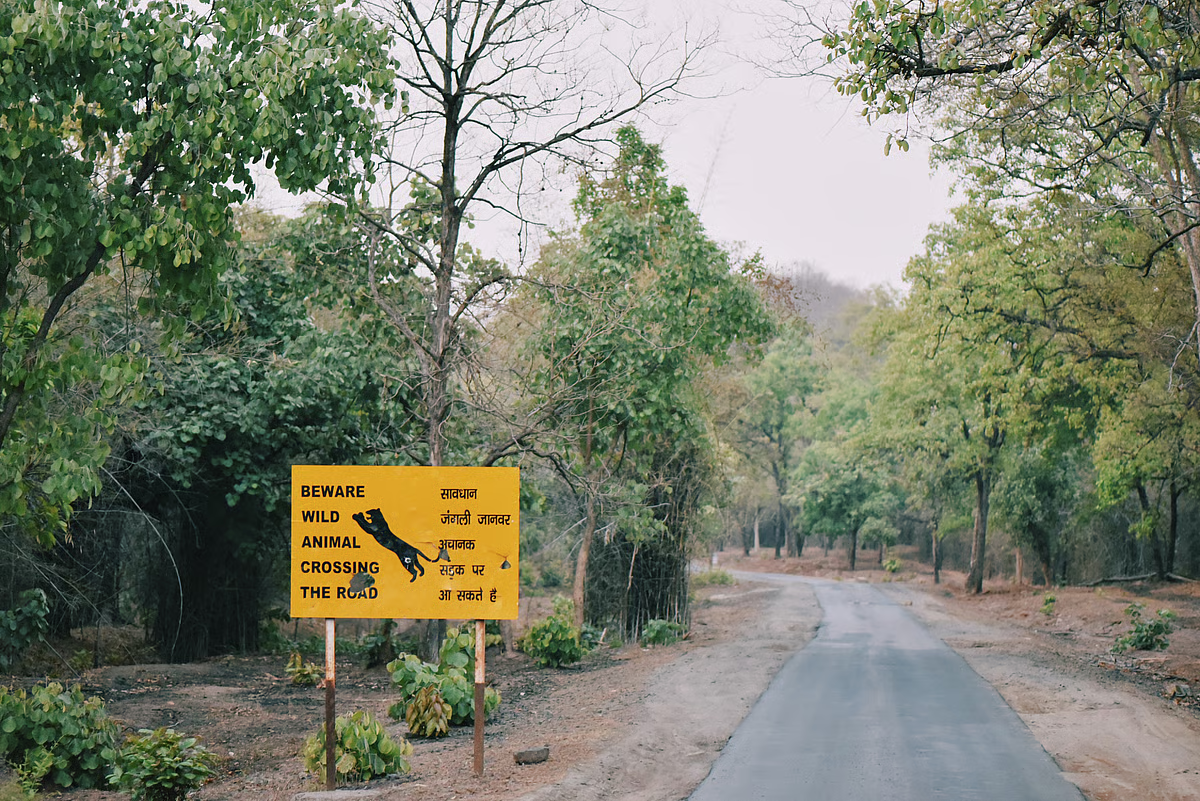
Led by Indian ecologist Ninad Avinash Mungi, the study analysed long-term data from India’s Project Tiger between 2006 and 2022 to track the spread of invasive plant species.
The researchers found invasive plants are expanding across India at a rate of around 729 sq km each year. Rising temperatures, shifting rainfall patterns and human disturbance are accelerating the spread.
By 2022, invasive plant species overlapped with the lives of 144 million people, 2.8 million livestock and 106,000 sq km of tiger habitat.
These invasions reduce native grasses and forage, disrupting herbivore populations and weakening food chains that support predators such as tigers. The findings highlight that even legally protected forests are not insulated from climate-driven ecological change.
Research published in in 2025, led by Australian scientist Graeme S Cumming, analysed vegetation changes around more than 12,500 protected areas worldwide over a 32-year period, from 1988 to 2020.
The study found that 71 per cent of protected areas had positive effects on vegetation beyond their boundaries.
However, these benefits depended heavily on management quality. “When protected areas are well managed, their benefits can extend to nearby communities through services like temperature regulation, soil protection and water availability,” professor Cumming said.
Across these studies, researchers point to a set of interconnected reasons why protected areas are underperforming.
First, protection is often weakly defined. Governments are permitted to designate areas as protected even when environmentally damaging activities continue within them. This emphasis on meeting numerical targets rather than conserving biodiversity undermines accountability.
Second, protected areas are treated as static spaces in a rapidly changing world. Climate change is shifting species ranges, altering ecosystems and enabling invasive species to spread, while management plans often remain outdated and slow to adapt.
Third, many protected areas suffer from limited management capacity. Shortages of trained staff, inadequate monitoring and weak enforcement mean that rules frequently exist only on paper.
Funding gaps and weak enforcement
Another issue repeatedly highlighted is funding. The scale of this funding gap is documented in the State of International 30×30 Funding report, published in December 2025. The report analysed global funding flows for protected and conserved areas in developing countries.
The report found that international funding reached just over $1.1 billion in 2024 — a 150 per cent increase since 2014. However, this growth still falls far short of what is required.
To meet the 30×30 target, international funding would need to rise to around $6 billion a year by 2030. At current trends, the world faces an annual shortfall of nearly $4 billion.
Even that figure represents only part of the need. Under a fully implemented 30×30 scenario, annual management costs for protected areas in low- and middle-income countries are estimated at $13.7 billion, while existing international funding covers just 6.5 per cent of that amount.
The report also highlights structural problems in how conservation is financed.
Much of the funding is short-term and project-based, whereas protected areas require permanent staff, long-term monitoring and sustained enforcement. A large share of funding is directed towards expanding protected area coverage rather than strengthening existing sites.
Funding is also unevenly distributed. Terrestrial ecosystems receive about 86 per cent of international protected area funding, while marine areas receive just 14 per cent, despite growing pressures on oceans from climate change and industrial fishing.
Nearly 48 per cent of funding flows to Africa, while small island developing states — which host around 40 per cent of the world’s coral reefs — receive only 4.5 per cent.
Donor concentration presents another risk. The five largest donors provide 54 per cent of all international 30×30 funding, with Germany alone contributing nearly a quarter. Recent aid cuts and institutional changes, including the closure of USAID, could slow funding growth further.
The report also notes that only between 5 per cent and 13 per cent of funding reaches Indigenous and community-managed conservation areas, despite their central role in achieving the goals of the Global Biodiversity Framework.
Taken together, the studies suggest that protected areas can still play a vital role in conserving nature, but only if governments change how conservation is approached.
Researchers argue that global efforts must move beyond area-based targets and focus on measurable outcomes. This includes setting clear standards for effective protection, particularly in marine environments, and monitoring whether ecosystems are actually improving.
They also stress the importance of adaptive management. As climate conditions shift, protected areas must be managed flexibly, supported by continuous monitoring and scientific input.
Strong management capacity is equally critical. Protected areas require trained staff, effective enforcement, long-term planning and meaningful engagement with local communities. Without these, legal protection remains largely symbolic.
All of these reforms depend on sustained, well-structured funding.
The report argues that improving the quality of protection matters more than rapidly expanding coverage, and calls for better balance between land and marine funding, stronger coordination among donors, and greater support for local institutions and communities managing protected areas on the ground.