
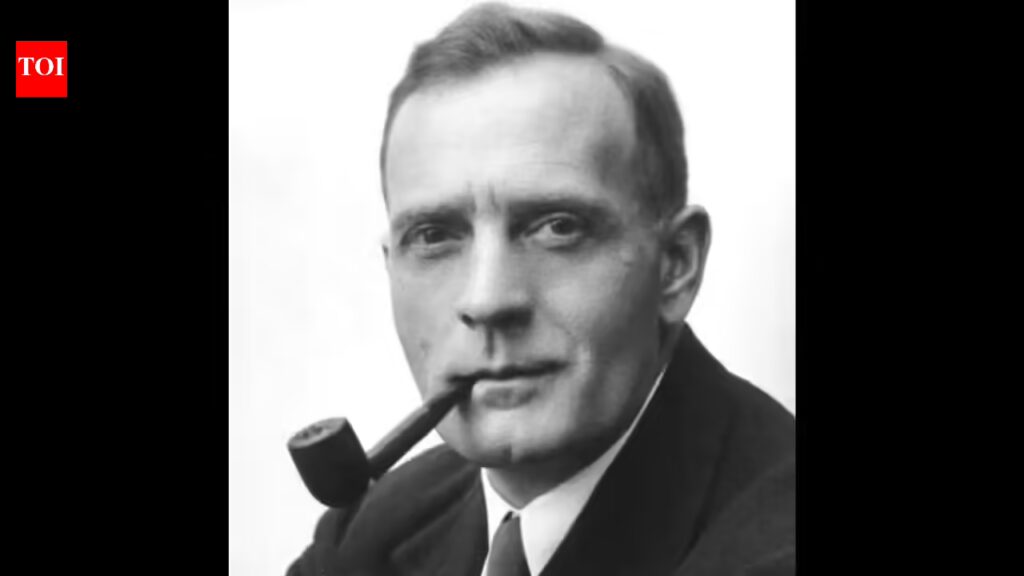
In a world where new things are found all the time and technology is always getting better, it’s easy to think that science knows everything. Modern science has helped people understand things in ways that were impossible a hundred years ago. For example, it has helped us learn about faraway planets and the smallest particles. Even with powerful telescopes and other high-tech tools, scientists still can’t go beyond certain limits. These limits aren’t just about how far away things are; they’re also about what can be seen, measured, and really understood.Edwin Powell Hubble, one of the most important astronomers of the 20th century, thought a lot about these limits. His well-known saying, “With increasing distance, our knowledge fades, and fades quickly…” sums up a basic truth about how science works. It reminds us that as we learn more, we also become less sure of what we know as we go deeper into the unknown. Astronomers often work with things that are millions or even billions of light-years away, so this idea is very important.Hubble’s words aren’t just about space. They also show how hard it is for scientists in every field to understand things that can’t be seen directly. Researchers are still pushing the limits of what can be known, so his insight is still important today.
Quote of the day by Edwin Powell Hubble
“With increasing distance, our knowledge fades, and fades rapidly. Eventually, we reach the dim boundary—the utmost limits of our telescopes. There, we measure shadows, and we search among ghostly errors of measurement for landmarks that are scarcely more substantial. The search will continue. Not until the empirical resources are exhausted, need we pass on to the dreamy realms of speculation.”
What Edwin Hubble meant by “knowledge fades with distance”
The quote gets to the heart of a simple but important idea. The more we look into space, the less we seem to know. We can study things that are close to Earth in great detail, but stars and galaxies that are far away look faint and are hard to measure accurately.Hubble says that knowledge “fades quickly” as distance grows. Scientists don’t stop learning when this happens; instead, their level of certainty goes down. Observations lose their accuracy, and conclusions are often based on indirect proof.He also talks about getting to “the dim boundary—the farthest limits of our telescopes.” This is the point at which even the best tools have trouble getting clear data. After this point, scientists are no longer looking at solid facts; instead, they are trying to make sense of weak signals and missing information.
The idea of “measuring shadows” in science
The phrase “we measure shadows” is one of the most interesting parts of the quote. This is not meant to be taken literally; it is just a way to say that scientists often work with indirect evidence.Astronomers learn a lot by looking at light, radiation, and other signals instead of physical objects. For instance, scientists can’t touch a star or galaxy that’s far away. They don’t look at the light that comes to Earth; instead, they look at the light that comes to Earth to learn about its temperature, composition, and movement.These signals can be weak or distorted, especially when they have to go a long way. Because of this, scientists have to make sense of data that isn’t always complete. Hubble calls this “searching among ghostly errors of measurement.” It shows how uncertain things can be when you have to deal with very long distances and complicated systems.
Why uncertainty is a part of scientific discovery
Hubble’s quote also makes an important point about science: uncertainty is not a flaw; it is a normal part of the process. Scientists often deal with unclear questions when they study areas that haven’t been studied before.Theories are often based on the best evidence that is out there, even if that evidence isn’t very strong. As technology gets better over time, these theories may change or even be replaced. This ongoing process is the only way science can move forward.The quote says that scientists should keep looking for answers, even if they don’t know what they are. It stresses that being curious and not giving up are important for finding things.
The role of technology in pushing boundaries
When Hubble talked about the limits of telescopes, he was also talking about the technology that was available at the time. Tools for observing have improved a lot since then. Telescopes can now see and record things that are much farther away, whether they are on Earth or in space.Even with these changes, though, there are still some things that can’t be done. The universe is still too big for us to reach some parts of it. Scientists are always trying to go beyond the “utmost limits” that Hubble saw.Scientists can see deeper into space thanks to new technologies, but they also show us how much we still don’t know. Every discovery usually raises more questions, which shows that the quest for knowledge never ends.
Relevance of Hubble’s words in today’s world
The quote was about astronomy, but it can also be used in other parts of life and research. We still don’t know a lot about medicine, physics, and environmental science, among other fields. Often, scientists have to deal with incomplete data and be very careful about how they interpret it.Hubble’s words remind us that we can’t know everything and that we should be aware of these limits. It encourages a balanced way of thinking that mixes curiosity with caution.The quote can also be seen as a comment on how people understand things in everyday life. People want clear answers, but not everything can be explained for sure. Accepting this can help you see things more clearly and realistically.
The importance of continuing the search
One of the strongest parts of the quote is “The search will go on.” This shows that scientific exploration is always going on. Even when scientists don’t know what’s going to happen or what they can do, they keep working.This idea is very important for moving forward. Every new thing we learn builds on what we already know, even if that knowledge isn’t complete. Innovation and understanding come from the willingness to keep looking, even when things get hard.Hubble also says that you don’t need to “dream up” ideas until you’ve used up all the facts. This means that scientists should try to use evidence and observation as much as they can instead of making guesses that aren’t backed up by any proof.
Other famous quotes by Edwin Powell Hubble
- “Equipped with his five senses, man explores the universe around him and calls the adventure Science.”
- “The history of astronomy is a history of receding horizons.”
- “Not until the empirical resources are exhausted, need we pass on to speculation.”
How Hubble’s thinking shaped modern astronomy
Most people know Edwin Hubble for figuring out that the universe is getting bigger. This finding changed how scientists thought about the universe and helped create modern cosmology.His research led to the Big Bang theory because it showed that galaxies are moving apart. This finding also showed how important it is to get the right distance in space.Hubble probably took his time with research because he knew that knowledge has limits. He knew that discoveries are important, but they need to be backed up by trustworthy data.
A broader perspective on knowledge and limits
Hubble’s quote makes us think more deeply about what it means to know something. It shows that knowledge isn’t always full or sure. But it is something that changes and grows as time goes on.The notion of attaining a “boundary” can be perceived as both an obstacle and an opportunity. It signifies the end of what we know now and the beginning of discoveries.This point of view is important for science, learning, and growing as a person. Knowing your limits can make you want to learn more and try new things.
Final takeaway from the quote
The quote from Edwin Powell Hubble makes you think about how people learn and how science works. It talks about how our understanding of things we don’t know becomes less certain as we learn more about them. This is especially true in fields like astronomy, where distance is very important.The quote also makes it clear how important it is to keep searching for answers. It reminds us that learning is always going to be uncertain and that progress depends on hard work and careful observation.Hubble’s words are still true today, even as scientists study the farthest parts of the universe. They remind us that we still have a lot to learn about the universe, even though we have come a long way in understanding it. The journey of discovery goes on because of curiosity, evidence, and the desire to learn more than what is already known.