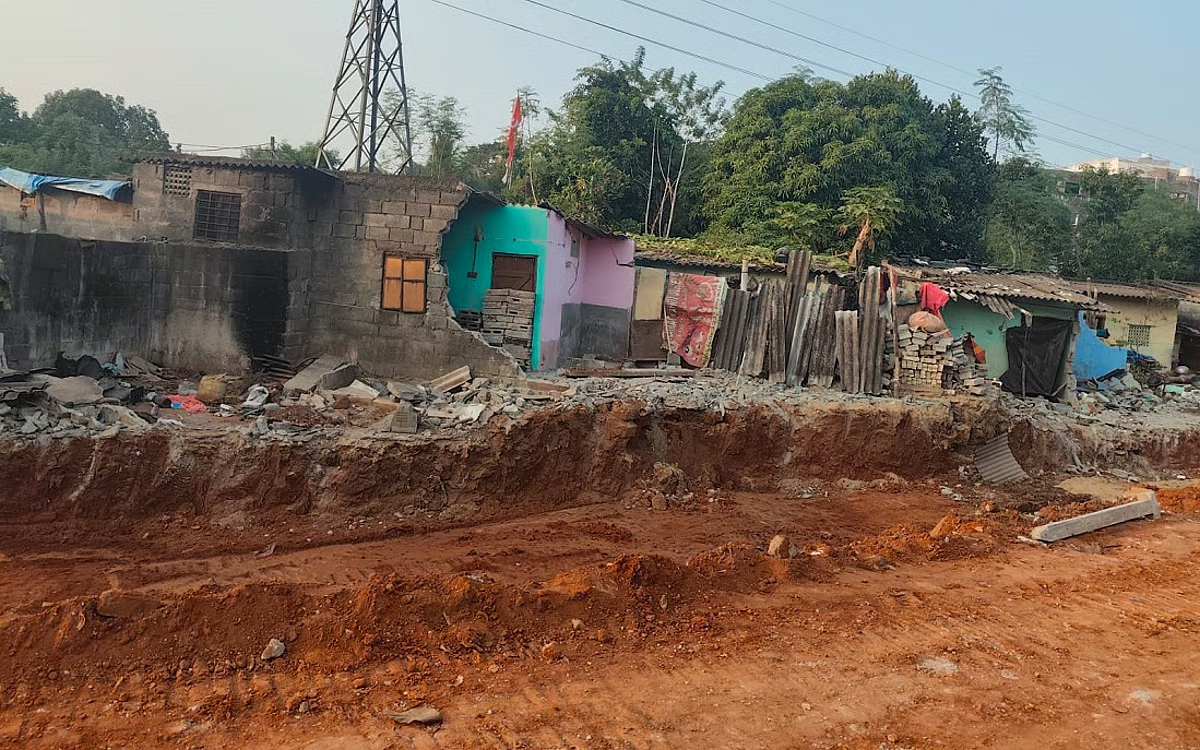
As the entire city was revelling in New Year celebrations, there were people who spent the night living under the open sky without access to basic necessities such as food, shelter, and clothing. These people included senior citizens, women and children mostly belonging to informal workers’ families who were displaced from their home in Bhubaneswar’s Salia Sahi slum. The eviction was carried out last November without prior written notice, household surveys, or verification, leaving residents with no opportunity for consultation before their homes were demolished. Reports indicate that authorities used force against those who resisted, and despite their pleas for time, their belongings were forcibly removed and damaged. The displacement disproportionately affected Scheduled Tribe families who had lived in the area for decades and were rendered temporarily homeless, as no alternative housing was provided. Rehabilitation options required a down payment, making them unaffordable for many families. Salia Sahi, one of Bhubaneswar’s largest slums, has existed since the late 1970s and grew due to its proximity to expanding commercial and institutional areas. Despite supplying essential informal labour and holding political significance, residents continue to face eviction threats due to insecure tenure, inadequate infrastructure, and weak rehabilitation measures.
In November 2025, state and municipal authorities demolished over 550 houses in what became one of the largest slum clearance drives in Bhubaneswar. The eviction was undertaken to construct a road aimed at easing congestion along the Jayadev Vihar–Nandankanan Road. The operation involved the Bhubaneswar Municipal Corporation, the Bhubaneswar Development Authority, the Works Department, and the district administration, and was conducted over several days under heavy police presence. Around 80 displaced families were left without immediate housing support, while approximately 274 families were relocated or identified for temporary rehabilitation. While infrastructure development may be necessary, it cannot justify serious violations of fundamental rights. The abrupt evictions left many families homeless, disrupted livelihoods, and fractured community networks, directly infringing Article 21 of the Constitution. Evictions conducted without prior notice, hearings, or rehabilitation plans are inherently arbitrary. They violate the right to live with dignity, including the right to livelihood recognised in Olga Tellis v. BMC (1985) and the right to shelter as integral part of right to life affirmed in Shantistar Builders v. Narayan Khimalal Totame (1990). Such actions also breach the Right to Equality under Articles 14 and 19(1)(e), as affected families were denied a fair opportunity to be heard. Mass evictions without viable resettlement options severely restrict the freedom of residence and disproportionately harm the urban poor. These actions further contradict the Directive Principles of State Policy under Articles 38 and 39, which require the State to promote welfare and reduce inequality.
The Odisha Land Rights to Slum Dwellers Act, 2017, and the Odisha Housing for All Policy, 2022 make it clear that eviction cannot be treated as a standalone administrative exercise. Any intervention must be preceded by mandatory surveys and identification of beneficiaries for the grant of Land Right Certificates. The framework mandates concrete rehabilitation planning, prioritising in-situ development under Section 4 and oversight by an Urban Area Slum Redevelopment and Rehabilitation Committee under Section 6. Evictions carried out without rehabilitation, without correcting survey errors, or without ensuring basic services and tenure security are contrary to this statutory scheme and may be challenged as violations of the right to shelter under Articles 14 and 21. In addition, the Land Acquisition, Rehabilitation and Resettlement Act, 2013 provides a broader legal framework for displacement caused by public projects, ensuring fair compensation and humane rehabilitation. Even where slum land is not formally acquired under the Act, courts routinely apply its rehabilitation principles in infrastructure-related displacement cases.
The extent
This issue extends beyond Odisha, affecting urban areas across India. As cities experience rapid population growth, real estate prices surge, rendering slum populations increasingly marginalised. The Housing and Land Rights Network (HLRN) reported over 153,820 home demolitions and 738,438 forced evictions in just the 2022-2023 period, a figure likely to be understated. From 2017 to 2023, more than 1.68 million individuals were displaced, with approximately 17 million living under the constant threat of eviction. Nearly 236 million people, or about half of India’s urban population, reside in slums, enduring inadequate living conditions and a lack of essential services. The Olga Tellis judgment, 1985 significantly altered the discourse surrounding slum evictions, emphasising the human impact of displacement rather than merely the legality of occupation. It affirmed that even unauthorised occupants deserve humane treatment and constitutional protections, asserting that any eviction conducted without prior notice, rehabilitation, and consideration of livelihoods is both legally and morally indefensible.
Path forward
Immediate humanitarian assistance is essential for displaced communities facing harsh winters and extreme summer heat. At the same time, a robust long-term rehabilitation framework is necessary to protect informal workers from repeated evictions. While affected families may seek legal remedies, the State must first ensure that minimum standards under existing policies are in place before any eviction is carried out. All eviction and demolition drives should be halted until adequate legal and procedural safeguards are ensured. Rehabilitation surveys must be transparently reviewed to correct errors and include all eligible households. Displaced families must be provided with safe temporary housing with access to clean water, sanitation, cooking facilities, and electricity. Effective grievance redressal mechanisms should be established at ward and zonal levels to address complaints, monitor rehabilitation progress, and provide timely information. Meaningful community consultations prior to relocation are critical to ensure transparency and reduce conflict. The State government must closely oversee rehabilitation to ensure compliance with the Odisha Slum Development and Rehabilitation Policy, 2013, and related laws. Special safeguards are required for Scheduled Tribe families, and eviction and rehabilitation processes must align, where applicable, with the Forest Rights Act, the Panchayats (Extension to Scheduled Areas) Act, and Fifth Schedule protections. Emergency funds should be allocated for immediate relief and essential services until permanent housing is secured. Clear accountability mechanisms must be enforced against officials responsible for illegal evictions or inadequate rehabilitation. A state-level independent inquiry committee should be constituted to examine the eviction process, identify failures, and recommend corrective measures to ensure transparency and public trust.
Civil society organisations should actively collaborate with government entities, human rights commissions, and relevant departments to promote fair and consistent implementation of rehabilitation policies, while strategic media engagement can raise awareness of the challenges faced by displaced families, fostering accountability and encouraging responsible action from authorities. During the transition phase, civil society organisations should also provide humanitarian assistance, counselling, and temporary shelter to alleviate the immediate hardships experienced by those affected.
It is essential for not only the state government but also various stakeholders, including civil society organisations and community leaders, to extend their support to the city makers residing in our slums. Their relentless efforts enable us to thrive in our workplaces and contribute to making our cities more liveable. Now, it is our responsibility to recognise, protect, assist, and ensure justice for the millions of domestic workers, construction workers, rag pickers, gig workers, and others who call these slums home.