
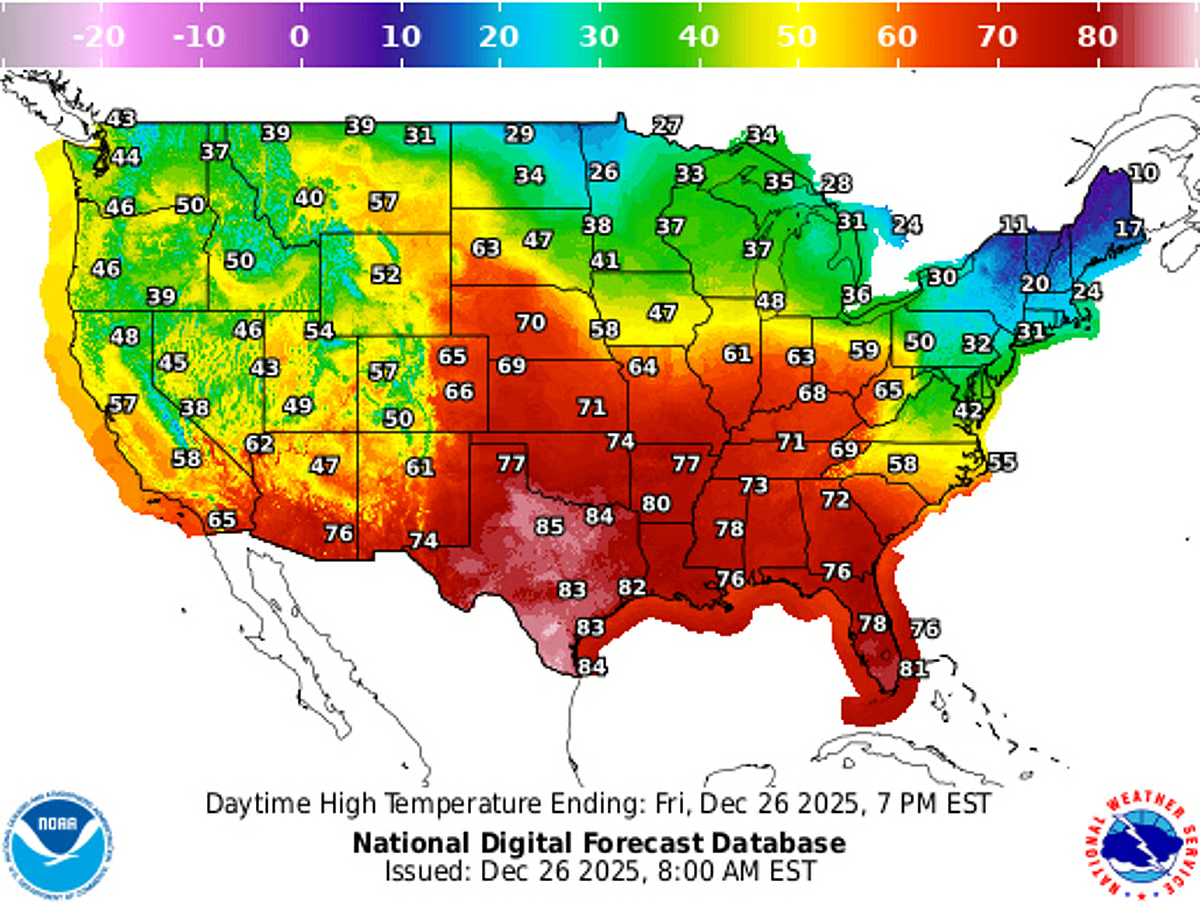
The United States and parts of Europe are experiencing anomalously high winter temperatures, prompting climate scientists to describe the conditions as winter heatwaves and, in some places, a “winterless Christmas”.
The immediate cause for this has been the formation of high-pressure ridges in the upper atmosphere over the affected regions. However, rapid warming induced by greenhouse gas emissions has also played a role. Historically, a large share of these emissions has come from the US and Europe.
In the week leading up to Christmas, large parts of the US recorded daytime temperatures up to 20 degrees Celsius (°C) higher than the normal for this time of the year.
“It’s an extremely warm week across the vast majority of the US. Much of the West, Plains, Midwest, South and Southeast are getting in on some extremely warm air,” wrote Peter Carter of the Climate Emergency Institute on (formerly Twitter). “Temperatures are running some 15-25 degrees Fahrenheit above normal for much of the country. In some spots, those temperatures will be 25-35 degrees [F] above normal,” he added.
Jeff Berardelli, chief meteorologist and climate specialist at WFLA-TV in Tampa, said the warmth was unprecedented for this time of year. “The week has been off the charts warm for much of the country,” . “Top: Departure from normal last seven days (dark red +20° [F]). Bottom: Record highs day by day through Christmas. Hottest US Christmas on record by a long shot.”
Across the Atlantic, parts of Europe also saw exceptional warmth. Iceland recorded its highest December temperature on December 24, 2025, when the thermometer reached 19.8°C in the town of Seyðisfjörður. The previous December record of 19.7°C was set in Kvískerjar in Öræfi on December 2, 2019.
The conditions were linked to a combination of warm air and strong winds, Birgir Örn Höskuldsson, a meteorologist with the Icelandic Meteorological Office, told Iceland’s public broadcaster RÚV. “When the air is warm and the wind is strong, cumulus clouds can form near the mountains, and then the air in the downdraft warms. It is in these circumstances that such monthly records are usually set”, said Höskuldsson.
Meteorologists and climate scientists had anticipated much warmer-than-normal conditions in both the US and Europe because of the formation of high pressure regions in the atmosphere also known as high pressure ridges or atmospheric blocking patterns. Under these systems, air sinks, warms and becomes trapped, forming what is often described as a heat dome. Temperatures tend to return to normal only when a storm system breaks up the dome.
“The Christmas holidays will be more like late spring than late December this year,” wrote independent forecaster Marko Korosec on the European weather and climate analysis platform . “Weather models hint at a powerful upper-level ridge forecast across large parts of the US, establishing a classic heat dome.”
US agency the National Oceanic and Atmospheric Administration (NOAA) also highlighted the risk of unseasonable warmth in its December 20 outlook, forecasting above-normal temperatures across most of the continental US between December 28, 2025 and January 3, 2026.
“We can see an extreme temperature anomaly will develop across the nation, which is 20-25 degrees [F] above normal,” Korosec wrote in a separate analysis. “And no precipitation is forecast either, which means dry, unseasonably warm days that will feel like spring.”
Another high-pressure ridge over the northernmost Atlantic and parts of northern and western Europe was linked to Iceland’s record warmth. The system set up strong south-westerly winds, carrying warm air towards Iceland and Greenland.
“The far North Atlantic will experience strong south-westerly flow, delivering a warm air mass towards Iceland and Greenland,” . He added that an intense warm wave on the western edge of the ridge would bring unusually high temperatures to the Faroe Islands, Iceland and even towards Svalbard, making Christmas Day among the warmest on record in those regions.
However, background global warming has increased the likelihood and intensity of such events. “This is accelerating global warming, with fossil fuel emissions being constantly increased,” Carter said.
High-pressure ridges and associated heat domes are more commonly associated with summer weather in the northern hemisphere rather than the winter season.