
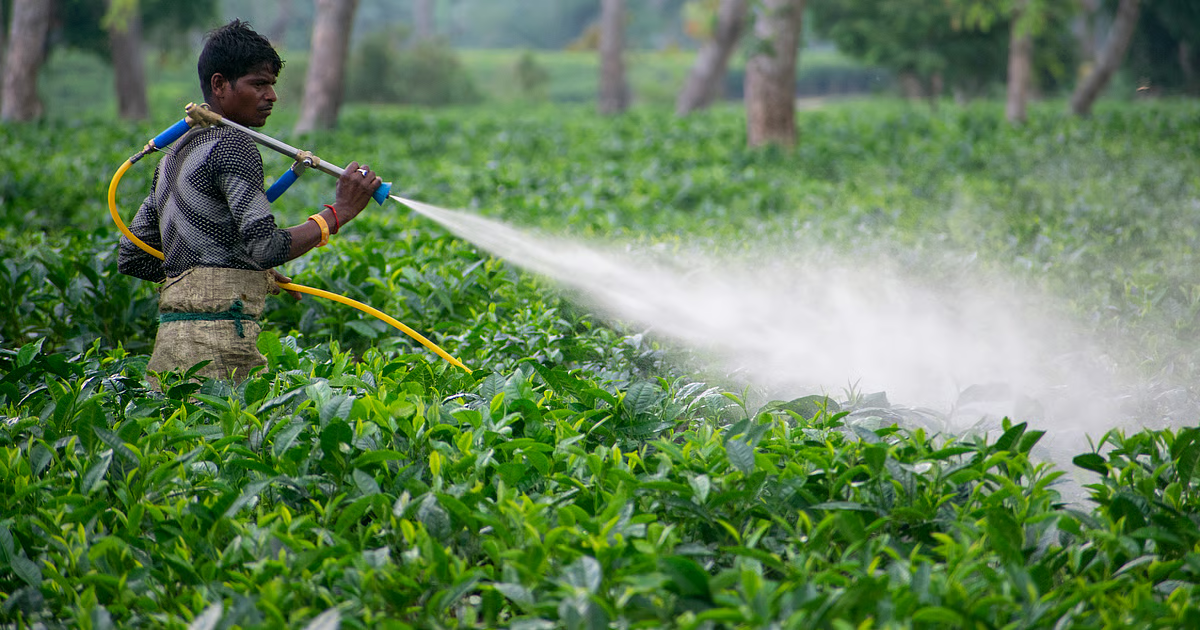
The regulation of India’s pesticide industry remains an unfulfilled promise, trapped in a cycle of outdated laws and opaque policymaking — but the problem runs deeper than administrative failure. At its core lies a fundamentally flawed paradigm: the Green Revolution model that built an entire agricultural economy dependent on chemicals designed to kill. This ideology, which equates modernisation with chemical intensity, has become so entrenched that regulatory reform seems almost beside the point when the underlying framework treats toxicity as a necessary input rather than a problem to be solved.
The Insecticide Act of 1968, once the backbone of chemical safety regulation in agriculture, has become a relic. Its primary provisions were either rendered obsolete by technological change or deliberately weakened through years of administrative neglect and industry capture. The very first attempt to introduce new pesticide regulation in 2008, after 40 years, ended up in the dustbin. Again, after 12 years, in 2020, another draft designed behind closed doors met the same fate.
The current effort in 2025 remains shrouded in silence so far — whispers of yet another draft Pesticide Management Bill reportedly in the works, expected within the next month.
The secrecy surrounding this latest effort should alarm anyone concerned with public health and democratic governance. Information about the draft remains conspicuously absent from the public domain. Consultations and deliberations, if they are happening at all, appear to be taking place behind closed doors — a pattern that suggests the bill may be crafted more to accommodate industry interests than to protect farmers and consumers. This opacity itself serves as a warning sign: when policymaking happens in the shadows, the resulting legislation rarely serves those most vulnerable to its consequences.
The true cost of pesticides on life — both human and ecological — remains tragically lost on policymakers who patiently listen to pesticide manufacturers and profiteers while remaining deaf to the voices of farmers who are literally dying from buying and using these chemicals.
This represents perhaps the most grotesque inversion of democratic governance: those who profit from toxicity enjoy privileged access to policy corridors, while those who bear the consequences — the farmers poisoned in their own fields, the children born with defects, the families watching their loved ones succumb to inexplicable illnesses — are treated as externalities, unfortunate but acceptable collateral damage in the pursuit of agricultural productivity.
The pesticide industry speaks the language of data, profits, and market growth; farmers speak of suffering, but suffering apparently lacks the vocabulary to penetrate policy chambers.
The path once believed to have achieved food security has become a nightmare for women, children, and future generations, as pesticides ravage bodies to their very core—so profoundly that they distort DNA itself. The security of life, even within a mother’s womb built by nature to ward off external threats, now exists under a shroud of chemical contamination.
Endocrine disruptors interfere with hormonal development, neurotoxins cross placental barriers to damage forming brains, and genotoxic compounds alter the genetic code that will be passed on to generations yet unborn. What was promised as the foundation of national food security has evolved into a systemic assault on biological security — the most fundamental security of all.
Women in farming households carry pesticide residues in their breast milk; children are born with birth defects in clusters that map precisely to areas of intensive chemical agriculture; and the long-term consequences of genetic damage may not fully manifest for decades, creating a silent epidemic whose true dimensions remain hidden.
Meanwhile, the human cost of regulatory failure continues to mount in India’s villages. Pesticide poisoning has evolved from isolated incidents into a pervasive rural health crisis. Farmers and agricultural workers suffer from chronic illnesses — some devastating in their severity — that corrode quality of life, strain family bonds, and deepen cycles of poverty. Neurological disorders, respiratory diseases, skin conditions, and reproductive health problems linked to pesticide exposure are well documented but inadequately addressed.
The gap between regulatory aspiration and ground reality has widened into a chasm. Enforcement mechanisms remain weak, testing infrastructure inadequate, and farmer education about safe pesticide use virtually non-existent in many regions. The proliferation of counterfeit and substandard pesticides in rural markets adds another layer of danger, as does the continued availability of chemicals banned or restricted in other countries.
What India needs is not another draft bill gestating in bureaucratic obscurity, but a fundamental rethinking of agricultural development itself. The Green Revolution’s chemical-dependent model has delivered yields at the expense of soil health, water quality, biodiversity, and human wellbeing.
True reform requires transparent, evidence-based regulation informed by public health data and meaningful consultation with farming communities, health professionals, and environmental scientists—but, more fundamentally, it demands that we question whether an economy built on substances designed to exterminate life can ever be truly sustainable or just.
It requires policymakers to finally hear the voices they have long ignored: not the smooth assurances of industry representatives in air-conditioned conference rooms, but the anguished testimonies of farming families burying their dead, the pleas of mothers holding malformed infants, and the desperation of communities watching their children’s futures poisoned before they can even begin.
Until the policymaking process itself is reformed—until drafts are publicly debated, stakeholder input genuinely sought, and implementation rigorously monitored—and until we dare to imagine agriculture beyond the chemical treadmill, the dream of effective pesticide regulation will remain just that: a dream deferred, while rural India continues to pay the price in suffering and lives cut short.