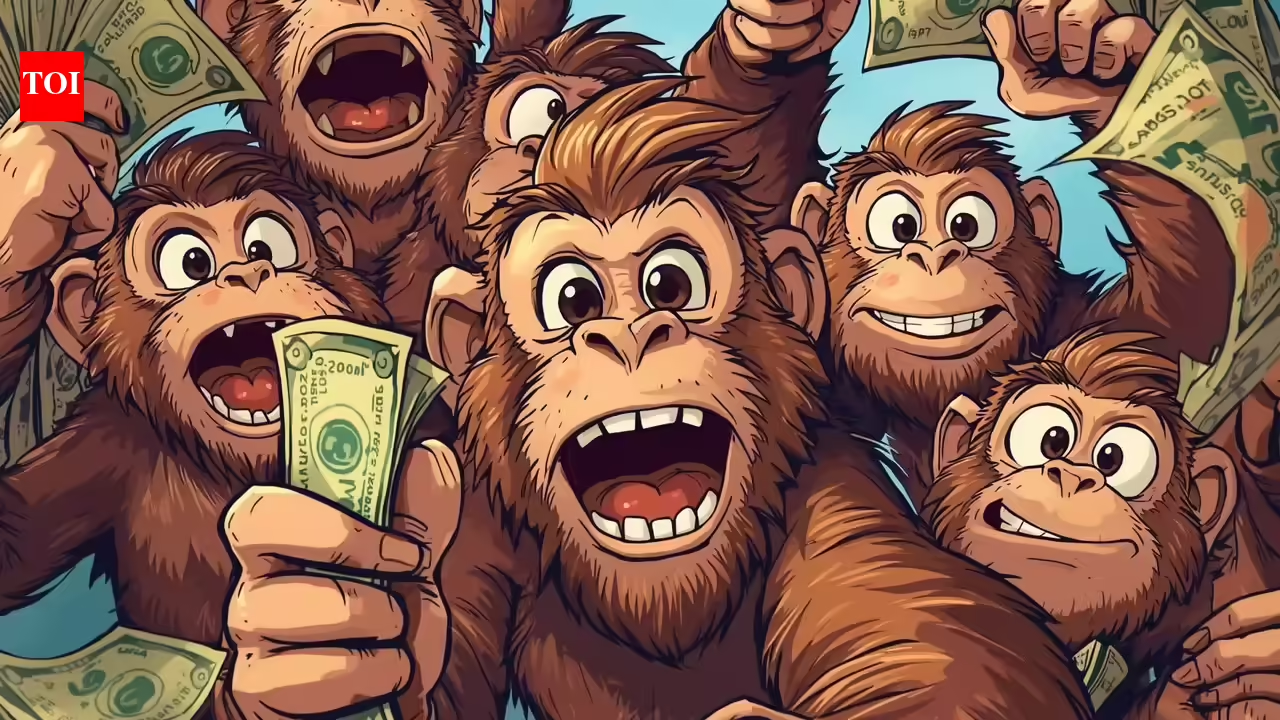
Research into how decisions are made often starts with people. Occasionally, it drifts elsewhere. A study from Yale University points to something familiar showing up in monkeys. The focus is on loss aversion, a pattern where avoiding loss matters more than gaining something new. In controlled tests, capuchin monkeys were observed trading tokens for food while prices and outcomes shifted. Their responses did not appear random. In many cases, they lined up behaviours already well known in human studies. The results suggest that some economic habits may sit deeper than culture or education. They may come from older mental patterns shared across primates, shaped long before modern ideas of money existed in any clear form.
Scientists find that monkeys make the same money mistakes as humans
‘Loss aversion’ is a technical phrase, but the idea is ordinary enough. Losing something tends to feel heavier than gaining the same thing. That feeling influences small choices as well as bigger ones. In the Yale study, researchers were not trying to teach monkeys economics. They were simply watching what happened when choices came with risk.Capuchin monkeys were used because they are alert, social, and quick to learn routines. They were given tokens that could be exchanged for food such as fruit or gelatine cubes. Nothing complicated was added. The setup stayed close to simple exchange, without language or instruction beyond repetition.
Monkeys handled changing prices
In one set of trials, the monkeys were given a limited number of tokens. The cost of food items changed from session to session. Sometimes apples required more tokens. Sometimes fewer. The amount the monkeys could also spend shifted.Their behaviour adjusted with those changes. When prices rose, spending dropped. When budgets grew, spending increased. These events followed a pattern economists would recognise. There was little sign of guessing or confusion. The monkeys appeared to notice cost and respond to it, even when conditions moved around.
Uncertain rewards mattered more
Another experiment focused less on price and more on risk. The monkeys had to choose between two options. One offered a single visible piece of food, with a chance of receiving an extra piece. The other showed two pieces of food, but sometimes one was taken away.On paper, both options were equal. Each had the same chance of ending with one or two pieces. The monkeys did not treat them as equal. They preferred the option that felt like a possible gain, rather than the one that carried the risk of losing something already visible. The pattern closely resembles how people tend to respond in similar situations.
What does this say about economic behaviour
The researchers suggest this combination is worth noting. The monkeys acted sensibly when prices changed but showed bias when loss entered the picture. Rational choice and error appeared side by side.This combination is common in human behaviour. People often manage everyday trade-offs well, yet struggle with risk and uncertainty. The study hints that this mix is not just a product of modern life. It may reflect older decision processes that humans still carry.
Why the findings still matter
The research adds context to how people approach saving and investing. Many avoid risk, even when long-term returns favour it. Loss aversion is one explanation. Seeing the same response in monkeys suggests it may be difficult to override.The study does not argue that these behaviours are wrong. It does not offer advice. It simply shows that the instinct to avoid loss appears to run deeper than markets or training. Where that leaves modern decision-making is less clear, and the work stops short of drawing firm conclusions.Information taken from YaleNews.