
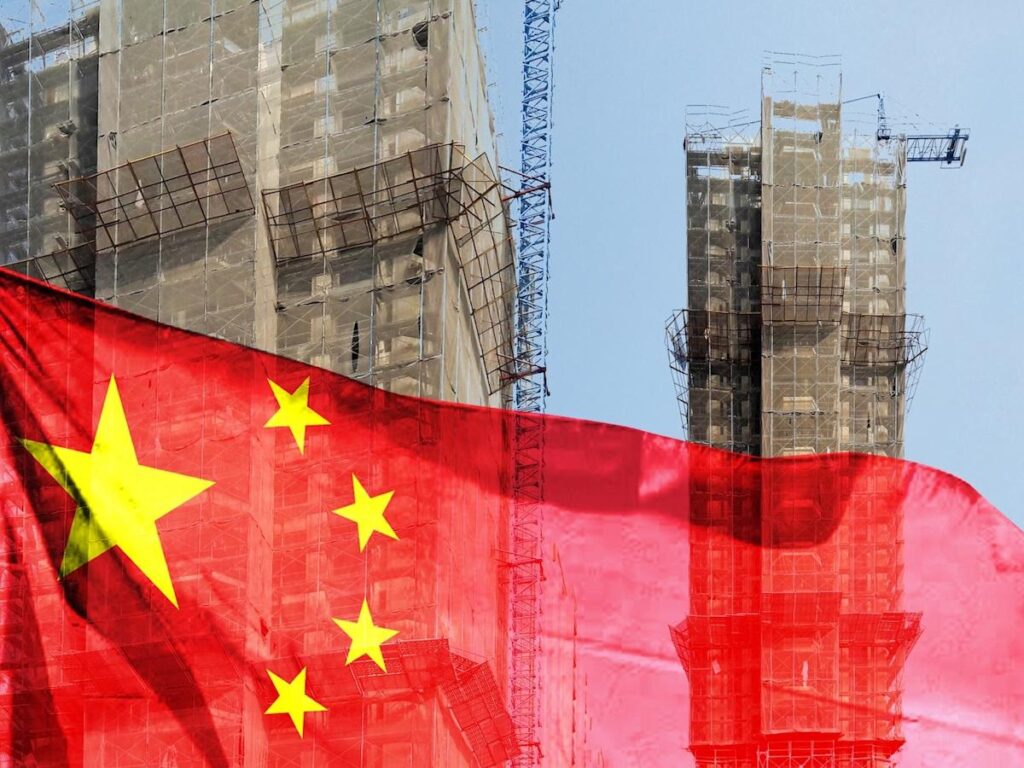
According to the National Bureau of Statistics (NBS), total investment in residential buildings in real estate development fell by 11.7% year-on-year (YoY) in March 2026, following a decline of 9.6% in February 2026. In cumulative terms, it declined by 10.6% in the first three months of 2026. Earlier, total investment in residential buildings in real estate development fell by 16.5% YoY in 2025, following annual contractions of 9.3% in 2024 and 16.7% in 2023.
This weakness is attributed to subdued investor and consumer confidence amid falling new home prices, rising debt amongst property developers, and weak confidence amongst private sector firms. The continued underperformance in the residential construction sector in China will once again weigh on the overall construction industry output in 2026. GlobalData expects residential construction output to contract by a further 1% in real terms in 2026, following a contraction of 4.1% in 2025.
China: total investment in residential buildings in real estate development, accumulated growth rate (%)
The weakness in the residential sector is showing no signs of abatement, with NBS data indicating that the total floor space of residential buildings on which construction had started declined by 22.3% YoY in the first three months of 2026, while the total floor space of residential buildings under construction declined by 12% YoY. Furthermore, according to the China Index Academy report, during January to March 2026, the top 100 real estate companies acquired land worth 146.5bn yuan ($20.5bn), a sharp 49.4% YoY decline, although the pace of decline eased slightly by 3% points compared to the previous month. This shows that developers are still cautious about new projects, which directly reduces future construction activity.
China: total floor space of residential area under construction and total floor space of residential builds started this year, accumulated growth rate (%)


At the same time, local governments also slowed land supply. In the first quarter of 2026, the planned construction area of residential land in 300 cities was 64.72 million square metres, down by 23.8% YoY, while land transactions reached 58.93 million square metres, falling by 25.9% YoY. Land transfer fees dropped even more sharply to 215.4bn yuan, a decline of 45.7% YoY. This overall slowdown in land supply and sales means fewer new projects entering the pipeline, which will continue to weigh on construction output in the short term.
Looking at city-level trends, the impact varies. In first-tier cities, the land market remained relatively stable, with transaction areas declining by just over 10% YoY, although land transfer fees fell by nearly 50% due to a high base last year. In second-tier cities, activity was much weaker—except for Hangzhou and Chengdu—with land transfer fees dropping by more than 60% YoY in most cities. Meanwhile, third-tier and fourth-tier cities continued to struggle, with both land supply and transactions declining by around 20% YoY.
However, more recent data suggest some early signs of stabilisation. According to the China Index Academy, total sales of the top 100 real estate companies reached 900.45bn yuan between January and April 2026, with the rate of decline easing by 3.8% points compared to the January–March period. This marks two consecutive months of improvement. This partial recovery is supported by policy measures in key cities, such as easing purchase restrictions, offering housing subsidies, and increasing public housing fund limits. These steps have boosted activity in the secondary housing market and are gradually supporting demand for new homes. In April 2026 alone, the YoY decline in sales of the top 100 real estate companies narrowed by 14.5% points compared to March 2026. Some major companies, including Poly Developments, China Overseas Land & Investment, China Resources Land, China Merchants Shekou, China Jinmao, Jianta Real Estate, and Poly Property, even recorded notable growth in sales during this period.
Despite these challenges, the industry is undergoing a structural shift. Developers are moving away from the earlier model of “high costs, high prices, and high risks” and focusing more on financial stability and project quality. This transition is happening alongside a major market correction—by 2025, the national sales area of commercial housing had fallen by over 50% compared to its 2021 peak. At the same time, the share of second-hand housing transactions increased to nearly 45% in 2025, up 17% points from 2021, reducing demand for new construction.
There are signs that the situation could gradually improve. Policy support keeps on increasing, and the government is focusing on “high-quality real estate development” under the 15th Five-Year Plan (2026–2030). Future housing demand is still significant, with total urban housing demand estimated at around 4.98 billion square metres during this period. Growth will be driven more by demand for better-quality housing, urban renewal projects, and services related to existing buildings rather than large-scale new construction. In simple terms, the construction industry in China will likely remain weak in the short term due to falling land investment and fewer new projects. But over time, government support, demand for better housing, and urban redevelopment are expected to stabilise the market and support a gradual recovery from 2026 onward.
“Residential activity in China continues to remain weak in 2026” was originally created and published by World Construction Network, a GlobalData owned brand.
The information on this site has been included in good faith for general informational purposes only. It is not intended to amount to advice on which you should rely, and we give no representation, warranty or guarantee, whether express or implied as to its accuracy or completeness. You must obtain professional or specialist advice before taking, or refraining from, any action on the basis of the content on our site.