
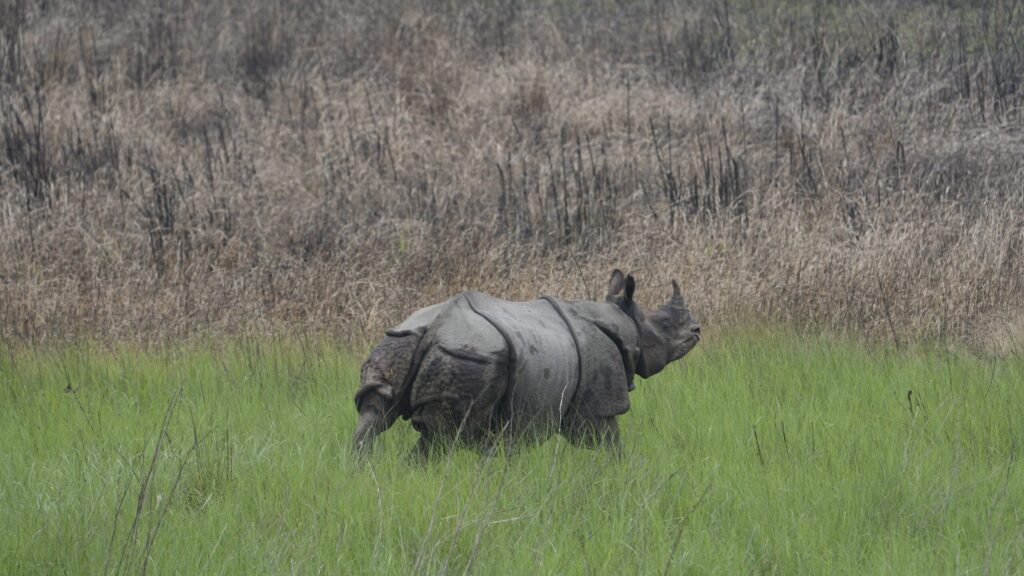
- At the end of March, four greater one-horned rhinos were moved a fenced rehabilitation area into Dudhwa National Park’s core grassland habitat.
- Dudhwa’s rhino programme began in 1984-85, when rhinos from Assam and Nepal were brought to the reserve after the species had disappeared from much of its former range in the Terai.
- Independent experts say the coming months will be crucial to assess whether the released rhinos settle, establish stable home ranges and avoid straying into high-risk areas.
In the grasslands of Dudhwa Tiger Reserve in Uttar Pradesh, a rhino stood inside a transport crate mounted on a tractor trolley as forest staff, veterinarians, mahouts and elephants gathered around it. Once the team lifted the door and stepped back, the animal paused briefly, looked around, and then moved toward the forest. The was part of a two-day release operation in March 2026, during which forest staff, veterinarians and field teams shifted four great one-horned rhinos from a fenced rehabilitation area into the reserve’s core habitat.
The rhinos (one male and three females aged 15 to 25 years) were tranquilised, fitted with radio collars, examined and then released into an unfenced grassland area inside the reserve.
With the introduction of the four rhinos in March, Dudhwa now has eight free-ranging rhinos. This exercise was carried out by a joint team of the Uttar Pradesh Forest Department and WWF-India. It was the third such effort after similar releases in November 2024 and March 2025. The team has set up a monitoring mechanism and control room to track the animals using VHF and satellite locations.
H. Rajamohan, Field Director, Dudhwa Tiger Reserve, said in a press release, the release of the four rhinos into the Dudhwa Tiger Reserve was a significant step in rhino conservation. “After decades of hard work, the efforts to bring back rhinos to India’s Terai landscape have finally begun to bear fruit. The exercise exemplifies the commitment of the Uttar Pradesh Forest Department to conserve and protect the greater one-horned rhinos.”
Dipankar Ghose, Senior Director, Biodiversity Conservation, WWF-India, said, “Rhinos are one of the best indicators of grassland ecosystems. They are often called ecological engineers, as by continuous grazing, they prevent tall and unpalatable grasses from dominating.” A viable population of free-ranging rhinos would benefit the larger Terai Arc landscape, he said.
Why Dudhwa’s rhinos were in an enclosure
Dudhwa’s rhino programme goes back more than four decades.
A 1984 paper by John B. Sale and Samar Singh noted that the greater one-horned rhino, once widespread across the Indus, Ganges and Brahmaputra floodplains, had been reduced to a few populations in Nepal, West Bengal and Assam due to hunting and habitat loss. It cited a 1979 recommendation by the SSC Asian Rhino Specialist Group to create new populations within its former range, leading to Dudhwa being selected for reintroduction based on habitat suitability, food plant availability and protection. Subsequent surveys estimated the area, of about 27 sq. km. in South Sonaripur range, could support up to 90 rhinos and it was desingated as a Rhino Reintroduction Area. A three-strand electric fence enclosure was set up while a 9 km stretch of park boundary was protected with a rhino-proof trench to prevent accidental escape.
The same historical account says that during March-April 1984, rhinos were captured near Pobitora Wildlife Sanctuary in Assam and moved to Dudhwa. Some rhinos did not survive the early phase of the translocation. Additional female rhinos were then brought from near Chitwan National Park in Nepal in 1985. Together, those animals formed the seed population of Dudhwa’s rhino reintroduction programme.
Mudit Gupta, Landscape Lead, Eastern Terai, Terai Arc Landscape, WWF-India, told Mongabay-India that the enclosure was part of the original conservation design.
“These rhinos remained in the enclosed rehabilitation area for nearly 40 years, which was a cautious decision due to the proximity to the India–Nepal border, which risks human–rhino conflict and poaching. The idea was to develop a stable, demographically healthy population before eventual release.”


The basis for release
The latest release follows years of discussion around how to move Dudhwa’s rhino population beyond long-term enclosure management.
Gupta said the latest release followed a scientific screening process. “This included health monitoring, with only physically fit, mature rhinos being chosen. Behaviour was another critical criterion, prioritising individuals who demonstrated natural ranging, grazing, and social behaviours. Additionally, genetic assessment through DNA analysis under the RhoDIS India program by the Wildlife Institute of India (WII) was used to select rhinos that were genetically unrelated or distanced, thereby minimising the risk of inbreeding post-release.”
He said Dudhwa’s habitat can support a much larger population if rhinos range beyond the fenced zone. “As per scientific assessments published in 2012, Dudhwa Tiger Reserve can support around 80-100 greater one-horned greater rhinos across its nearly 500 km² of grassland and wetland mosaic, assuming rhinos are allowed to roam outside fenced areas.”
What will determine success
The first few weeks and months after release will be critical for rhino survival, said D. K. Dutta, Deputy Director in Aaranyak’s Rhino Research and Conservation Division. Dutta was not involved in this project and offered comments as an independent expert on the ecological and monitoring aspects of the Dudhwa rhino release.
“The response of rhinos after release can vary depending on their age and sex. In general, individuals tend to remain close to the release site initially, especially if adequate water sources and grazing areas are available. Over time, adult males and solitary subadults may begin to explore surrounding areas beyond the core release zone, including areas around the enclosure,” Dutta told Mongabay India. “Regular grazing behaviour (~40-60% of total time) is a key indicator of adaptation, and frequent wallowing is also important. Typically, rhinos may take around 90 days to establish and settle into a more defined range within the landscape.”
Dutta also said the main ecological challenges are likely to be limited because the animals are being released within the same broad landscape. “The main ecological challenges for rhinos transitioning from long-term managed enclosure conditions to a free-ranging landscape are generally limited, especially when releases occur within the same broader habitat. Since the animals are already familiar with the landscape’s ecological conditions, drastic adaptation issues are not typically expected.”
He added, “While the habitat is broadly similar, individuals may still need time to identify optimal grazing grounds and establish preferred areas, which could lead to temporary competition or displacement.”

Risks after release
The official monitoring focus now shifts from capture and release to movement, social interactions and conflict prevention. Dutta said adult males and solitary subadults may expand their home range beyond secure areas.
“Dutta said adult males, as well as some solitary subadults, may gradually expand their range and at times move beyond protected area boundaries, which could raise the risks of human-wildlife conflict and poaching. He added that territorial interactions between males may displace some animals from secure zones, while aggressive encounters between adult males and subadult females could cause injury, mortality, or long-distance straying.
Gupta of WWF-India said the post-release risks identified by managers include conflict, poaching and habitat pressure. “One major concern is human–wildlife conflict, particularly the risk of rhinos straying into farms or villages. To prevent this, releases are confined to secure core areas far from human settlements, supported by early-warning systems, rapid-response teams, and trained elephant squads prepared to intervene if animals’ approach human areas.”
He added, “Poaching remains a potential threat once rhinos are outside fenced protection, and it is countered by increased ground patrols, intelligence-led protection initiatives, ongoing radiotelemetry tracking of released rhinos, and close cooperation with enforcement agencies across borders. Additionally, habitat pressure and competition with large herbivores such as elephants have been carefully considered; this is managed through science-based grassland and wetland management, control of invasive species, and a phased release plan that prevents sudden population surges and supports both habitats and wildlife as they adapt gradually.”
What success would look like
For Dutta, the release cannot be judged by the translocation alone. “A release can be reasonably considered successful once the animals demonstrate stable spatial behaviour, adaptation to the landscape, and signs of long-term viability.”
>Dutta said the release could be considered successful if the rhinos begin to establish stable home ranges, show limited dispersal outside protected areas, and display normal social and reproductive behaviour. He added that pregnancy and calving would be strong indicators of long-term population establishment. Among the red flags, he listed prolonged dispersal, repeated straying, aggressive interactions, poor health, lack of reproductive progress, weak community awareness, collar-related risks, and possible tiger predation.
“Long-term rhino conservation in Dudhwa Tiger Reserve follows a phased, science-based strategy to develop a self-sustaining, free-ranging population. In the initial phase, there are plans to release 10 rhinos to establish a breeding population outside the rehabilitation area, enabling managers to monitor demographic and ecological responses before increasing releases. Genetic management is crucial, using DNA-based selection to ensure the health and diversity of the population,” said Gupta.
Banner image: A rhino released in Dudhwa Tiger Reserve. Image by Vipin Kapoor Saini.

