
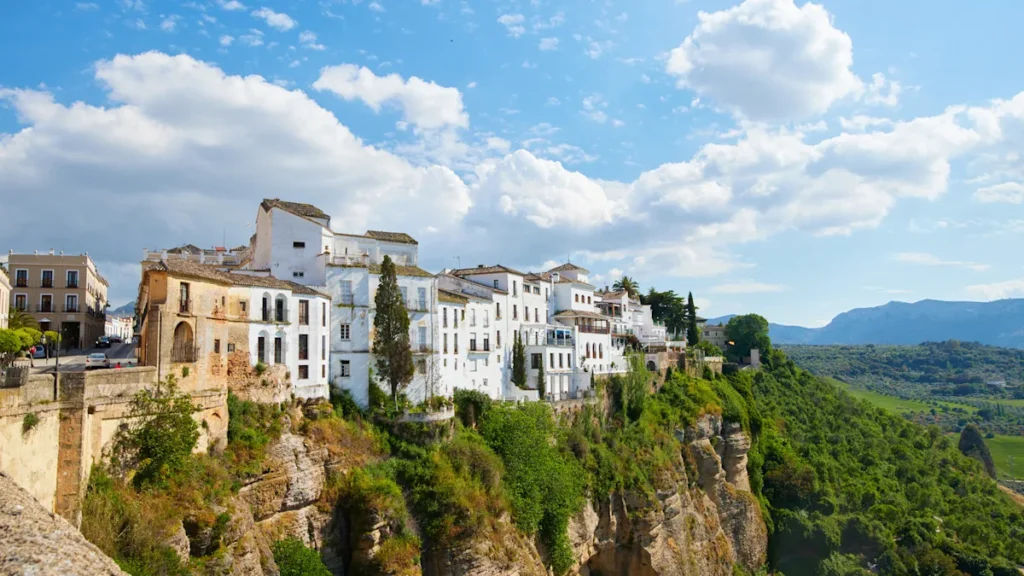
Andalusia (spelled Andalucía in Spain) is one of Spain’s most fascinating regions. The land of flamenco, jamón Iberico, and rugged fortified hilltowns, it is wild, historic, and remote, filled with history, adventure, and magnificent landscapes. On his website, travel expert Rick Steves describes Andalusia as “the Yankee dream of Spain,” an almost stereotypical vision of classic Spanish imagery. He writes that he adores it for its “string of whitewashed hill towns, sunny skies, vibrant festivals, and tempting tapas. … that feels more quintessentially Spanish than perhaps anywhere else”. It is the perfect place to immerse yourself in southern Spanish culture.
According to Rick Steves, the most popular spots in Andalusia are its three largest cities, Granada, Córdoba, and Sevilla, as well as the buzzing resort towns of the Costa del Sol. But the authentic, unspoiled beauty of the region is better found by exploring the smaller towns in the mountains, the Ruta de los Pueblos Blancos (Route of the White Towns). According to Steves, “the middle-sized towns that dot this undulating route are more accessible and friendlier than the big cities, but still pack a whallop of delightfully pure Spanish culture.”
From Arcos de la Frontera, one of Rick Steves’ favorite towns, which he calls “a photographer’s feast [that] smothers its hilltop, tumbling down its back like the train of a wedding dress,” to the tough bastion of Ronda, on its “breathtaking perch above a deep gorge”, small-town Andalusia is gorgeous. But according to Rick Steves’ protege Cameron Hewitt, when it comes to getting information from the friendly tourist offices scattered around the region, you may find them less than fully equipped.
Read more: Rick Steves Recommends Cinque Terre’s Only Resort Town For A Vibrant Italian Getaway
Tourist information offices with no information
Tourists standing outside the Ronda Municipal Tourist Office – 4kclips/Shutterstock
Rick Steves’ guidebooks always mark where the tourist offices are in the towns he visits, and he recommends using them as a great source of local knowledge and information. But in Andalusia, as Cameron Hewitt writes on Steves’ blog, “the dearth of information at tourist ‘information’ depots is as comprehensive as it is unapologetic.” Hewitt says that when travelling in the region, he is “continually reminded how travelling in Europe’s traditional corners — especially this southern slice of Spain — comes with a certain ‘dramatic tension’: between old ways and new.”
Hewitt tells a story about a visit to Arcos de la Frontera, where “the tourist office — tasked with informing tourists — has a tenuous grasp on the bus that virtually every arriving tourist is likely to take,” which he says is “typical of my travels around small-town Andalucía.” He mentions several other of the most popular towns along the Ruta de los Pueblos Blancos — Zahara, Grazalema, Setenil de las Bodegas — where he “was struck by the near-complete absence of basic signage to help approaching travellers get their bearings.”
Of course, for many travelers, brick-and-mortar tourist information points are something of an anachronism, made obsolete by the vast amount of information available on the internet. Most modern tourists will have everything they need to know at their fingertips on a smartphone or tablet, and will be able to call up an entire world of knowledge in a matter of seconds. But when confronted by old-fashioned spots like Andalusia, this isn’t always enough. In his tourist office encounter, when Cameron Hewitt asked if the bus runs twice an hour, the response was: “No. Sometimes. Not exactly. Maybe you should check with the bus company.” In situations like this, the internet isn’t much use!
Taking Spain on Spain’s terms


Tourists looking at the famous Puente Nuevo bridge in Ronda –
Cameron Hewitt writes that “as a visitor in Andalucía, I find that Spain retains a certain suspicion and stubbornness when it comes to us travellers.” He feels that there is a tension between the reliance a town like Arcos de la Frontera has on tourism and the locals’ attitudes to tourists themselves. He describes it as “a land where tradition overrules modernity, until it doesn’t,” meaning that the old ways of afternoon siestas and a relaxed approach to timekeeping don’t mesh well with the hollowing-out of smaller towns to operate almost exclusively as tourist attractions.
This is something that Spain, and many countries across the globe, are grappling with. Overtourism is an issue in many places, but one that is particularly marked in Spain, where mass protests and spraying tourists with water pistols have caused a stir in recent years. Hewitt says, “I don’t blame them one bit for asking difficult questions about how to ensure that the dizzying growth of the tourism sector is sustainable,” but also worries about the future of the smaller towns in Andalusia if tourism declines. After all, it is only a few years since the Spanish government launched the National Network of Welcoming Towns, an initiative designed to attract remote workers to smaller communities across the country that were struggling with decreasing populations.
Ultimately, Hewitt admits that “if you’re coming to Spain, you should expect to take Spain on Spain’s terms.” And in “Andalucía, long famous for its mañana attitude,” this might mean that you will have to put up with the friendly tourist offices being light on solid tourist information.
Ready to discover more hidden gems and expert travel tips? Subscribe to our free newsletter for access to the world’s best-kept travel secrets. You can also add us as a preferred search source on Google.
Read the original article on Explore.