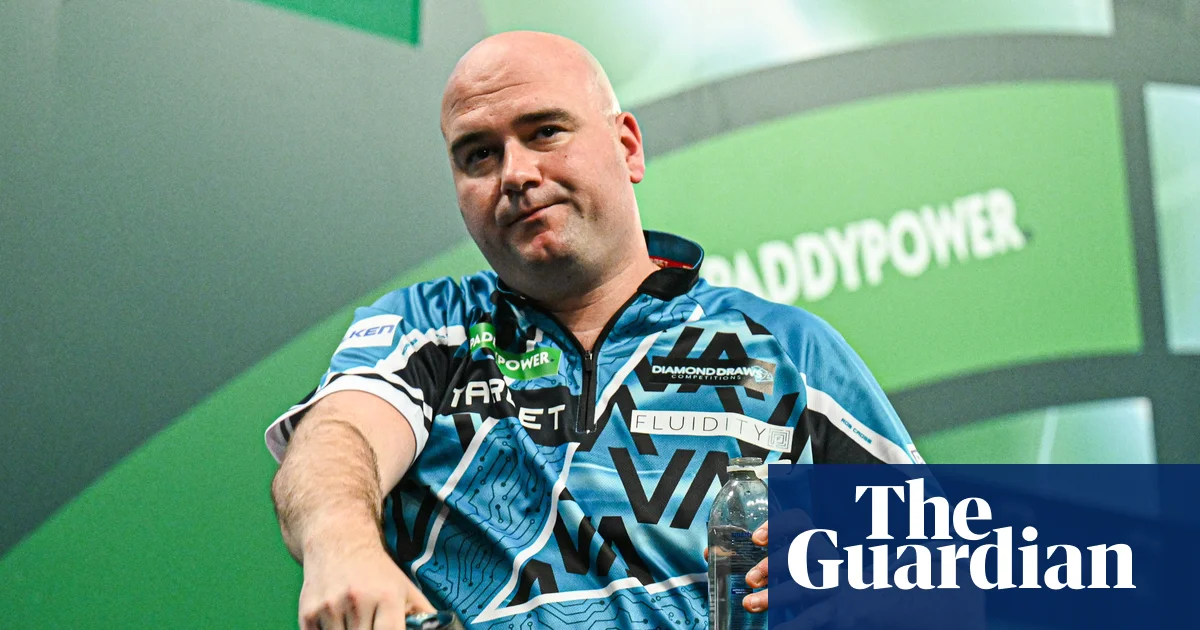
Rob Cross doesn’t want to say what he saw at the children’s hospital in Cologne a couple of weeks ago. Some of the stories were “horrific”, he confides, but in any case they’re not his stories to tell. All he knows is that he went along with a few other players, after appearing in an exhibition the previous night, and it changed him.
“You see what people are going through,” he says. “And it puts life in perspective for people whose lives are sort of OK. Whose kids are OK. Sometimes we have to find a bit of good. It made me realise how lucky I am in life. There’s always someone out there going through something worse than what you’re going through. That’s why you need to talk.”
And Cross wants to talk now, about what he’s been going through. Maybe the aftermath of a routine 3-1 second-round win against Ian White at the world championship is the right time to do it, and maybe it isn’t. He doesn’t want to get into the weeds of it, and he certainly doesn’t claim to have all the answers. But talking helped him, and so he reasons it might help someone else too.
For the 2018 world champion, 2025 has been a year of nightmares. He had a bad Premier League. He’s dropped from No 4 in the world to No 20. He hasn’t made the quarter-finals at any major. In the summer he entered into an Individual Voluntary Arrangement over unpaid taxes of more than £450,000. Last week his long-time manager Rob Bain, a man Cross describes as “like a father”, was taken to hospital.
But of course with mental health struggles, there is rarely a straightforward cause and effect. “I would have had these problems even if it weren’t darts,” he says. “Doesn’t matter where you’ve come from, what you’ve got. If you’re not happy, you’re not happy. I can play the Billy Big Bollocks, but it isn’t the case. We can only wear so much as human beings.
“I’ve suffered with it a long time before darts. We all get low, and we grow up thinking to ourselves that we should be stronger. That you can’t show that side. And that’s where I’m at. I’m guilty of not expressing myself to the people that I trust with my life. Anyone who wants to help, you need to speak up. It’s going to eat you away eventually.”
And so for all his struggles on the oche, for most of this year Cross has been trying to search for himself. He drifted in and out of tournaments, found practice a chore. He went on medication for his ADHD, which – and he makes clear this was a personal choice – he stopped taking just before the start of this tournament.
“It is the way to go, but it just cuts a few things out when you want to be clear,” he says. “I think if I’d stayed on it, I’d have been out first round.
“I just thought I’m better off being mates with the person inside rather than trying to shut him off, no emotions. I feel OK. It brings the hyperness out instead of trying to lock it away. I think I’m fixed. I just can’t switch off, so we need to sort that out.”
In which context perhaps it seems of only the slightest relevance that Cross has been in very decent form here, as good as he has looked all year.
Now he can enjoy the festive season with his four children and look forward to a last-32 game against Damon Heta. “If I’d have lost today, it would have been a miserable Christmas,” he admits. “Would have gone home and sulked like a big baby. Now I get to enjoy Christmas with my babies. It’ll mean the world to me.”
Longer term, the jigsaw remains incomplete. Unless he reaches the semi-finals at least he will start 2026 outside the top 16, and thus face a scramble to qualify for the big tournaments. He can probably forget about the Premier League for the time being. And the taxman still needs to be repaid. But if darts has given him a certain grief, darts still offers the surest way out of it.
“The biggest thing for me,” he says, “is when I enjoy it. When I light that buzz. Hit that shot, under scrutiny. Feel the adrenaline. The money won’t change my life. Nothing could change my life. But winning this is the pinnacle of the game. And that’s the most important bit.”
In the UK, Samaritans can be contacted on 116 123 or email jo@samaritans.org. You can contact the mental health charity Mind by calling 0300 123 3393 or visiting mind.org.uk