- Mizoram witnessed Thingtam in 2025, as gregarious bamboo flowering triggered a surge in rodent populations and crop loss.
- Bamboo-flowering–driven rat infestations are the most well-documented and accurately predicted ecological disasters in the region, even triggering Mizoram’s statehood, yet responses remain short-term.
- Poison-based rodent control has undermined local food systems, affecting rat meat trade, fishing and crab harvesting, prompting some villages to reject rodenticides and rely on indigenous traps.
As the sun slips behind the Lushai Hills, groups of farmers in Maulcheng village in Lunglei, Mizoram, set out for their jhum fields carrying bundles of bamboo traps. They meticulously set them before darkness falls, returning a few hours later to find most of them holding a rat.
After nearly five decades, the dreaded “Thingtam” returned to Mizoram late last year. Thingtam is a period marked by an exploding rodent population that raids fields and granaries night after night. A farmer may lay over 30 traps in one hectare in a single evening. Within hours, most will spring shut, and the cycle is repeated twice, sometimes thrice, before dawn.
C. Lalhriliana, one of the farmers, says that agriculture is the mainstay for 60 households in the village, which cultivate rice and ginger across about 1.5 sq. km. “The destruction wasn’t limited to surface crops; even root vegetables like yams and ginger were eaten. I lost almost ₹25,000. Now I must buy rice from the market to feed my family of seven, which will severely strain my household budget,” he adds.

Almost every village across the state had the same nightly ritual which continues even today though the infestation has reduced in parts.
Lalrautkima, vice president of the Mamte Village Council, informs Mongabay-India that nearly 90% of the 130 households farm 20,000 to 30,000 square metre of jhum each. This Mongabay-India reporter met the villagers for an interview late last year. “Every year, villagers set traps for bamboo rats around November and December. The meat is considered a delicacy,” he says. “However, the severity of this year’s (2025) outbreak forced us to begin trapping as early as June.”
Some are consumed, while the surplus is fire-dried and sold in local markets, fetching approximately ₹200 for six to eight pieces.
Bamboo death as cause
Mizoram boasts expansive bamboo forests that cover nearly 57% of its total geographical area of 21,087 sq km. The state is home to more than 20 bamboo species across nine genera. Of these, Melocanna baccifera, locally known as Mautuk or Muli, accounts for nearly 90% of the bamboo growing stock. Among the remaining species, about half are Bambusa tulda, called Rawthing. Both species flower, bear fruit, and die after a lifespan of 48 to 50 years. The fruit, rich in nutrients, triggers a population boom among rodents, with some accounts suggesting that rats even migrate from neighbouring areas to gorge on the sudden abundance.

As the bamboo fruit supply is exhausted, the burgeoning rat population spills out of the forests and into human settlements. Fields are soon overrun, triggering widespread crop destruction.
The flowering of Mautuk and the destruction that follows is known as Mautam — from mau, meaning bamboo, and tam, meaning death. A similar cycle linked to the flowering of Rawthing is called Thingtam, also known as Rawtam.
Flowering begins with a preliminary phase, known locally as Sehsam, when only a few plants of the species start to bloom, followed by Sehkum, the year when bamboo flowers en masse.

Famine to statehood
In 1881, the British encountered an explosion of rats following the gregarious flowering of bamboo in the Lushai Hills (now the Mizo Hills), a part of the Indo-Burmese hill range. The rodents devoured standing crops and plunged the hills into famine, killing an estimated 15,000 people. The same cycle returned in 1912, spreading hunger across the Mizo, Chin and Chittagong Hills, including areas under Burmese rule.
Colonial records, cited by Sajal Nag, a professor, in his study, describe farmers setting hundreds of traps, with some individuals catching up to 500 rats in a single night. The rats were dried for food but could not replace rice, the staple diet. For many, survival meant foraging for roots and wild yams as granaries were overrun. In December 1924, an estimated 45,000 to 50,000 rats were killed in the then Aizawl subdivision alone.
For generations, Mizos have learned to read the signs of these events in their surroundings, drawing on memory and lived experience to anticipate the next famine. Typically, there is an 18-year gap between a Mautam and a Thingtam, and a 30-year interval between a Thingtam and the next Mautam. As per established patterns, the 2025 Thingtam was accurately predicted.

Bamboo flowering and rodent infestation cycles in Mizoram
In 1958, the Mizo District Council warned the then Assam government of an impending Mautam-induced famine and sought financial assistance as a preventive measure. The request was rejected, and the prediction was dismissed as “superstition”. When famine struck, the administration was unprepared. In response, a welfare organisation, the Mizo National Famine Front, emerged in 1960, mobilising relief and rehabilitation for famine-stricken communities.
“In 1961, the group dropped the word ‘famine’ from its name to become the Mizo National Front (MNF). Continued delays and apathy from the Assam and the Central governments, among other issues, deepened public disillusionment. The Front transformed into an ethnic political force demanding a sovereign Mizoram — a movement that culminated in a 20-year insurgency, ending with the Peace Accord of 1987,” says Pu Zoramthanga, who was second-in-command in the guerrilla movement and later served three terms as the chief minister of Mizoram.

The return of Thingtam
Deputy Director (Plant Protection) Lalrindiki shares, “Sporadic flowering of B. tulda was initially spotted in February 2024 at Hriphaw in Mamit district. Later that year, flowering was observed in 15 more villages across Mamit, Aizawl and Lunglei districts.”
Official records show that by the end of the 2025 harvest season, 5,317 farmers across all 11 districts had been affected by rodent infestation. Nearly 42% of crops were damaged, impacting about 4,307 tin (approximately 4000 sq. metres) of land. At least 32,375 rodents were collected and either burned or buried in 2025, excluding the several hundred that were consumed.
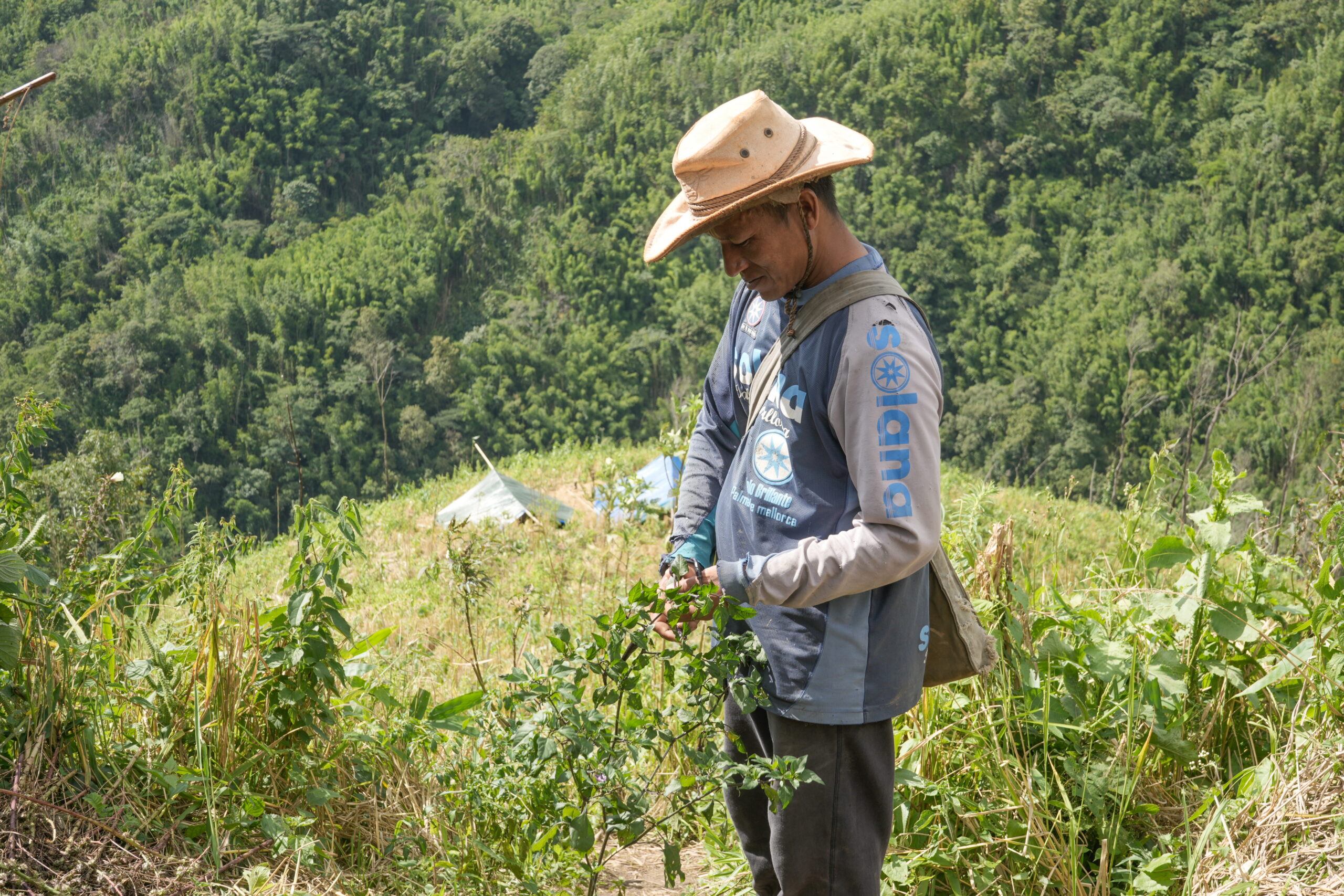
Banner image: A farmer tends to his field in Mamte village, Mizoram. Image by Subrajit.