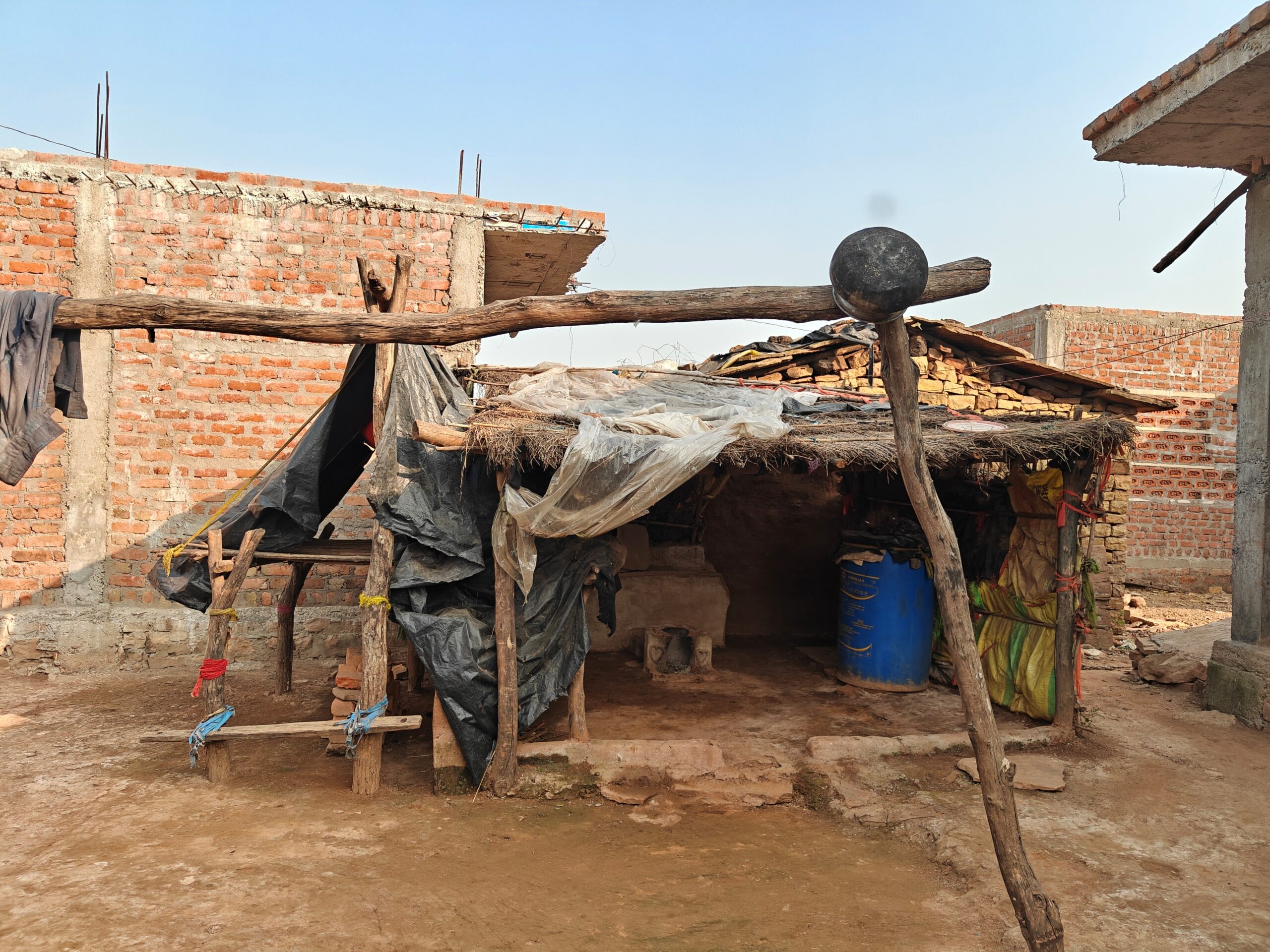
- Sahariya Adivasi and other communities displaced from Kuno National Park between 1998 and 2003 for a lion reintroduction project, report that most resettlement promises remain unfulfilled.
- Now, a recently revived irrigation project on the Kunwari river threatens to submerge areas where these communities have resettled, putting them at risk of displacement for the second time.
- Official documents from different agencies state conflicting figures about the submergence area due to the project.
- The views, findings and analysis are those of the authors. The findings are not independently verified by Mongabay-India.
“Hume yahan kyu patka, agar ye dam banana tha toh?” [in Hindi]
(Why were we thrown here if a dam was supposed to be built?)
This question from a 68-year-old resident of Paira B, a village in the Sheopur district of Madhya Pradesh, as part of an interview conducted last December, strikes at the core of India’s displacement crisis. His question about why his village was resettled at the submergence zone of a planned dam, has no clear answer. His village was among 24 villages displaced from the Kuno forest, during 1998-2003, for a lion translocation project that never happened . While the much-celebrated African cheetahs arrived at the site 20 years later, the promises made during the resettlements for lion translocation largely remain unfulfilled.
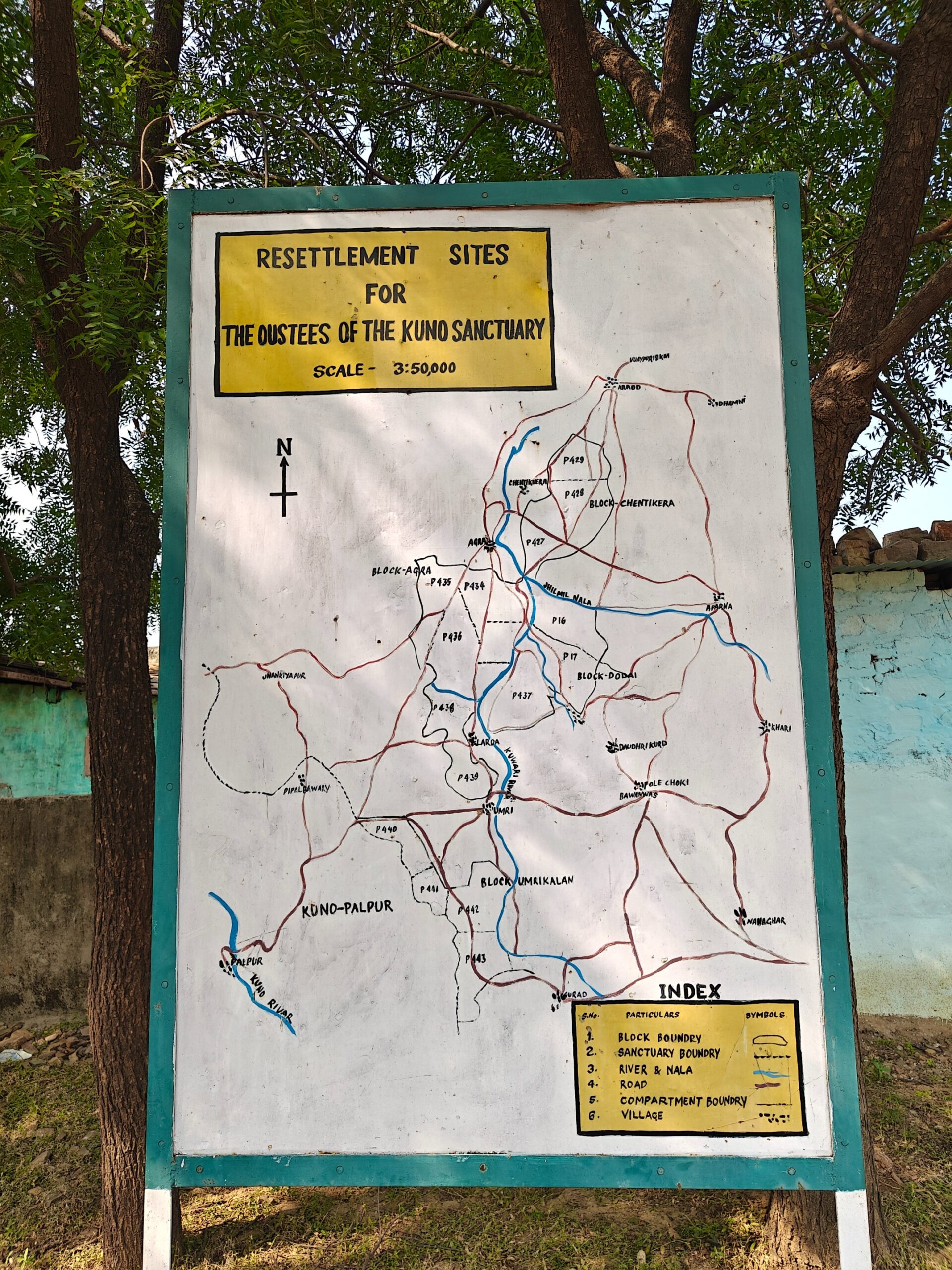
Now, more than two decades later, Chentikheda, an irrigation project across the Kunwari river, threatens to submerge part of the original resettlement site, forcing communities to be displaced twice in 25 years.
This issue of double displacement is not an isolated case of poor planning and administrative oversight. It is representative of how the country’s conservation and development apparatuses continue to produce precarity for some of the most vulnerable social groups in our country – the Sahariya Adivasi (a particularly vulnerable tribal group in this case).
Loss after the first displacement
The 1998-2003 displacement resulted in a series of hardships for the Sahariya Adivasis, Scheduled Caste (SC) communities (such as the Jatavs), and Other Backward Caste (OBC) communities (such as the Kushwahas). According to interviews with the residents (conducted as part of fieldwork) of eight displaced villages (Paira B, Palpur, Meghpura, Jakhoda, Nainagarh, Kerwara, Peepalbawdi, and Taprapura), they were made promises about receiving electricity, roads, schools, hospitals, dug wells, job opportunities, nine-bigha land for all adult men, and money to build houses. .
A study on conservation-induced displacement of Adivasis mentions similar details about compensation packages developed under the Beneficiary Oriented Scheme for Tribal Development (BOTD), including two hectares (approximately eight bighas) of land and a cash compensation of ₹1 lakh per family. Every male member over 18 was considered a separate family. However, these promises have remained largely unfulfilled over the years. To add to the hardship, the uncertainty about livelihood persists . Agriculture remains precarious due to infertile, stone-ridden land and the rainfed nature of irrigation.
“If you dig 30 metres into the soil in the jungle, you would not find any stones, but here the land is full of stones,” said a woman resident, 40, from Paira B. Rainfall is the primary source of irrigation, with half-dug wells used in some cases. The largely-rainfed nature of agriculture limits cultivation to a single cycle, unlike in forests, where families could cultivate multiple crops.
The unprofitable nature of farming has pushed many people into daily wage work in the nearby areas whereas others migrate. Employment is also temporary, and they work as guards, drivers, or more recently as cheetah trackers. Village residents have also lost access to the forest and can no longer collect non-timber forest products (NTFPs) such as firewood, resins and gum, mahua (fruits of Madhuca indica), tendu leaves, grass, fruits like ber (fruits of Ziziphus spp), jamun (fruits of Syzygium cumini), and bel (fruits of Aegle marmelos) from the jungle.
Communities living close to the forest also experience human-wildlife conflict when wildlife preys on livestock or attacks humans.According to the State Wildlife Action Plan 2023-43 for Madhya Pradesh, 12,429 cases of cattle predation, 11,182 cases of injuries to humans, and 66 human deaths were reported between 2019 and 2022 in the state. The state paid more than ₹13 crores as compensation during this period. Although the process of compensation exists, the interview respondents noted that the compensation process is rather complicated, with extensive paperwork for which it is also difficult-to-obtain photographic evidence. Moreover, there is no compensation for crop damage below 25% of the damage.
The impacts of reduced access to forest is not just limited to material loss. The curtailed access to the forest has also led to the erasure of cultural practices once hallmarks of communities living within it.
A 25-year-old man describes this change: “Since Kuno has become a National Park, and cheetahs have come, they have introduced stricter restrictions, and people cannot go in. There is Kerkho, a temple where we used to have a communal feast every year, during winter. So, for the 28 villages that got displaced, we all used to go to the communal feast. But now they do not let us go.”
Another woman, aged 75 years, reminisced about the loss of community and physical proximity that was once part of forest living, “The land we left behind in the jungle was excellent. We have so many fond memories there, and it was our place.” Resettlement destroyed the cohesiveness that once held the community together, as relatives within the same community were resettled in different locations. In the process of building their lives and creating an identity over the last two decades, these communities again face a second displacement.
For many residents of these villages, it took years of work to move from their huts and build their own pucca houses. However, this news of imminent displacement looms over the life they have built in these past 25 years. “When we came here, for the first two-three years, there was a severe water scarcity. I do not know how we survived here. We used to live in huts for years. However, after all these years, they want to displace us again. We will have to start over. My ancestors died in the jungle, but I won’t even be able to die here. We will be displaced again,” worries another man from Paira B.
The risk of double displacement
The cause of the second displacement in Paira B and several other villages, such as Khalai, Padari, Chakk, Badrain, and Khajuri, located near the Kunwari River, is the Chentikheda Irrigation Dam. The discussion about the construction of this dam and associated resettlement has been going on for the past two decades. A Master’s thesis submitted to the University of Calgary in 2013, on the Chentikheda dam, reported the presence of surveyors in 2004, 2008, and 2011.
The residents of Paira B claim that they got to know about the proposed dam project seven years after moving to the resettlement site. In 2012, the district collector held a public meeting to announce that the Chentikheda Dam Project had received clearance. There are newspaper articles written around this time, but the next decade is a blur. After years of a lull, in 2023 the project was proposed for approval again due to the demands of residents of the Vijaypur and Sabalgarh tehsils.
The construction of the dam could lead to the complete or partial submergence of their farms and homes, along with the connecting bridge between Agara (the only market in the area) and the villages, researchers have noted. There could be repercussions for the villages outside the submergence zone as well. Despite multiple repercussions for some of the most vulnerable social groups, uncertainty about this project lingers, including its commencement, the area to be submerged, and the compensation for those who will be twice displaced. Another woman from Paira B expressed this uncertainty, “The government has not clearly said anything, whether our fields would be submerged or not. We do not know what, if any, compensation would be given. They have made no promises yet about land or money that they would give.”
Land is the preferred compensation for village residents. However, they are highly apprehensive if their needs would be met. The first resettlement process from the Kuno forest has not set a good precedent for new promises. Therefore, many seem reluctant to put their faith in the Forest Department.
The discrepancy in the total area of the private land in the submergence zone adds uncertainty to this matter. While official documents state 7.47 square kilometres (Sheopur district administration) and around 7.1 square kilometres (Ministry of Environment, Forest and Climate Change), a newspaper report mentions this figure as 8.63 square kilometres.

What must change
Regardless of intent or administrative explanations, the outcome is clear: Sahariya communities face potential displacement for a second time in 25 years, with the first resettlement’s promises documented as largely unfulfilled. There is a need for explanation and a fundamental shift toward clear, transparent communication with communities to ensure they are no longer left in the dark about their own futures.
The contrast between protesting original villages and largely silent second-displacement communities may reflect multiple factors. The first displacement scattered previously proximate communities and created experiences that shape current responses. Several documented gaps point to a systemic lack of inter-departmental coordination, resulting in conflicting land-acquisition figures across sources.
Furthermore, residents report a complete absence of official communication about submergence, leaving a vacuum in which reasonable compensation and its timely disbursement should have been clearly outlined. The timeline shows surveyors in the area by 2004, years after resettlement site selection—a discrepancy that demonstrably creates uncertainty and prevents affected communities from preparing for potential displacement.
“Why did they throw us here?” is a fair question from residents facing second displacement. Answering it requires more than just an official response; it requires a commitment to transparent communication and a guarantee that reasonable compensation is not just promised, but distributed promptly. More importantly, it requires ensuring that the pattern, irrespective of its cause, does not continue.
Communities should not bear the costs of both conservation and development repeatedly, while legal protections remain theoretical. Breaking this pattern is not about assigning blame; it is about establishing inter-departmental accountability and protections that actually function.
Stuti Singh studies M.A. Development at Azim Premji University. Shaurabh Anand is a faculty at Azim Premji University. The views and opinions expressed in this article are those of the authors and do not necessarily reflect the views or the positions of the organisation they represent.
The commentary draws from Stuti Singh’s research and fieldwork on the perceptions and attitudes of local communities living around Kuno National Park (including Sahariya Adivasis and Kushwahs) towards cheetahs and other wildlife. The research findings are yet to be formally published.
Banner image: The house of a Sahariya Adivasi from Nainagarh village. Image by Stuti Singh.